Study: Impact of Scheduling on Event Staff Morale
February 9, 2026


How you schedule your event staff affects everything - from their morale and job satisfaction to their attendance and mental health. Research shows that unpredictable schedules cause stress, disrupt sleep, and lead to high turnover rates. For event workers, this problem is even worse due to last-minute changes and irregular hours.
Key findings:
Solutions include:
Effective scheduling doesn’t just reduce stress - it improves retention, performance, and overall staff satisfaction.
Impact of Scheduling on Event Staff Morale: Key Statistics
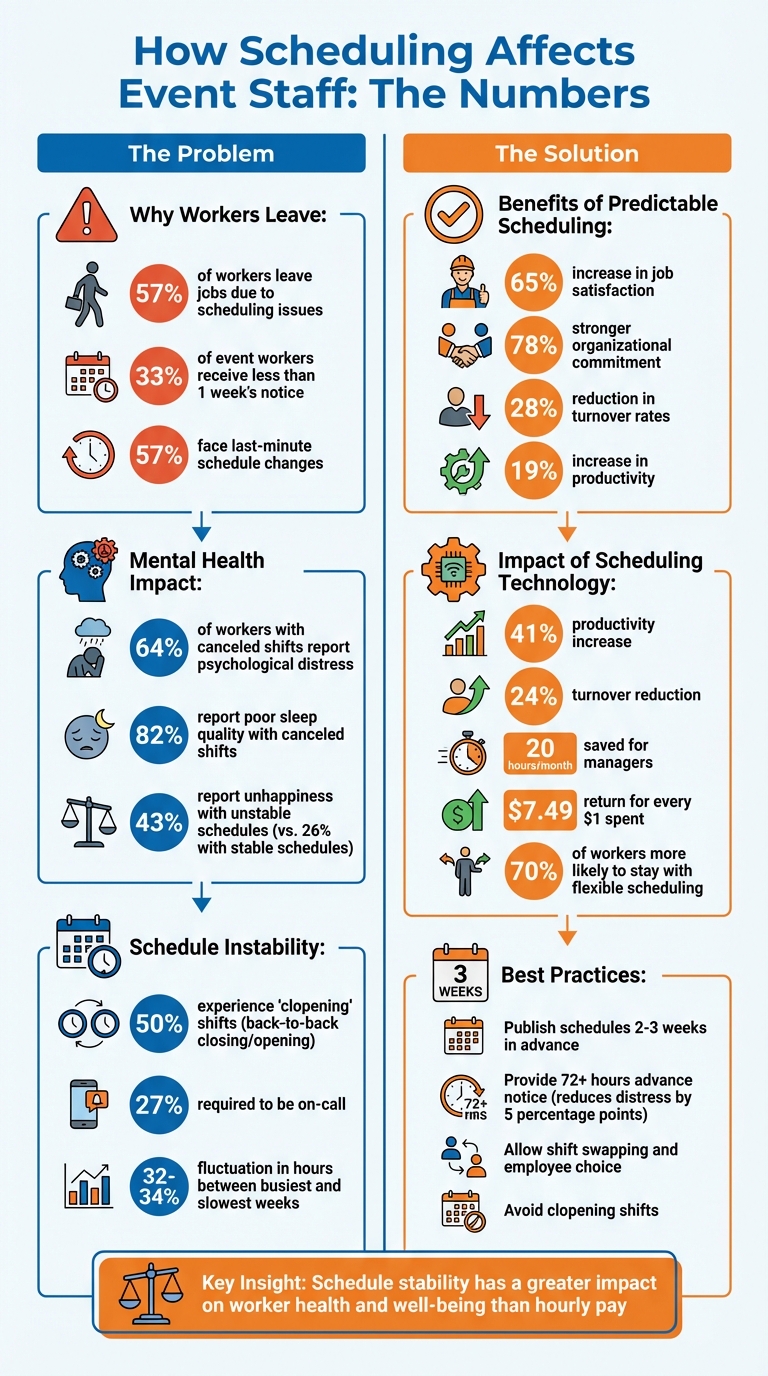
Research highlights how unpredictable scheduling takes a toll on temporary event workers. For example, 54% of service-sector workers report experiencing moderate to severe psychological distress, a number that rises to 64% for those with canceled shifts. Sleep issues are even more striking: 82% of workers with canceled shifts report poor sleep quality.
Financial instability is another major concern. Workers face a 32% to 34% fluctuation in hours between their busiest and slowest weeks in just a month. One retail worker from New York summed it up:
"One week you could be working 30 hours, one week you could be working 8. It's like you never really know what your paycheck's going to look like and all that stuff. That's stressful".
Interestingly, schedule stability has a greater impact on worker health and well-being than hourly pay. According to the Harvard Shift Project, removing on-call shifts could cut psychological distress by 15 percentage points, improve sleep quality by 8 percentage points, and increase happiness by 9 percentage points. Even minor improvements, like providing 72 hours of advance notice, can reduce psychological distress by 5 percentage points.
While these statistics highlight widespread scheduling issues, event staff face even more severe challenges due to the nature of their work.
Event workers operate in a complex "triangular relationship" that involves the worker, staffing agencies, and event organizers. This setup creates unique scheduling difficulties that other industries don't encounter. Unlike retail or restaurant workers, who may deal with irregular but somewhat predictable schedules, event staff are subject to volatile, just-in-time scheduling driven by client bookings.
The instability is clear: 33% of event workers receive less than one week's notice for their schedules. On top of that, 50% experience "clopening" shifts, 27% are required to be on-call, and 57% face last-minute schedule changes. These conditions create a high-stress environment. As researchers Daniel Schneider and Kristen Harknett explain:
"The temporal dimension of work is central to the experience of precarity and an important social determinant of well-being".
Unpredictable scheduling creates what experts call "temporal precarity", shifting the burden of economic uncertainty onto workers themselves. The effects ripple far beyond the workplace. For example, event staff often face last-minute schedule changes, making it nearly impossible to maintain consistent routines like getting enough sleep or pursuing education.
For parents, the impact can be especially harsh. Many are forced into what’s known as the "child-care scramble," relying on informal or last-minute childcare arrangements. These irregular schedules also disrupt responsibilities like elder care and managing household tasks. The chaos at home often spills into the workplace, lowering job satisfaction and leading to higher turnover rates, which in turn destabilize household income.
Interestingly, a 2016 study of Gap franchise locations revealed that much of this instability isn’t driven by customer demand but by internal management issues, such as abrupt shifts in sales strategies. The study also found that providing predictable schedules not only improved employee morale but also boosted sales.
These disruptions in personal life create a foundation for deeper challenges related to mental health and job satisfaction.
The mental health consequences of unpredictable schedules are both serious and measurable. Research indicates that unstable work hours are more closely tied to psychological distress, poor sleep, and overall unhappiness than even low wages. For instance, canceled shifts cause distress for 64% of workers, compared to less than 50% among those with stable schedules. Similarly, the rate of unhappiness nearly doubles - from 26% with stable schedules to 43% when shifts are canceled.
Unstable schedules also strongly predict job turnover. Many workers leave their jobs due to the stress of erratic hours. In fact, job satisfaction accounts for nearly 50% of the relationship between schedule instability and turnover, while about 25% stems from conflicts between work and family responsibilities. The combination of income volatility and interference with personal obligations is a major factor driving poor mental health and overall well-being.
Fairness is the backbone of strong team morale. When staff feel shifts are distributed equitably, turnover rates can drop by 28%, and productivity can climb by 19%. Transparency is key - clearly document and share how shifts are allocated to avoid any perception of favoritism [21, 2].
One way to ensure fairness is by using rotation systems for less popular shifts, like late nights, weekends, or holidays [21, 2]. For larger teams, consider grouping staff by roles or qualifications - whether they’re ticket takers, medical personnel, or setup crews - to match tasks with the right skills efficiently.
Another approach is "bottom-up" scheduling, where staff choose their shifts from available options. This method not only gives employees more control but also reduces the scheduling workload for managers. Digital shift marketplaces can also help, enabling employees to trade shifts while maintaining proper skill coverage. Organizations that adopt self-scheduling options report up to 30% fewer unplanned absences [21, 22].
When there’s competition for time off, use a structured, transparent system to resolve conflicts. Digital tools can collect staff preferences, and consistent rules ensure everyone understands the process.
Fair shift distribution isn’t just about reducing turnover - it’s also about creating a predictable and effective scheduling system that supports team morale.
Consistency in scheduling is crucial for keeping employees satisfied and engaged. In fact, 88% of workers say week-to-week predictability is vital to their job satisfaction, and 79% of shift workers factor their schedule into decisions about staying with an employer. Predictable schedules also correlate with 65% higher job satisfaction and 78% stronger commitment to the organization.
To achieve this, publish schedules 2–3 weeks in advance, giving employees ample time to plan for childcare or other responsibilities [21, 26]. Seattle’s Secure Scheduling Ordinance, enacted in 2017, requires employers to provide at least 14 days’ notice. A 2021 study published in the Proceedings of the National Academy of Sciences found the ordinance improved workers' sleep quality by 11 percentage points and reduced material hardships, like food or housing insecurity, by 10 percentage points.
"Our paper shows that Seattle's law not only increased scheduling predictability, but also improved subjective well-being, sleep quality and economic security." - James F. Smith, Harvard Kennedy School
Flexibility is just as important as predictability. While 79% of workers prioritize knowing their schedule in advance, 76% also rank flexibility as one of their top priorities [2, 25]. Combining these two elements can make a big difference. Offer employees the ability to swap shifts or bid on open slots while providing mobile access to schedules - something 81% of hourly workers prefer. These practices significantly boost engagement and retention.
Lastly, protect your team’s rest time. Avoid scheduling "clopenings" (back-to-back closing and opening shifts) that lead to exhaustion and burnout [21, 23]. Implementing a "right to rest" policy, which enforces a minimum number of hours between shifts, shows respect for your staff’s well-being [21, 4]. By valuing their time and health, you’ll see improvements in morale and a stronger commitment to the job.
Automated scheduling systems take the predictability of fixed schedules to the next level, making life easier for both employees and managers. Unlike manual vs digital staff scheduling - where critical details often get lost in spreadsheets, texts, or phone calls - these systems keep everything centralized and accessible, eliminating unnecessary friction.
Research shows that scheduling geared toward employees can increase productivity by up to 41% and cut turnover by 24%. When workers can access their schedules via mobile apps, sync shifts with personal calendars, and swap assignments without needing a manager’s approval, their autonomy skyrockets. In fact, 64% of employees feel more satisfied in workplaces that offer self-service scheduling tools.
"Online scheduling helps to enhance employees' personal well-being through satisfaction with schedule flexibility and job autonomy." - Shi Xu, Hubert Van Hoof, and Peter Nyheim
The benefits don’t stop there. Businesses using employee-focused scheduling systems see an average return of $7.49 for every $1 spent. Managers save about 20 hours a month on administrative tasks, giving them more time to engage with their teams. Plus, 70% of workers are more likely to stay with employers offering flexible scheduling options.
Automated tools also tackle the stress caused by unpredictable schedules. Employees can block off unavailable dates, avoiding irrelevant shift requests and constant back-and-forth communication. Features like real-time conflict checks, calendar syncing, and automated reminders help prevent double-booking and no-shows. These improvements create the kind of transparency and reliability that directly contribute to job satisfaction.
With these benefits in mind, specialized tools like Quickstaff are stepping in to meet the specific needs of the events industry.

Since 2013, Quickstaff has been a go-to solution for event professionals, streamlining scheduling for over 20,000 events. It’s tailored for caterers, wedding planners, and event vendors, helping them save time and reduce scheduling headaches.
One standout feature is centralized availability tracking, which gives managers a clear view of who’s available while allowing staff to block unavailable dates instantly. The platform also supports role-based assignments, making it easy to match the right people with the right tasks for each event.
Communication is another area where Quickstaff shines. With integrated messaging via SMS, email, and in-app alerts, managers can share all event details - like dress codes, parking info, and meal vouchers - in one place. No more sifting through endless email threads. Staff can sync their schedules with Gmail or Outlook to avoid conflicts, and the mobile-friendly interface lets them accept shifts, check updates, and stay informed on the go.
Quickstaff also embraces a "bottom-up" scheduling approach, which research shows boosts morale. Employees can sign up for shifts or trade them directly with peers, giving them more control over their schedules. Real-time tracking lets managers see who has accepted or declined shifts, making it easier to fill gaps quickly. Companies using these tools report 42% higher team cohesion scores.
For event businesses looking to try it out, Quickstaff offers a 14-day free trial - no credit card required. Pricing starts at just $49/month for teams of up to 35 staff, making it an affordable way to improve operations, reduce turnover, and enhance employee satisfaction.
Studies reveal that predictable scheduling has a greater impact on staff morale, retention, and business performance than hourly pay. In fact, 65% of employees report higher job satisfaction when schedules are consistent. On the flip side, last-minute changes create frustration, disrupt sleep, and lead to psychological stress - all of which contribute to costly turnover.
Implementing fair scheduling practices is a smart move for any business. It can boost productivity by 41% and cut turnover rates by 24%. Considering that scheduling issues account for 57% of voluntary departures in the hospitality sector, it’s clear that poor planning comes with a hefty price tag.
Benefits of event staff scheduling software can make a world of difference. Features like availability tracking, shift swapping, and mobile access streamline operations, saving managers up to 20 hours per month. These tools not only reduce administrative headaches but also foster a stronger sense of commitment among team members.
To succeed, event managers should focus on providing advance notice, distributing shifts fairly, and leveraging scheduling technology. This approach doesn’t just boost morale - it directly impacts the bottom line. After all, in an industry where every event hinges on dependable staff, effective scheduling is a game-changer.
Predictable scheduling plays a key role in boosting event staff morale by offering stability and acknowledging the importance of their personal time. When schedules are shared well in advance - like providing a weekly schedule two weeks ahead - employees feel respected and experience less stress from unexpected changes. This approach often leads to greater job satisfaction, stronger engagement, and a more upbeat workplace atmosphere.
Involving staff in the scheduling process and steering clear of last-minute or on-call shifts can also create a sense of fairness and collaboration. By using tools that streamline scheduling and enhance communication, managers can better meet these expectations. The result? Happier, more motivated teams and improved staff retention.
Event staff often face unpredictable schedules, with last-minute changes, on-call shifts, and minimal advance notice being part of the job. These challenges can take a toll, leading to stress, disrupted personal routines, and a strain on both physical and mental health.
Compared to industries with more predictable schedules, event staff regularly deal with irregular hours and fluctuating workloads. This lack of control over their time can hurt morale, diminish job satisfaction, and even drive higher turnover rates.
Quickstaff takes the hassle out of scheduling by automating tasks such as assigning shifts, monitoring staff availability, and sending out reminders. This automation helps eliminate common headaches like double-bookings or last-minute conflicts, ensuring operations run smoothly and efficiently.
With real-time updates and adaptable scheduling features, Quickstaff allows team members to manage their availability and even swap shifts effortlessly. This added convenience not only eases stress but also improves communication and trust within the team, boosting morale and job satisfaction. Tools like Quickstaff turn scheduling into a straightforward process, benefiting everyone involved - from managers to staff.