Staffing Agency vs Host Employer: Liability Guide
September 3, 2026


If a temp worker has a pay issue, harassment complaint, or on-site injury, the staffing agency and the host employer can both be liable. In most cases, the key question is simple: who controlled the work?
Here’s the short version:
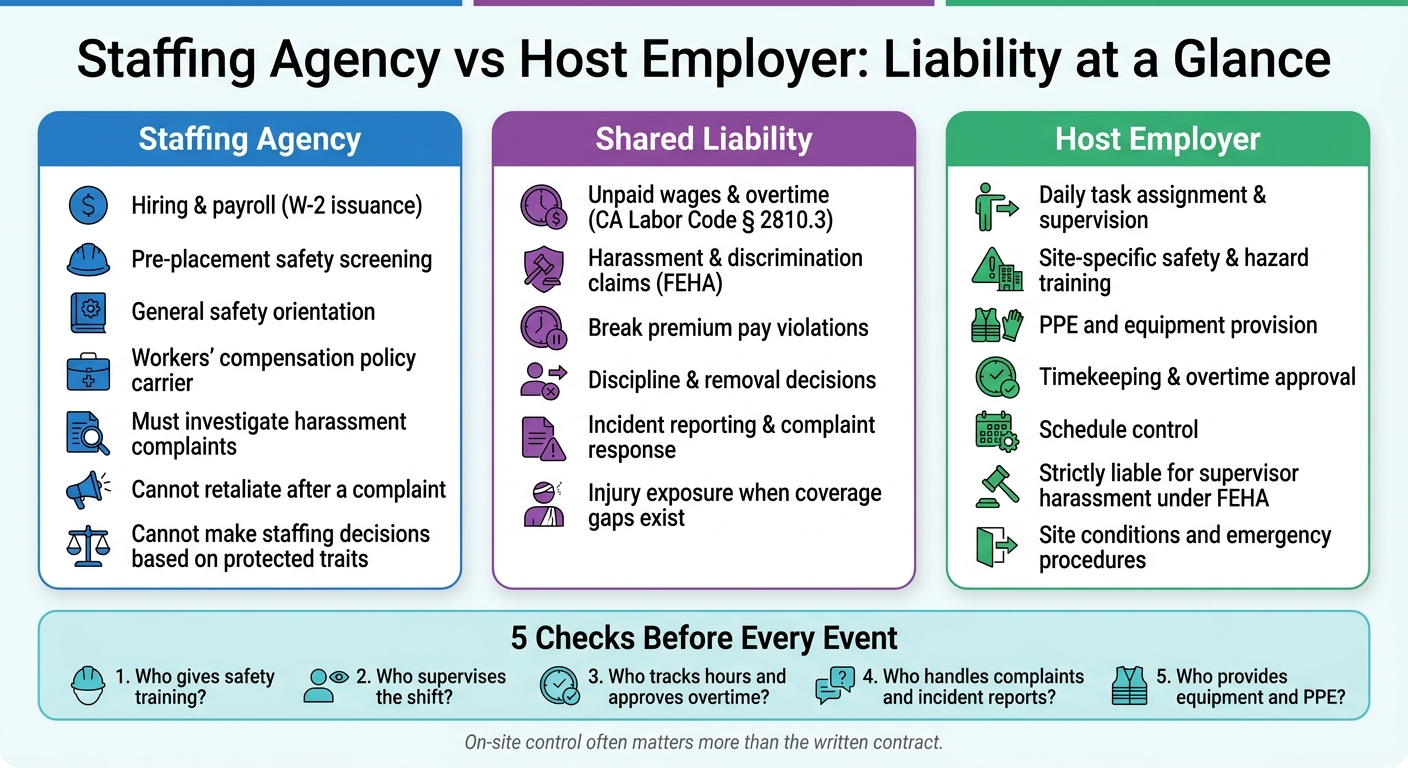
Staffing Agency vs Host Employer: Who Is Liable for What?
| Issue | Staffing Agency | Host Employer | Shared Risk |
|---|---|---|---|
| Hiring and payroll | Usually yes | Usually no | Sometimes |
| Daily supervision | Sometimes | Usually yes | Yes |
| Site safety and equipment | Limited before placement | Usually yes | Yes |
| Timekeeping and overtime | Payroll side | Shift-control side | Yes |
| Harassment response | Must investigate and protect worker | Must stop conduct on site | Yes |
| Injury exposure | Workers’ comp often runs here | Site control can still create exposure | Yes |
If I had to reduce the whole issue to five checks before every event, they would be:
That’s the core of it. If those five points are not clear before workers arrive, the risk of disputes goes up fast.
Once control is shared, the next issue is who takes care of safety, training, and supervision on site. In most cases, liability tracks on-site control.
Before a worker gets to the event site, the staffing agency handles basic safety screening and orientation. That includes checking for role-specific safety qualifications. The agency also has to vet the host site before making the placement.
If the agency sends workers to a site it knows is unsafe, or brushes past reported hazards, it can end up sharing injury liability. Put simply, the agency can't act like its job ends the moment it fills the shift.
The host employer usually controls the physical workspace, the equipment, and the day-to-day supervision. So the host will usually handle site hazard training, emergency procedures, and the supply of PPE and task-specific equipment. This is often part of a broader event day preparation checklist to ensure all safety and operational needs are met.
The host also usually assigns the work and controls the shift. That matters because the party giving directions on site often carries the most weight when something goes wrong.
| Duty | Primary Responsibility | Notes |
|---|---|---|
| General safety orientation | Staffing agency | Part of screening for role-specific safety qualifications before placement |
| Site-specific training | Host employer | The host controls the specific workplace and task assignments |
| PPE and equipment provision | Host employer | The host typically provides the tools or safety gear |
| Day-to-day supervision | Host employer | Includes assigning daily tasks and managing the schedule |
There are times when both sides can be exposed. For example, if a host supervisor tells a temp worker to use equipment without proper training and that worker gets hurt, liability may not stop with the host. The host may be on the hook for the unsafe instruction, while the agency may also face exposure if it knew about the hazard or failed to act after a report.
Those same lines of control also shape wage and injury liability.
Who controls the shift usually controls the risk. That shows up in wage claims, conduct issues, and injury matters.
| Function | Primary Controller | Joint Liability Notes |
|---|---|---|
| Scheduling | Host Employer | Host sets daily hours, establishing substantial control |
| Timekeeping | Host Employer | Gate logs and shift reports often decide wage disputes |
| Paycheck Issuance | Staffing Agency | Agency is the employer of record for W-2 and tax purposes |
| Overtime | Host Employer | Host directs extra work; both may be liable for unpaid overtime |
| Discipline and Removal | Joint | Host typically requests removal; agency executes the termination |
| Complaint Response | Joint | Host must stop the conduct; agency must investigate and protect the worker |
The staffing agency cuts the check, but the host employer often controls the workday. It sets hours, approves extra time, and shapes whether breaks happen, often requiring scalable event scheduling to maintain compliance. That split is where pay problems start.
Under California Labor Code § 2810.3, host employers share liability with staffing agencies for wage payment. Both parties can be liable for unpaid wages and overtime under the joint employment doctrine. And if no one makes sure legally required breaks happen, both can face exposure for premium pay violations.
In plain terms, one side can't shrug and point at the other. If the host controls the time and the agency handles payroll, both need to stay in sync.
The same split in control shows up in harassment and discrimination claims. A staffing agency can't make staffing decisions based on protected traits. Neither can the host employer. That includes race, sex, age, national origin, and other traits covered by federal and state anti-discrimination law.
When a complaint comes in, both sides may face exposure. Under California's Fair Employment and Housing Act (FEHA), the host employer is strictly liable if the harasser is one of its supervisors, even if the worker is a temp. The staffing agency becomes liable if it is told about the problem and does nothing. The agency also cannot retaliate by ending the assignment after a complaint.
That means the host has to stop the conduct on site, and the agency has to investigate and protect the worker. If either side drops the ball, the risk doesn't stay neatly on one desk.
Injury claims tend to follow the same pattern. If a temp worker gets hurt on site, workers' compensation coverage runs through the staffing agency. The host can still share exposure if temporary workers are not properly covered.
So while the agency may carry the workers' comp policy, the host is not automatically out of the picture. Site conditions, coverage gaps, and day-to-day control can all matter.
A staffing agreement sets the starting point. But what happens on site often decides who ends up on the hook. It’s one thing to divide duties in a contract. It’s another thing to follow that plan during a live event.
A well-drafted staffing agreement should leave no gray areas. Before any temp worker shows up on site, the contract should define who owns each of the following:
Those terms only go so far if daily supervision tells a different story.
A contract can assign duties. Still, day-to-day control on the event floor can override what the paper says.
Courts look at who actually controlled the work - who made the schedule, who handed out daily tasks, who supplied the tools, and who had the power to discipline or remove a worker from the assignment. If a venue manager, event captain, or production lead is directing a temp worker’s day, the host employer may still face liability, even when the agreement says someone else is in charge.
In practice, on-site conduct often decides which contract terms carry weight:
| Liability Area | Contractual Allocation (Typical) | What Operational Control Can Override |
|---|---|---|
| Daily Supervision | Assigned in the contract, but actual on-site direction controls liability | Host managers giving direct instructions can increase host exposure |
| Tools & Equipment | May state the agency or worker provides gear | Worker using the host's computers, software, or machinery signals host control |
| Discipline/Firing | Usually reserved for the staffing agency | Host "removing" a worker from the assignment is treated as exercising the power to fire |
| Wage Payment | Agency issues W-2 and handles payroll | Host is still civilly liable for unpaid wages and overtime under Labor Code § 2810.3 |
| Harassment | Agency responsible for HR and complaints | Host is strictly liable for supervisor conduct under FEHA, regardless of contract |
Digital gate logs, shift reports, and Slack or Teams messages often show who was actually directing the work. That’s why a signed agreement helps only when site operations line up with it.
Use the contract to lock down who handles supervision, safety, pay, complaints, and injuries before staff arrive.
Contracts set the plan, but what happens on site often decides liability. Under joint-employment rules, both parties can share liability for wage, harassment, and discrimination claims. Contracts matter, but day-to-day control still carries a lot of weight.
Before staff arrive, lock down these five role decisions.
Every event assignment should settle these five decisions in advance:
Document these five decisions before the first shift.
A temp worker’s legal employer comes down to who actually controls the work, not just whose name is on the paperwork. In many staffing agency and host employer setups, that means both companies count as joint employers.
Here’s how that usually plays out: the staffing agency takes care of hiring, payroll, taxes, and benefits. The host employer, meanwhile, runs the day-to-day side of the job, including on-site supervision, safety, and working conditions.
Because both sides often share responsibility, both can be on the hook for problems tied to pay, workplace safety, or discrimination.
Keep records that show behavioral control, financial control, and the nature of the relationship. That means saving things like signed contracts, written agreements, and messages about schedules or work instructions.
It also helps to keep:
A clear event file with role assignments can save a lot of headaches. It makes supervision and responsibility much easier to sort out if questions come up later.
Before any shift starts, the staffing agency and host employer should have a clear written agreement that spells out who handles what. That agreement should cover safety training, wage compliance, recordkeeping, and hazard disclosures.
Liability often turns on who controls the day-to-day work, including tasks, tools, and schedules. So both sides should document how they coordinate, especially when it comes to shared safety information and actual hours worked.


