How Event Staff Report Work Injuries
September 1, 2026

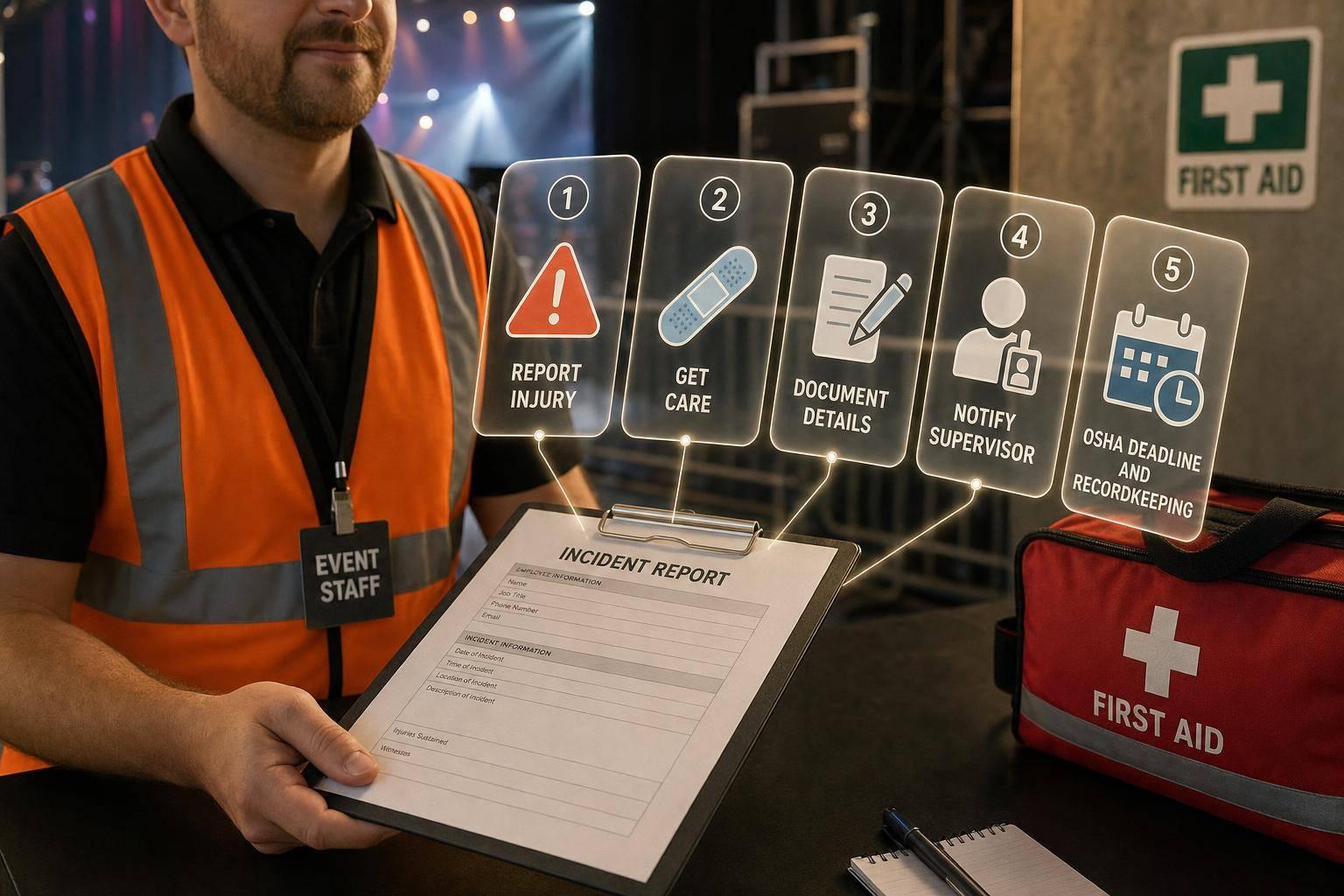
If someone gets hurt at an event, I should do four things fast: get care, tell a supervisor, write down the facts the same day, and file the case the right way.
That’s the whole process in plain English. If the injury leads to a death, the employer must tell OSHA within 8 hours. If it leads to an inpatient hospital stay, amputation, or loss of an eye, the deadline is 24 hours. For recordable cases, OSHA Forms 300 and 301 must be completed within 7 calendar days, and records must be kept for 5 years.
Here’s the short version:
A few points matter most for event teams. Work injuries are not just big accidents. They can include slips, burns, cuts, strains, heat illness, and exposure incidents during setup, service, or breakdown. And for temp staff, the host employer often handles OSHA recordkeeping because it controls day-to-day work on site.
This article breaks that process into a simple flow: respond, notify, document, collect witness statements, review the case, and store the file.
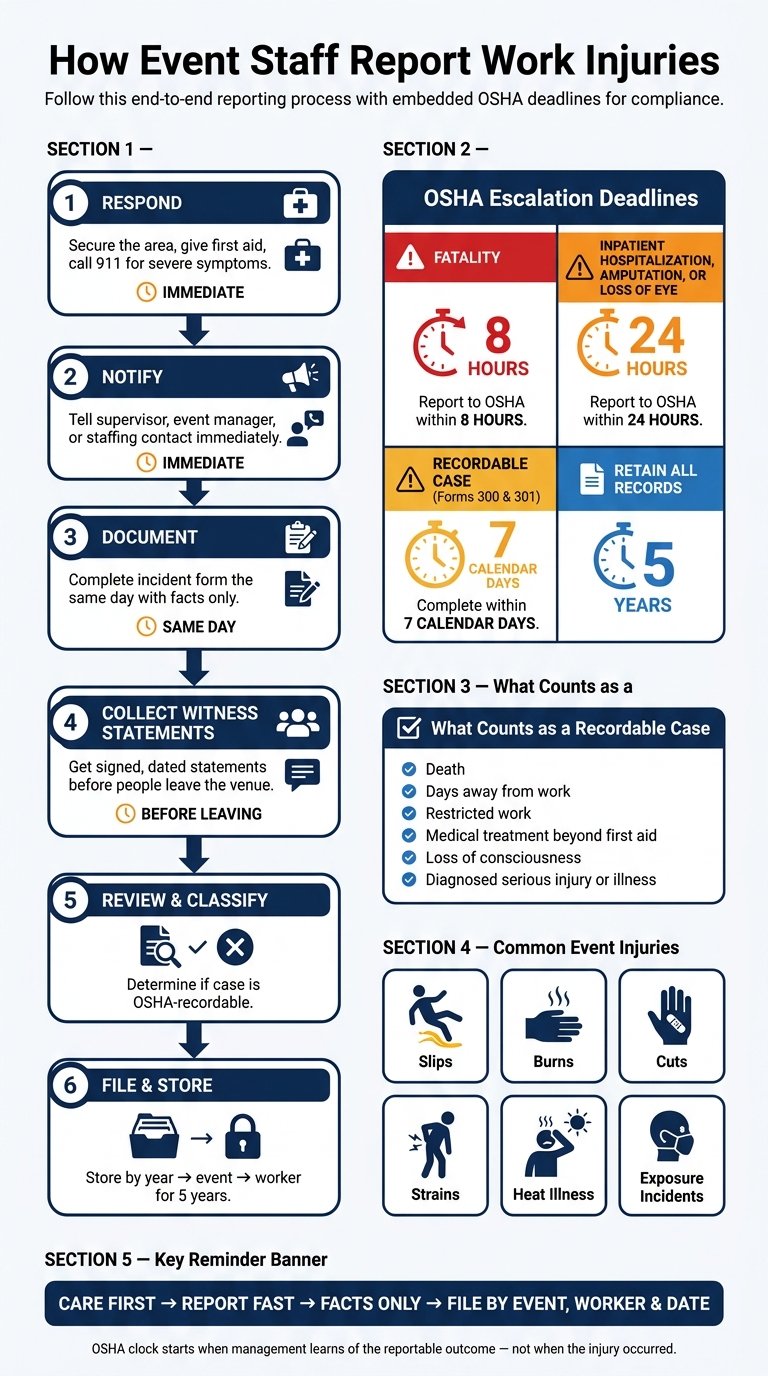
How Event Staff Report Work Injuries: 6-Step Process & OSHA Deadlines
Start with safety and care, not paperwork.
If there’s still a risk in the area, stop work there first. Then focus on the injured worker. Give the right first aid for the injury, keep untrained staff back, and call 911 for severe symptoms. Only trained first-aid or CPR responders should give care.
Call 911 right away if you notice:
When you call, share the venue name and street address, the exact spot inside the building - like the ballroom kitchen prep area - what happened, how many people are injured, and the worker’s current condition. Stay on the line until the dispatcher tells you to hang up. Have someone meet responders at the main entrance.
Once the area is safe and the worker is stable, notify the on-site supervisor, event manager, or staffing contact right away. Ideally, this happens within minutes.
If the injured worker can’t report it, a coworker or nearby lead should do it at once.
Keep that first report short and factual while the details are still fresh. Include the worker’s name, role, time, location, activity, injury, and what treatment is needed.
Some cases can’t stay internal. Under federal OSHA rules, employers must report work-related fatalities within 8 hours and inpatient hospitalizations, amputations, or loss of an eye within 24 hours of learning about the outcome. These are legal deadlines.
Here’s the part that trips people up: the OSHA clock starts when management learns of the reportable outcome, not when the injury happened.
So if a worker is admitted to the hospital overnight after a fall, or a finger or fingertip is amputated while handling equipment, the supervisor needs to alert the company’s safety lead or owner at once. Report by phone to OSHA or the 24-hour hotline. Managers should also follow the venue’s emergency plan, which may include notifying venue security, the event organizer, or a designated safety officer.
After that immediate report, move to the incident form and witness notes.
Use the table below to see when a case stays internal and when it moves to OSHA reporting.
| Injury scenario | Immediate response | OSHA escalation required? |
|---|---|---|
| Ankle sprain, treated on site | First aid, notify supervisor | No |
| Overnight hospital admission after a fall | Call 911, notify supervisor and safety lead | Yes - report within 24 hours |
| Fingertip amputation from equipment | Call 911, notify supervisor and safety lead | Yes - report within 24 hours |
| Fatality on site | Call 911, notify supervisor and safety lead | Yes - report within 8 hours |
| Heat exhaustion, treated and released | Move to cool area, first aid, notify supervisor | No |
| Heat stroke with hospital admission | Call 911, notify supervisor and safety lead | Yes - report within 24 hours |
Managers should name one person - such as an owner, HR director, or safety manager - to handle OSHA notification. Supervisors should have that person’s direct phone number and be able to reach them at any hour during an event.
Once the supervisor has been notified, complete the incident form and collect witness notes.
Once the scene is under control and the supervisor knows what happened, document the incident that same day.
Your incident form should match OSHA Form 301, which is required for every recordable work-related injury or illness. At a minimum, include the following:
| Field | What to include |
|---|---|
| Worker information | Full name, job title, employer of record |
| Event and assignment | Event name, client name, job number |
| Incident date and time | Date in MM/DD/YYYY format, time of incident (for example, 8:45 p.m.), time worker started work |
| Exact location | Facility name, specific room or area (for example, Dock 2 loading bay) |
| Task being performed | Brief factual description (for example, carrying stacked chairs from storage to ballroom) |
| What happened | Describe only what was seen and heard, in chronological order. Do not speculate or assign blame. |
| Object or substance involved | Direct cause of the injury (for example, wet floor from melted ice, loose cable) |
| Nature of injury and body part | Specific injury and location (for example, sprain, right ankle) |
| Treatment and disposition | What was done on site, and whether the injured worker went to urgent care, the ER, or back to work |
| Treating provider | Name, address, and phone of treating clinic or physician, if care was provided |
| People notified | Names, titles, and notification times for supervisor and staffing coordinator |
Stick to the facts. Write down what people saw, heard, and did in the order it happened. This isn't the place for guesses or finger-pointing.
Get witness statements as soon as possible, ideally before people leave the venue. The longer you wait, the fuzzier details can get.
Each witness statement should include:
Every statement should be signed and dated by the witness. Give each incident its own case number, then place that number on the main form and every attached statement so the records stay tied together.
If the injured worker can't write a statement, a supervisor or coordinator should complete the form using witness accounts, coworker notes, and photos of the scene. Later, when the injured worker is medically able, have them review the record and sign a supplemental statement. Attach that statement to the original file so the case record is complete and ready for review and recordkeeping.
Once the incident form is complete, the next step is recordkeeping. The shift here is simple: move from gathering facts to making sure the case is reviewed and filed the right way.
After the form is submitted, a supervisor or manager should review it the same day. Go line by line and confirm that the names, roles, event details, location, shift time, and cause are all there. If something is missing - witness names, contact details, or follow-up actions, for example - reach out to the injured worker, any witnesses, or the on-site lead before the report is finalized. If your team uses Quickstaff, you can cross-check the event, shift, and supervisor details before filing.
Then decide whether the case is OSHA-recordable. A case is recordable if it is work-related, new, and leads to one of the following:
The line between first aid and medical treatment matters here. Stitches or prescription medication make the case recordable. A cut treated with only a bandage does not.
If the case is recordable, enter it on OSHA Form 300 and complete OSHA Form 301 within seven calendar days of learning about the injury or illness. Then file the case and update the log if needed.
After you classify the case, file it in a way that lets you pull it fast for OSHA, workers' comp, or an internal review. Nobody wants to dig through scattered folders when the clock is ticking.
At the end of each calendar year, review the Form 300 log for accuracy and completeness. Then prepare and certify Form 300A, the annual summary. A company executive - such as the owner, general manager, or senior operations director - must sign it to confirm that the information is accurate.
Post the certified 300A in a visible workplace location from February 1 through April 30 of the following year. Keep the Form 300 log, the Form 300A summary, and each Form 301 for five years after the calendar year they cover. If the case outcome changes, update the records.
Good filing makes life a lot easier. When a manager needs a full case for an inspection or claim review, they should be able to pull it without a scramble.
Set up records first by year, then by event, then by worker. In a digital system, a folder path might look like this: Safety & Incidents → 2026 → 2026-05-17 – Smith-Jones Wedding – Dallas, TX → Lopez, Maria – Banquet Server.
Each worker folder should include:
Use event IDs and shift IDs in file names so records match the right staff member and event. It also helps to name files with the incident date in YYYY-MM-DD format, which keeps sorting clean and easy.
These records should have restricted access. Keep medical notes separate and limit access to HR and safety staff. In a digital system, permissions should be limited to HR, senior operations managers, and designated safety personnel. Paper records should stay in a locked cabinet, not in a shared office area. A simple index with the event date, location, and worker initials can speed up retrieval without exposing private details.
Once the report is filed, the next job is staying consistent. A clear workflow stops incidents from turning into chaos when people are busy and the pressure is on.
At its core, the process is simple: respond, report, document, collect witness notes, classify the case, and file it by event, worker, and date for 5 years. Each step connects to the next. Skip one, and you’re left with holes that are tough to fix later.
Quickstaff can link an injury report to the shift, location, and staff assignment tied to the incident.
The point isn’t to build a process that only works in training. It needs to work during a packed, hectic event when people are moving fast and attention is split.
A few reminders are worth repeating:
When staff know the steps, managers can spend their time on follow-up instead of chasing missing details. Steady reporting helps protect workers, protects the business, and gives managers a better shot at fixing hazards before the next event.
The injured temporary worker - or the frontline staff member who spots the incident - should report it right away to a supervisor or the on-site safety lead.
Then the person in charge, usually the event manager, general manager, or owner, should document the injury and make sure it’s recorded the right way. If the worker was placed through a staffing agency, that manager should also notify the agency and share the incident record.
First aid means basic, immediate care for minor injuries. That includes things like a bandage or antiseptic for a small cut or scratch.
Medical treatment is care provided by a healthcare professional when an injury goes beyond what first aid can handle. If care moves past first aid, treat it as a serious safety incident and follow your formal reporting and escalation process.
Prioritize immediate medical care and follow the event’s emergency escalation protocols. Write down the facts you have at that moment, including the time, location, staff involved, and the type of incident or injury.
In the incident report, note that a statement could not be obtained. Keep monitoring the situation, coordinate with the staffing agency if needed, and maintain accurate records in the shift file for later review.


