


Returning event staff don’t automatically need a new Form I-9. First, confirm whether they stayed employed or left and are being rehired.
Check work authorization separately. Temporary authorization may need reverification before work resumes, but an expired identity document alone doesn’t trigger that step. Base deadlines on the actual employment start date - including paid training - not just the event date. Keep I-9 records and deadline tracking separate from scalable event scheduling.
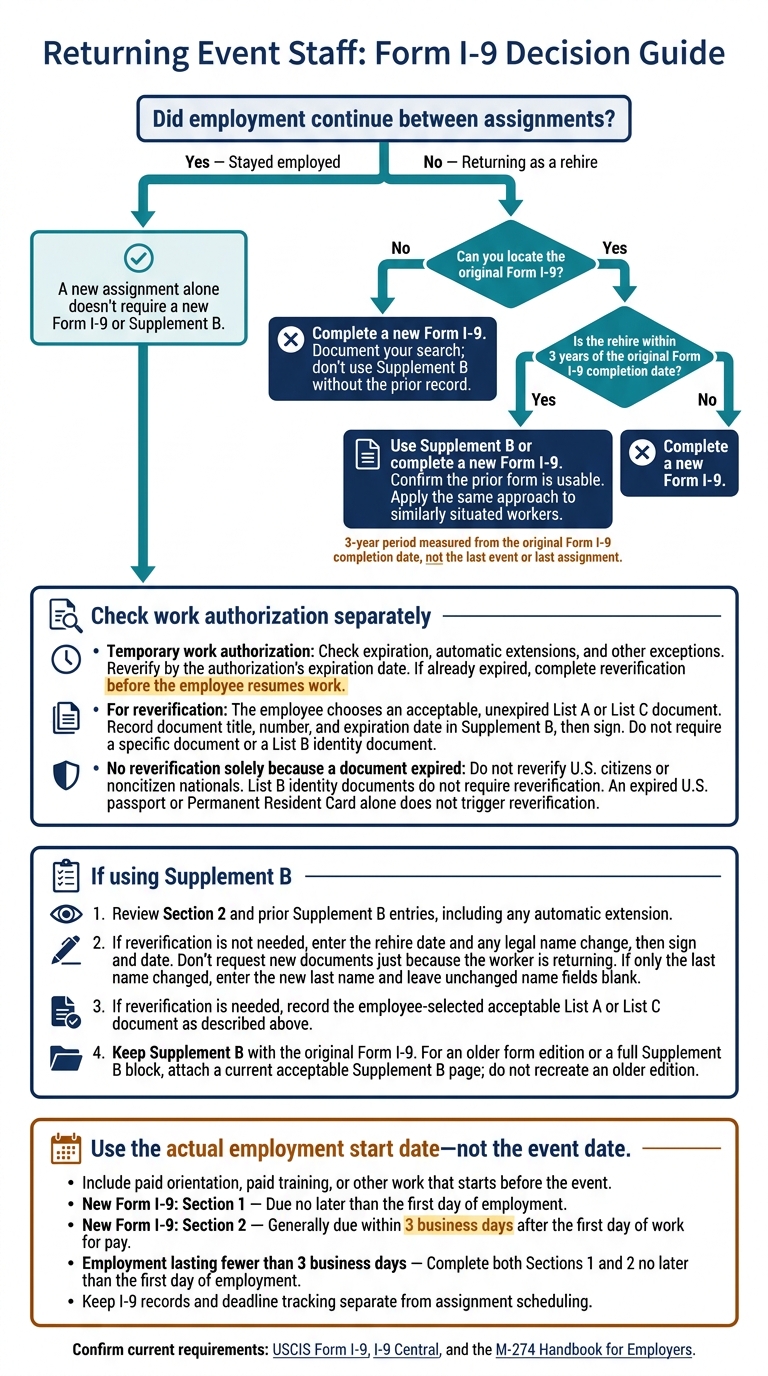
Returning Event Staff: Form I-9 Decision Guide
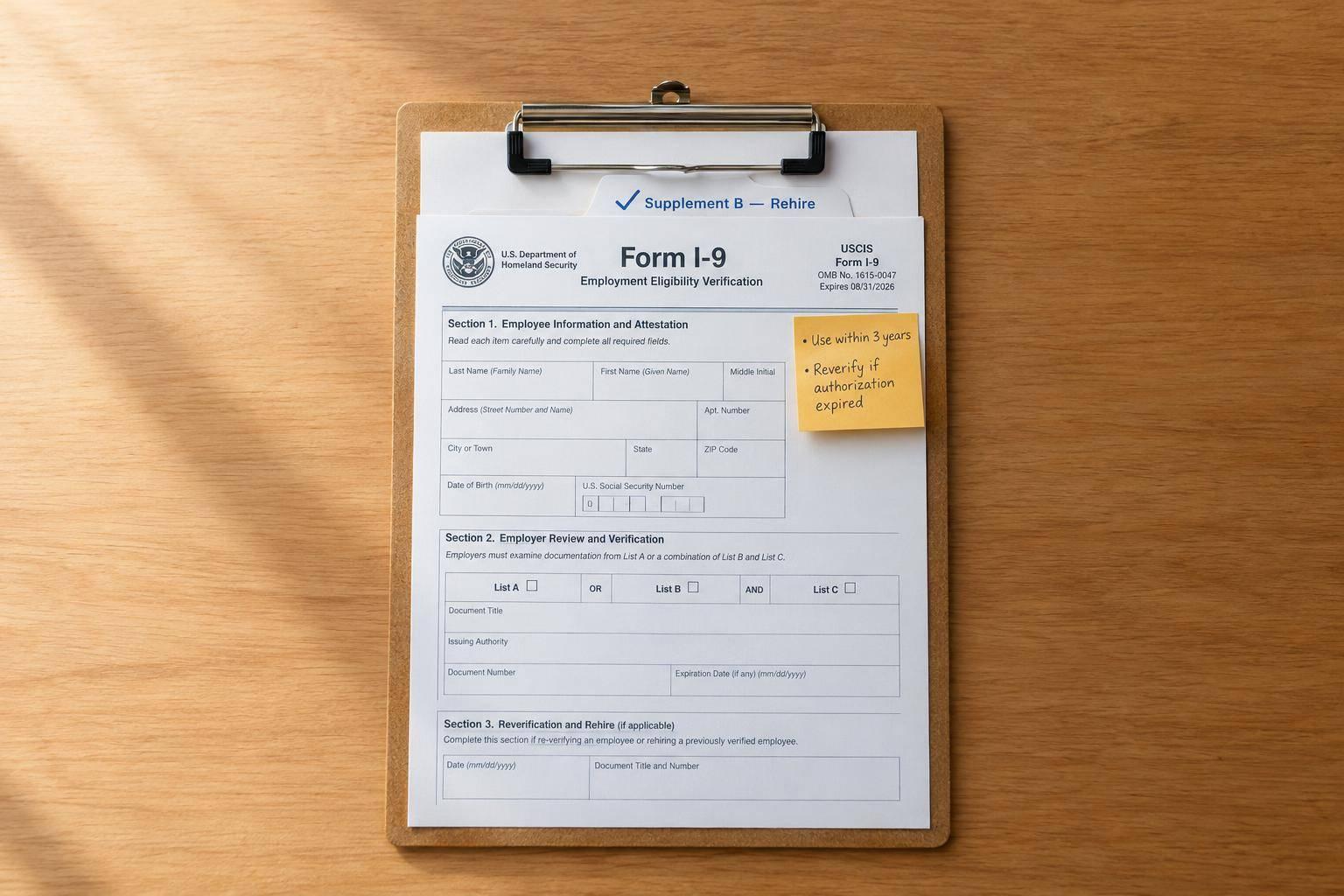
Use Supplement B on the existing Form I-9 for an eligible rehire when the prior form is still usable. Apply the same approach to similarly situated workers: use either Supplement B or a new Form I-9 consistently.
Once you confirm the worker qualifies for a rehire entry, review and document the rehire as follows.
Find the original Form I-9 and confirm it belongs to the returning worker. Check Section 2 and any prior Supplement B entries to confirm current work authorization, including any automatic extension.
If reverification isn’t needed, enter the rehire date and any legal name change in Supplement B, then sign and date it. If only the last name changed, enter the new last name and leave the unchanged name fields blank. Don’t request new documents just because the worker is returning.
If reverification is needed, let the employee choose an acceptable, unexpired List A or List C document. Enter the document title, number, and expiration date in Supplement B before signing. Don’t require a specific document or a List B identity document for reverification.
If the original form is an older edition, complete the current acceptable Supplement B page and file it with the original form. Don’t recreate an older edition. If one Supplement B block is full, attach another current Supplement B page.
If you can’t find a returning worker’s prior Form I-9, complete a new Form I-9. Don’t use Supplement B without the prior record. Document your search and meet the Form I-9 deadlines.
Use these rules to determine whether you need a new form or can use Supplement B:
| Employment status | Form I-9 treatment | Employer action | Key timing rule |
|---|---|---|---|
| Rehire within three years | Supplement B or a new Form I-9 | Review the prior form and work authorization; document the rehire | Count from the original Form I-9 completion date |
| Rehire more than three years later | New Form I-9 required | Complete the current Form I-9 process | Count from the original Form I-9 completion date |
| New hire | New Form I-9 required | Complete Sections 1 and 2 by the applicable deadlines | Section 1 is due no later than the first day of employment; Section 2 is generally due within three business days after the first day of work for pay |
Deadlines follow the actual employment start date - not the event date. If employment will last fewer than three business days, complete both Sections 1 and 2 no later than the first day of employment.
Check whether paid orientation, training, or other work begins before the event, and consider the benefits of event staff scheduling software to manage these timelines. Also check whether employment continues between assignments. Use the actual start date to determine which deadline applies.
Once you confirm that a returning worker can be treated as a rehire, check whether their current work authorization needs reverification.
Another event does not automatically require a new document check. Reverification and rehire processing are separate steps.
Only temporary work authorization requires reverification. Complete it by the authorization’s expiration date. If authorization has already expired, complete reverification before the employee resumes work. Check for automatic extensions and other exceptions first.
Let the employee choose any acceptable, unexpired List A or List C document for reverification, then record it in Supplement B.
Do not reverify U.S. citizens or noncitizen nationals. List B identity documents do not require reverification either. An expired U.S. passport or Permanent Resident Card alone is not a reason to require a new one.
Review I-9 status before booking a returning worker. Confirm whether employment continued or ended, locate the previous Form I-9, and check its original completion date and any Supplement B entries. Use Supplement B only for a qualifying rehire within 3 years of the original Form I-9 completion date. After that, complete a new Form I-9.
Track I-9 and reverification deadlines separately from assignment booking dates. Keep Supplement B with the original Form I-9 and follow retention rules.
For teams handling frequent return assignments, Quickstaff offers event assignments, availability tracking, reminders, and centralized scheduling to help prompt I-9 review. Use scheduling tools for reminders, but keep I-9 review in a separate compliance process.
Visit the USCIS Form I-9 page for the official form, instructions, and acceptable editions. Check I-9 Central for Supplement B guidance and the M-274 Handbook for Employers.
First, confirm whether employment ended. Review termination notices, any resignation, payroll separation records, and whether both parties reasonably expected the worker to return.
Finishing an event or assignment does not automatically end employment. If the worker is still employed, returning for another event is not a rehire. If employment ended, you may use Supplement B for a rehire within 3 years of the original Form I-9 completion date. Otherwise, complete a new Form I-9.
No. The three-year window starts on the date the original Form I-9 was completed. Using Supplement B does not restart the clock.
You can use Supplement B for multiple rehires of the same employee during that window. Once the window closes, you must complete a new Form I-9 for a rehire - even if you used Supplement B before.
Keep Form I-9 records for three years after the hire date or one year after employment ends, whichever is later. Calculate both deadlines and use the later date as the destruction date.
Store the original Form I-9, any Supplement B pages, and any new forms together. Using Supplement B for a rehire does not change the original form’s retention requirements.


