I-9 Audit Checklist for Event Staffing Firms
October 11, 2026

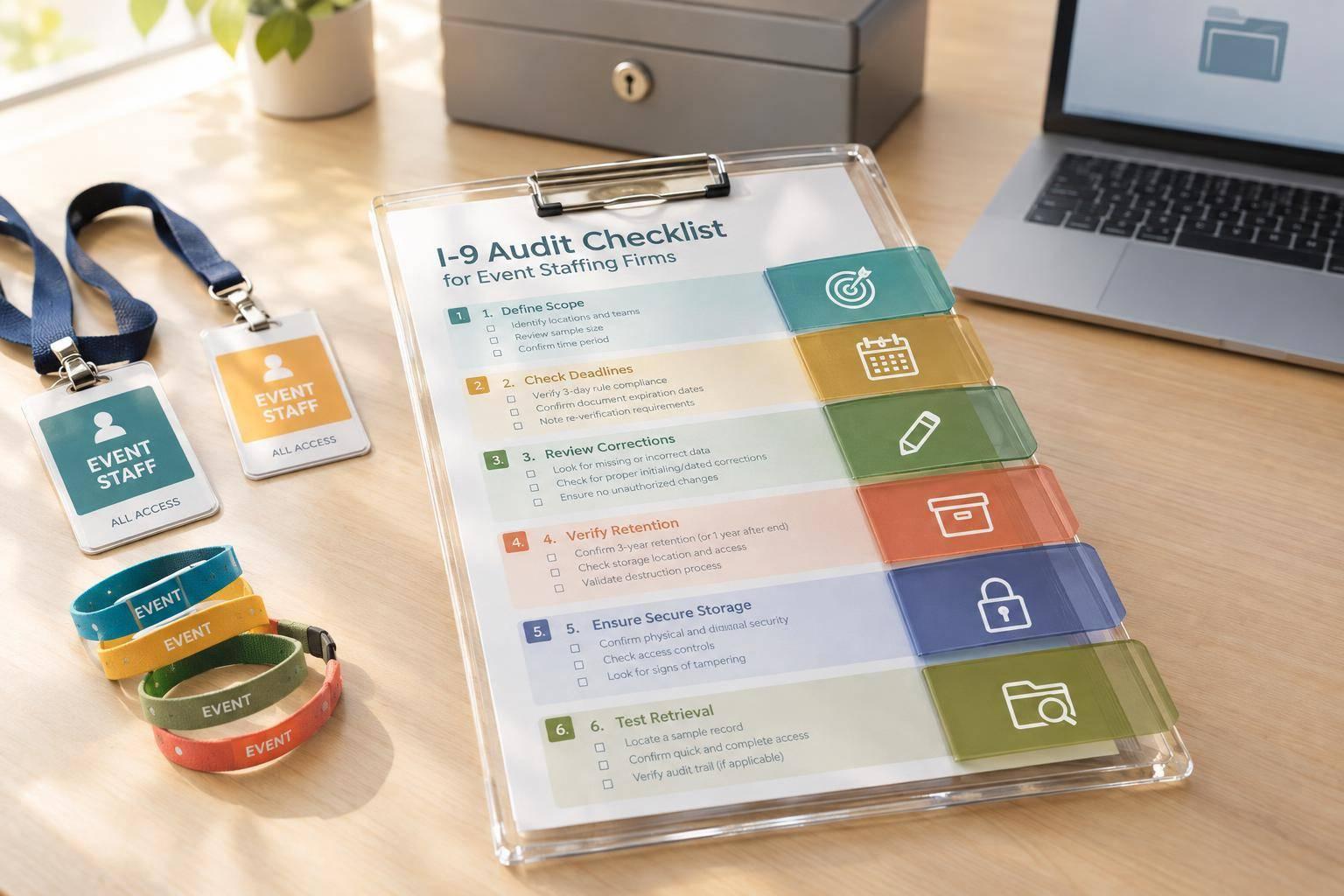
I start an I-9 audit with payroll records - not event rosters. Your checklist should confirm each worker’s employer, check forms and deadlines, document corrections, calculate retention dates, and test file retrieval.
Here’s what I check:
Scalable scheduling records help reconcile your worker list. They do not replace Form I-9 or prove compliance.
Match each worker to the correct I-9 using their legal name, hire date, termination date if applicable, employer entity, and employee identifier. Flag missing or duplicate forms, check that entries are legible, and confirm the form version was valid when completed. Investigate unexplained mismatches, but don’t treat an explained name change or accent mark as an error. Log each deficiency without changing or discarding the original.
Review the employee’s legal name, address, date of birth, citizenship or immigration-status selection, required immigration-number fields, signature, and date. Section 1 is due no later than the first day of work for pay.
If someone helped complete the form, review Supplement A or the older form’s preparer/translator fields. Don’t flag blanks that are optional or don’t apply. An SSN is optional unless E-Verify applies. If the number is pending, document that and follow up.
Verify the employer details, representative’s name and title, signature, certification date, and first day of work for pay. Review document titles, issuing authorities, numbers, and expiration dates for either one List A document or one List B document plus one List C document.
Section 2 is due within three business days after the employee’s first day of work for pay. If employment lasts fewer than three business days, it’s due on the first day of work for pay. Use that first paid workday - not each event date - and keep proof of any late completion, perhaps by using budget-friendly staff scheduling tools to track hire dates.
Confirm that documents were examined physically or through a DHS-authorized alternative procedure. Don’t demand specific documents or extra documents. For receipts, check the type and deadline. Qualifying receipts are valid for 90 days from the first day of work, or from authorization expiration for reverification.
Compare retained copies with the form entries and check that copying follows the firm’s consistent policy. Copies do not replace a completed I-9.
Compare Supplement B or the older-form section with the worker’s employment history. Continued seasonal employment doesn’t automatically count as a rehire. For eligible rehires, confirm whether the prior I-9 is still usable.
Track work authorization expiration dates and qualifying extensions, and complete required reverification on time. Do not reverify U.S. citizens, noncitizen nationals, lawful permanent residents who presented a Permanent Resident Card, or List B identity documents. Flag unresolved deadlines for follow-up.

I-9 Retention and Disposal Decision Guide
After the field review, confirm how long each file must be kept and where it is stored.
Keep current employees’ Forms I-9, applicable supplements, and retained copies throughout employment and through the required retention period. Enter a separation date only after HR confirms termination. For employees still working, mark the record as active employment. Use event schedules only to confirm hire and separation dates for the retention log.
Record hire and separation dates in MM/DD/YYYY format. For separated employees, calculate both deadlines: three years after hire and one year after separation. Keep the record through whichever date is later.
The retention log should include the employee identifier, hire date, separation date, both deadlines, final retention date, storage location, status, and reviewer. Track temporary, seasonal, and rehired staff in the log separately from active event schedules. Review the log monthly or quarterly if you frequently hire short-term staff.
Before destroying records, confirm that the retention deadline has passed. Check for inspection notices, subpoenas, audit requests, legal holds, or government inquiries. Suspend destruction when a hold applies. Document the hold check, who approved destruction, which records it covers, and the destruction date and method. Keep supplements, attached copies, correction records, and explanations with the form until disposal is authorized.
For files that must remain in storage, confirm they can be retrieved securely.
After setting retention dates, check whether each file can be accessed and reproduced promptly.
Store I-9 files separately from general personnel and event-operating records so staff can find and reproduce them promptly for inspection. Limit access to authorized HR, compliance, and management staff. For paper files, check locked storage, controlled keys or badge access, clear indexing, and protection from water, fire, and removal without permission. Link each retained copy and explanation to the correct employee record.
For electronic files, verify access controls, protections against changes or deletion without permission, backups, recovery procedures, and audit trails that record the user, date, and action taken.
Test retrieval for current, separated, and seasonal workers. Record missing pages, unreadable scans, access failures, and retrieval time. The system must produce complete, readable records within three business days of an authorized request.
Before destroying scanned paper originals, verify that every page, attachment, correction, and signature is legible and linked to the correct employee. Document the scan review.
After checking deadlines and storage, correct the record. Classify each finding as a missing form, omitted field, recording error, late completion, or unresolved issue. Assign it to the worker’s actual employer - not the venue client. Corrections improve the record, but they do not fix late filing dates.
The employee corrects Section 1. The employer or authorized representative corrects Section 2 and Supplement B. If a preparer or translator helped, that person should make or document the correction. Staff without permission must not change an employee’s attestation.
On paper forms, draw one line through the error so it remains readable. Enter the correction, then initial and date it. Never erase, use whiteout, hide an entry, or backdate. Electronic corrections must retain the original value, corrected value, user, timestamp, and reason.
Complete a missing Form I-9 promptly with the current form and actual completion date. Attach a dated note listing the discovery date, cause, reviewer, and completion date. Do not recreate earlier signatures or verification details.
For multiple errors, complete the affected section on a new form and attach it to the original. Use a full replacement only for major errors, such as a blank section or Section 2 completed with unacceptable documents. Keep the original and attach the replacement section or form. Add a memorandum explaining the reason for the change, discovery date, responsible person, and correction date.
Refer uncertain cases, unavailable employees, conflicting records, or suspected work-authorization problems to qualified immigration counsel. Document attempts to contact employees. Do not demand specific documents. An incomplete form alone does not prove that a worker lacks employment authorization.
Record the employee ID, form edition, issue, affected field, responsible person, requested action, request date, completion date, reviewer, and follow-up status. Link explanations, replacement sections, and correspondence to the form.
Limit sensitive details and access. Leave out document numbers unless needed, and close an item only after reviewer approval. Track repeat findings by recruiter, location, or authorized representative to address onboarding and training gaps. Use the log to confirm that the file is inspection-ready.
Before closing the review, confirm its scope, retention requirements, and correction status. Check reviewed workers against payroll and onboarding records, not just event rosters. Assign each unresolved finding an owner and due date. Record the review period, files reviewed, method, exceptions, reviewer, approval date, and next review date.
Schedule the next full review before peak hiring. During peak season, check new hires monthly, then review rehires and terminations after the season ends. Once the file review is closed, confirm that you’re ready for an inspection.
Assign one response owner and a backup. Keep an up-to-date I-9 index so records are easy to find, and test retrieval for active, seasonal, terminated, and rehired workers. Include records held by authorized representatives. This test checks inspection readiness for temporary and seasonal staff. Document who accessed or supplied each record, and confirm that forms and supporting records are readable and accessible within the required response period.
A Notice of Inspection usually allows three business days to produce Forms I-9, but subpoenas or warrants may not. Follow the notice instructions and get legal guidance when needed. Keep the notice, index, copies produced, and proof of delivery. Log who produced each record and when.
Keep scheduling separate from compliance records. Use Quickstaff scheduling records only to reconcile rosters - not to set termination dates or meet Form I-9 requirements. Keep verification records, sensitive identity and work-authorization information, retention calculations, correction logs, and audit trails in the firm’s designated I-9 compliance process.
No. A properly completed Form I-9 remains valid while the employee continues working for your company.
If you rehire an employee after a break in service, you may need a new form. However, if you rehire them within three years of completing the original Form I-9, you can generally use Supplement B instead.
If the employee’s work authorization expires and requires reverification, complete Supplement B, not a new Form I-9. Not every expired document requires reverification.
Check for missing or incorrect fields and outdated document information. Update your records and clearly document both the issue and the correction. If misclassification led to other employment or tax problems, review the classification, reclassify as needed, and update tax reporting under your compliance plan.
Keep the corrected I-9 and supporting documents in the worker’s personnel file for the required federal retention periods - at least three years for key employment records.
For workers placed through a staffing agency, the agency is the employer of record. It must complete and maintain Form I-9 to verify their work authorization.
The agency and host employer are often joint employers for safety and wage compliance, but the agency typically handles I-9s. Set out recordkeeping responsibilities in a written agreement to meet compliance requirements and prevent documentation gaps.