First Aid Training Programs for Large Event Security
June 19, 2026

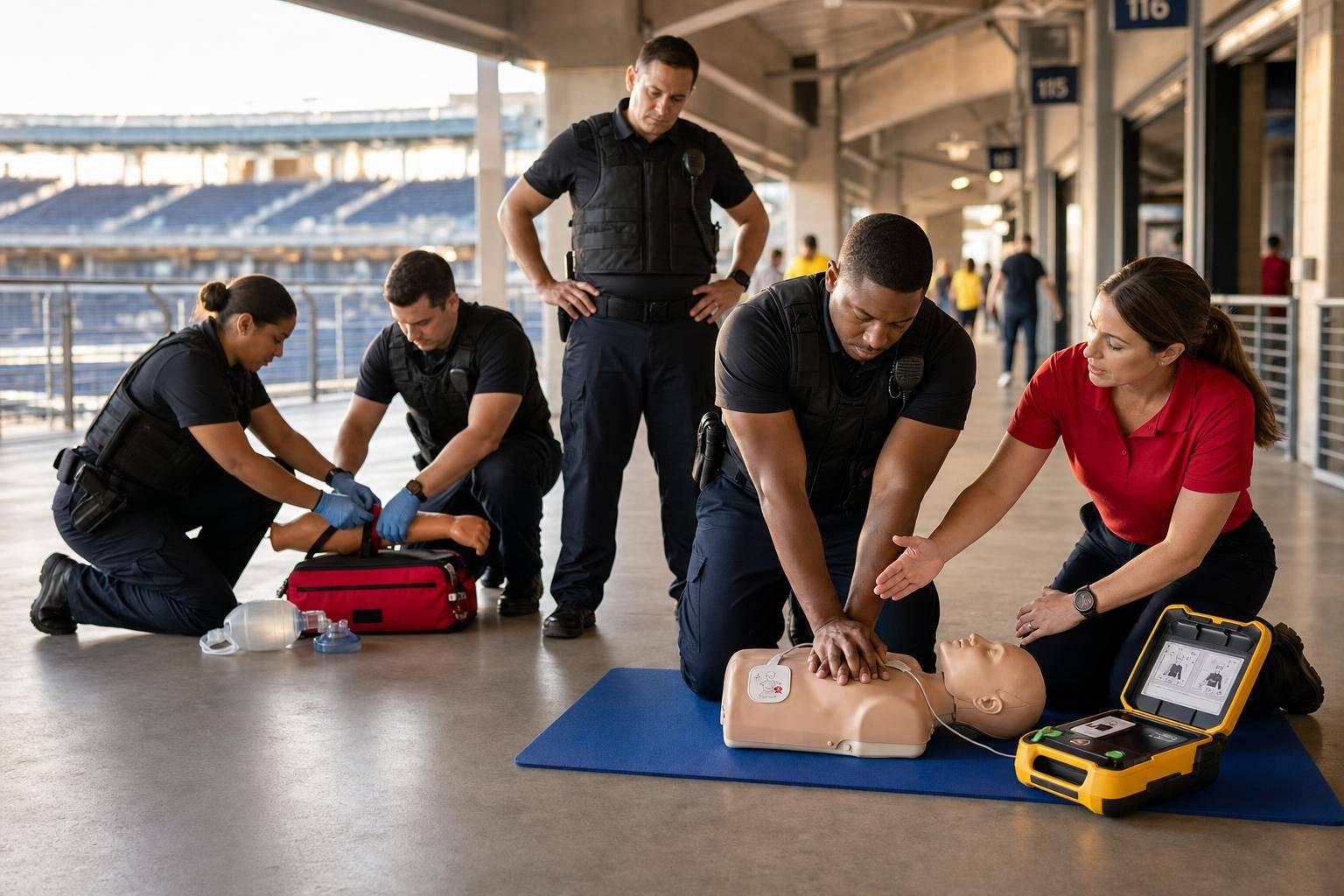
At large events, a 5- to 15-minute EMS delay can be too long. If your security team may reach a collapsed guest before paramedics do, they need more than a basic card. In most cases, I’d use a layered setup: First Aid/CPR/AED for most staff, Stop the Bleed for trauma, BLS or Professional Rescuer for team leads, and TECC only for higher-risk posts.
Here’s the short version:
What matters most is simple:
Cardiac arrest brain injury can start in 4 to 6 minutes without oxygen, and severe bleeding can turn deadly in 3 to 5 minutes. So I wouldn’t treat this as a check-the-box issue. I’d match the training to the post, the crowd, and the likely medical calls.

First Aid Training Programs for Event Security: Quick Comparison Guide
| Program | Best For | Main Gap | Length | Typical Cost |
|---|---|---|---|---|
| ARC First Aid/CPR/AED | General event security | No tourniquets or triage in base course | Varies by format | Varies |
| ARC CPR/AED for Professional Rescuers | High-risk posts, response teams | Less trauma focus than TECC | Varies by format | $100 to $150 |
| AHA Heartsaver | Ushers, stewards, general guards | No wound packing, tourniquets, or MCI training | ~4 to 5 hours blended total | $80 to $100 |
| AHA BLS | Supervisors, lead responders | More time and cost than baseline CPR | ~4 to 5 hours | $100 to $150 |
| Stop the Bleed | Any staff needing hemorrhage control | No CPR or illness care | 60 to 90 minutes | Often free to $25 |
| TECC (Civilian/Non-EMS) | High-risk teams, VIP, rapid response | Higher cost; in-person only | 8 hours | $200 to $350 |
If I were building a venue plan, I’d train most staff for baseline medical calls, then give selected responders the trauma and team-response skills that fit the site.
American Red Cross First Aid/CPR/AED is the baseline layer for event security staff at large U.S. events.
This training covers the basics security teams are most likely to face on the job: CPR, AED use, choking, minor wounds, sudden illness, and heat/cold emergencies.
The main weak spots are severe bleeding and mass-casualty triage. That’s why it should be paired with Stop the Bleed if your team may need to handle tourniquets or wound packing. Naloxone and overdose response are also not built into the base course and need separate add-ons.
For large teams, blended delivery usually makes the most sense. Staff can finish the coursework remotely and then come in for a short, in-person skills check.
That setup facilitates scalable event scheduling without skipping the part that matters most: showing they can do the skills in person. Online-only training is not appropriate for professional security training.
Certifications stay valid for 2 years. Digital certificates include a unique ID and QR code, which makes employer verification simple.
The blended format works well at scale because organizers don’t have to book as many full-day classroom sessions, while staff still complete a hands-on check.
For team members posted in higher-risk areas, the Red Cross baseline works best alongside Stop the Bleed training so they’re better prepared for severe bleeding incidents.
| Format | Hands-On Skills Check | OSHA Compliant | Best Use Case |
|---|---|---|---|
| In-Person | Yes | Yes | Teams needing direct instructor interaction |
| Blended | Yes | Yes | Large teams with flexible scheduling needs |
| Online-Only | No | No | General awareness; not for professional security |
Teams that need a more advanced resuscitation focus should compare this baseline with professional-rescuer CPR/AED training next.
A basic first aid course covers the incidents most teams run into. CPRO goes a step further.
CPR/AED for Professional Rescuers (CPRO) is built for people who have a duty to act, including security guards, lifeguards, and public safety personnel. In plain English, this is the course for teams that may need to do more than call 911 and wait.
The training covers quick patient assessment, mask ventilation, two-rescuer Bag-Valve-Mask (BVM) technique, and coordinated multi-rescuer response. That matters in crowded venues, where one person rarely handles a medical event alone.
CPRO comes in both instructor-led classroom and blended learning formats. That gives managers some room to work with different schedules and staffing setups.
For large teams, blended learning can take a lot of pressure off the calendar. It cuts in-person time and reduces scheduling burden, which helps when you're training people across mixed shifts or multiple posts.
CPRO certifications stay valid for 2 years and come with a digital certificate that includes a unique ID and QR code for employer verification. That makes recordkeeping much less of a headache.
Red Cross credentials are widely recognized by U.S. employers. And while the card lasts 2 years, annual refreshers are a smart move for high-stress event settings where people need to react fast under pressure.
CPRO fits best for staff assigned to higher-risk posts or medical support roles. If security needs to work as part of the venue’s medical response, this is usually the stronger pick.
Pricing from the Red Cross can vary by provider, but professional-level courses often land around $100 to $150 per person, with larger groups sometimes getting discounted on-site training.
| Format | Best For | Key Advantage |
|---|---|---|
| In-Person Classroom | High-risk posts, first-time CPRO learners | Direct instructor feedback on BVM technique |
| Blended Learning | Large teams, mixed shifts | Reduces in-person time by about 60% |
| On-Site Batch (15+) | Staff working with event medical teams | Instructor comes to you; lowest per-head cost |
Heartsaver sits in the middle for general security staff. The AHA Heartsaver First Aid CPR AED program is built for nonmedical team members who need a recognized credential.
The course covers adult, child, and infant CPR, AED use, choking relief, and basic first aid for heart attacks, strokes, and breathing problems. Recent updates also add naloxone for opioid emergencies, which matters at places like festivals and arenas.
That said, there’s a clear limit here. Bleeding control is restricted to direct pressure and bandaging. It does not teach tourniquets, wound packing, or mass-casualty triage. So this is a baseline course, not a trauma course for higher-risk posts.
AHA offers classroom, blended, and self-guided formats. The blended option takes about 3 hours online and 2 hours in person. To get the completion card, learners must pass a hands-on skills check.
That last part matters. Watching videos is one thing. Using CPR steps and an AED under instructor review is where people start to build muscle memory.
Heartsaver is widely recognized for non-healthcare roles. Security managers should book Heartsaver Total, not Heartsaver Basic. Total is the track meant for workplace compliance.
This course fits general security staff well. For posts with a higher chance of serious injury, pair it with trauma training.
At $80 to $100 per person, Heartsaver is one of the more accessible choices for large rosters. The blended and self-guided formats are a good match for 24/7 operations across more than one site.
| Format | Time Required | Best For |
|---|---|---|
| Classroom | ~3.5 hours | First-time learners wanting direct instructor feedback |
| Blended Learning | ~3 hours online + ~2 hours in person | Rotating shifts, large teams |
| Self-guided | ~2 hours online + ~1 hour skills | 24/7 operations, multiple locations |
Teams assigning medical leads should compare this option with BLS next.
BLS builds on standard CPR and airway training for staff who have a duty to act. It goes past what Heartsaver covers. In plain terms, that makes BLS a better match for posts expected to lead a resuscitation, not just help with basic first aid.
The program includes high-quality chest compressions at a rate of 100 to 120 per minute and a depth of 2 to 2.4 inches, AED use, two-rescuer CPR protocols, and the basics of bag-mask ventilation. One part that clearly separates BLS is team-response practice. Staff train on how multiple rescuers work together and divide roles during a resuscitation. For large event security teams, that kind of coordination can keep the scene from turning chaotic.
AHA BLS is usually taught in an instructor-led class that takes about 4 to 5 hours. There’s also a blended option with 2 to 3 hours of online coursework and 1 to 2 hours of in-person skills verification. For large teams covering rotating shifts, that setup is often the best way to handle scheduling because it cuts down the time staff need to be off post, which can be managed through event staff availability tracking apps.
Real-time feedback manikins let staff practice compression depth and rate before skills testing.
BLS is the better fit for higher-risk security roles. It is often required for security staff in healthcare facilities, schools, and large entertainment venues. U.S. Good Samaritan laws generally protect trained responders who act in good faith, which can help ease liability concerns for certified staff.
Certification stays valid for two years, and recertification is then required.
At $100 to $150 per person, BLS costs more than Heartsaver. That extra spend can be worth it for security staff who serve as the primary first responders at a venue. If a team’s role is more general, Heartsaver may be enough. If the role carries more risk, BLS is the stronger pick.
| Feature | Heartsaver First Aid CPR AED | Basic Life Support (BLS) |
|---|---|---|
| Target Audience | General security staff | Higher-risk security roles |
| Time Commitment | ~2–3 hours | ~4–5 hours |
| Team-Response Practice | Not included | Core component |
| Bag-Mask Ventilation | Not included | Included |
| Cost Per Person | $80–$100 | $100–$150 |
BLS covers resuscitation; Stop The Bleed fills the trauma gap.
BLS is about resuscitation. Stop The Bleed is about catastrophic bleeding.
The program teaches three core bleeding-control skills: applying direct pressure, packing a wound with gauze, and using a tourniquet. Put simply, this course fills the trauma gap. It works best as the bleeding-control layer on top of CPR/AED training, not as a full first aid course on its own.
That matters because uncontrolled bleeding is a leading preventable cause of death after injury. And severe blood loss can turn fatal in as little as 3 to 5 minutes. In a live event or security setting, that window is brutally short.
ACS Stop The Bleed courses usually run 60 to 90 minutes. The Red Cross FAST version takes 135 minutes in person or 90 minutes online plus a 45-minute skills session.
That short format makes the course easy to add to an existing CPR/AED program. You’re not asking staff to sit through a long class. You’re giving them one sharp, practical skill set they may need fast.
Instructors issue certificates after participants demonstrate the required skills. The training is widely recognized and accepted for trauma control in higher-risk settings, and the certificate has no official expiration date.
That said, most providers still suggest refreshers every 1 to 2 years. That makes sense. Bleeding control is hands-on work, and skills like wound packing or tourniquet use are easier to recall when they’ve been practiced more than once.
For large teams, the course is often easy on the budget. ACS courses are often free through volunteer-led instruction, while some private providers charge about $25 per person. Groups with large security rosters can also apply for a STOP THE BLEED® Educational License to train staff internally at low cost.
For event security, the upside is simple:
If your team already has CPR/AED coverage, Stop The Bleed is the trauma add-on that rounds out the response.
| Feature | Stop The Bleed |
|---|---|
| Primary Focus | Life-threatening hemorrhage control: pressure, packing, and tourniquet use |
| Course Duration | 60–90 minutes (ACS); 135 minutes (Red Cross FAST) |
| Hands-On Requirement | Yes - participants must demonstrate the skills for certification |
| Certificate Expiration | No official expiration; 1–2 year refresher recommended |
| Typical Cost | Often free (ACS); about $25/person for some private providers |
TECC takes bleeding control and puts it inside a tactical response model for higher-risk incidents.
Once staff have basic CPR/AED and bleeding control training, TECC fills in the gap those courses leave behind. It covers the tactical choices that matter when a scene is chaotic, help is delayed, or violence is still a factor. In the training ladder, this is the highest-risk layer, built for security roles that may deal with assaults, crowd injuries, or slow EMS access.
TECC uses MARCH - Massive Hemorrhage, Airway, Respiration, Circulation, and Hypothermia/Head - along with phase-of-care tactics for hot, warm, and cold zones. That makes it better suited to active-threat incidents or scenes where EMS cannot get in right away. For posts that may face violence, crowd injuries, or delayed EMS access, that difference matters.
For security teams, TECC-LEO is the practical choice. It is an 8-hour course built for non-EMS responders, including security personnel, executive protection, and law enforcement. It covers hemorrhage control, casualty movement, and immediate-action tourniquet drills.
TECC is fully in person and heavily skills-based. The course centers on scenario drills, casualty movement, and supervised stress exposure. This is not sit-and-watch training.
One part stands out. Drills under physical stress - such as running stairs before performing medical tasks - are part of the course design, so staff can feel tunnel vision and shaking hands before they deal with them in the field. Training also uses high-fidelity moulage and simulated blood to mirror real conditions.
TECC aligns with ACS-COT and Hartford Consensus active-threat guidance and offers CAPCE credit. TECC-LEO participants earn 8 hours of CAPCE continuing education credit.
Certification stays valid for 4 years, longer than any of the programs reviewed above. Refresher courses run about $200 per person.
TECC-LEO fits frontline staff at higher-risk venues who may need to move before EMS arrives. Pricing usually falls between $200 and $350 per person.
That said, TECC is not the starting point for every guard on every shift. It works best as the advanced layer for the people posted closest to violence or delayed rescue. For most teams, the real call is whether TECC should be a targeted add-on or limited to specialized posts.
| Feature | TECC-LEO (Security/Non-EMS) |
|---|---|
| Duration | 8 hours |
| Primary Focus | Bleeding control + casualty movement |
| Certification Validity | 4 years |
| CAPCE Credits | 8 hours |
| Typical Cost | $200–$350/person |
The right program comes down to what your team needs most: broad first aid coverage, trauma response, or a mix of both.
Heartsaver and American Red Cross First Aid/CPR/AED are the go-to baseline options for most event security teams. They cover the incidents you’re most likely to see at large events: cardiac arrest, choking, heat stroke, and fainting. For many teams, that gets the job done.
That said, baseline coverage works best when you add a bleeding-control layer for posts with more risk.
Baseline programs have limits. They aren’t built for catastrophic bleeding, crowd crushes, or scenes where EMS can’t get in fast. That’s where Stop the Bleed and TECC come in. They fill the gap as add-ons, not stand-alone replacements.
A practical setup looks like this: use Heartsaver or ARC First Aid/CPR/AED for day-to-day coverage, add Stop the Bleed for bleeding control, and keep TECC for rapid response teams and high-risk posts where violence or delayed rescue is a real concern.
The table below shows where each program fits in a layered event-security model.
| Program | Key Strength | Main Limitation | Best-Fit Role |
|---|---|---|---|
| ARC First Aid/CPR/AED | Broad medical coverage | No trauma or tactical care | General event security |
| ARC CPR/AED for Professional Rescuers | Team response, advanced rescue | More rigorous than Heartsaver | Rapid response, high-risk posts |
| AHA Heartsaver | Easy to scale | No advanced trauma content | Stewards, ushers, general guards |
| AHA BLS | Professional airway and team dynamics | Higher cost, stricter testing | Supervisors, healthcare-adjacent venues |
| Stop the Bleed | Short, high-impact, skills-based | No CPR or illness coverage | All staff as a CPR/AED supplement |
| NAEMT TECC (Civilian) | Tactical trauma care | Specialist instructors, higher cost | Rapid response, VIP detail, high-risk posts |
Training choice also shapes scheduling, renewals, and post coverage. This is where things often get messy in the field.
High turnover can leave you with staggered expiration dates and holes in coverage. Most CPR and first aid certifications last for 2 years, but many security teams are better off doing 12-month refreshers because skills tend to fade well before the card expires.
The table below compares the programs against the day-to-day factors that matter most for shift-based security teams.
| Operational Factor | Heartsaver / ARC First Aid | BLS / Pro Rescuer | Stop the Bleed | TECC (Civilian) |
|---|---|---|---|---|
| Scheduling Complexity | Low - blended options widely available | Moderate | Very low - short sessions | High - specialist instructors needed |
| Group Onsite Training | Excellent | Good | Excellent | Limited / custom arrangements |
| Refresher Burden | 2-year cycle; annual refreshers recommended | 2-year cycle; annual refreshers recommended | Skills-based; annual drills recommended | 4-year cycle |
| Shift Compatibility | High - blended learning fits off-shift hours | Moderate | High - fits pre-shift or briefing windows | Lower - multi-day course |
| High-Risk Suitability | Moderate - insufficient for violent trauma | High | High for trauma only | Very high |
Keeping up with certification records across temporary staff can turn into a headache fast. Quickstaff helps coordinators track certifications, manage training sessions, assign only qualified staff to posts that require them, and send renewal reminders.
The right setup comes down to three things: the role, the venue’s risk level, and how much medical response you expect security staff to handle.
For general event coverage, start with the simplest stack that still gets the job done.
For ushers, ticket-takers, and perimeter guards, First Aid/CPR/AED is the baseline. Add Stop the Bleed for severe bleeding control. From there, add only the modules that match your venue’s risk profile.
For assigned response roles, go one step deeper.
Supervisors, site leads, and rapid response teams should use BLS or CPR/AED for Professional Rescuers. These programs add airway management and team-based response skills for higher-risk posts. If an event has a real chance of violence, major trauma, or delayed EMS access, TECC and Stop the Bleed give selected responders trauma skills that baseline programs don’t cover.
Match training levels to the venue type and the risks most likely to show up. Some staff need baseline coverage. Others may need trauma or mass-casualty training.
Build the stack around the event itself and the emergencies you’re most likely to face. Outdoor summer festivals should include heat-illness modules. Family-focused venues should include pediatric CPR. For mass gatherings, supervisors should train in START triage for mass-casualty incidents.
| Training Level | Target Staff | Best-Fit Venue/Event |
|---|---|---|
| Standard First Aid/CPR/AED | General security staff | Low-risk events |
| BLS / Professional Rescuer | Supervisors, rapid response teams | Large stadiums, high-density indoor arenas |
| TECC / Stop the Bleed | Specialized high-risk posts | Festivals, high-risk concerts, high-risk public events |
| START Triage / MCI | Security management, command post staff | Mass gatherings, marathons, parades |
Most certifications renew every 2 years, so it makes sense to put annual refreshers on the calendar.
At a minimum, every event guard should hold Emergency First Aid at Work (EFAW) certification. That gives them the core skills to deal with common medical emergencies until paramedics or other medical staff get there.
For supervisors or events with more risk, First Aid at Work (FAW) is a better fit. CPR/AED training matters too. And for large events, it often makes sense to add training in crowd medicine, bleeding control, and mass casualty response.
BLS goes beyond basic CPR/AED when a security role calls for a more advanced, professional level of emergency response, especially in high-risk, medical, or clinical settings.
It includes the core lifesaving skills taught in standard CPR, along with advanced airway management, bag-mask ventilation, two-rescuer protocols, and team dynamics during resuscitation.
TECC is intended for people working in high-threat, tactical, or hazardous civilian settings. At large events, that can include law enforcement, EMS, firefighters, tactical medics, and designated first responders who may need to treat trauma during mass-casualty or active-shooter incidents.
For most event staff, the focus is usually general crowd management and basic first aid. TECC is geared toward team members in higher-risk roles who may need to give care in austere or hostile conditions.