Complaint Outcome Communication Manual
September 16, 2026

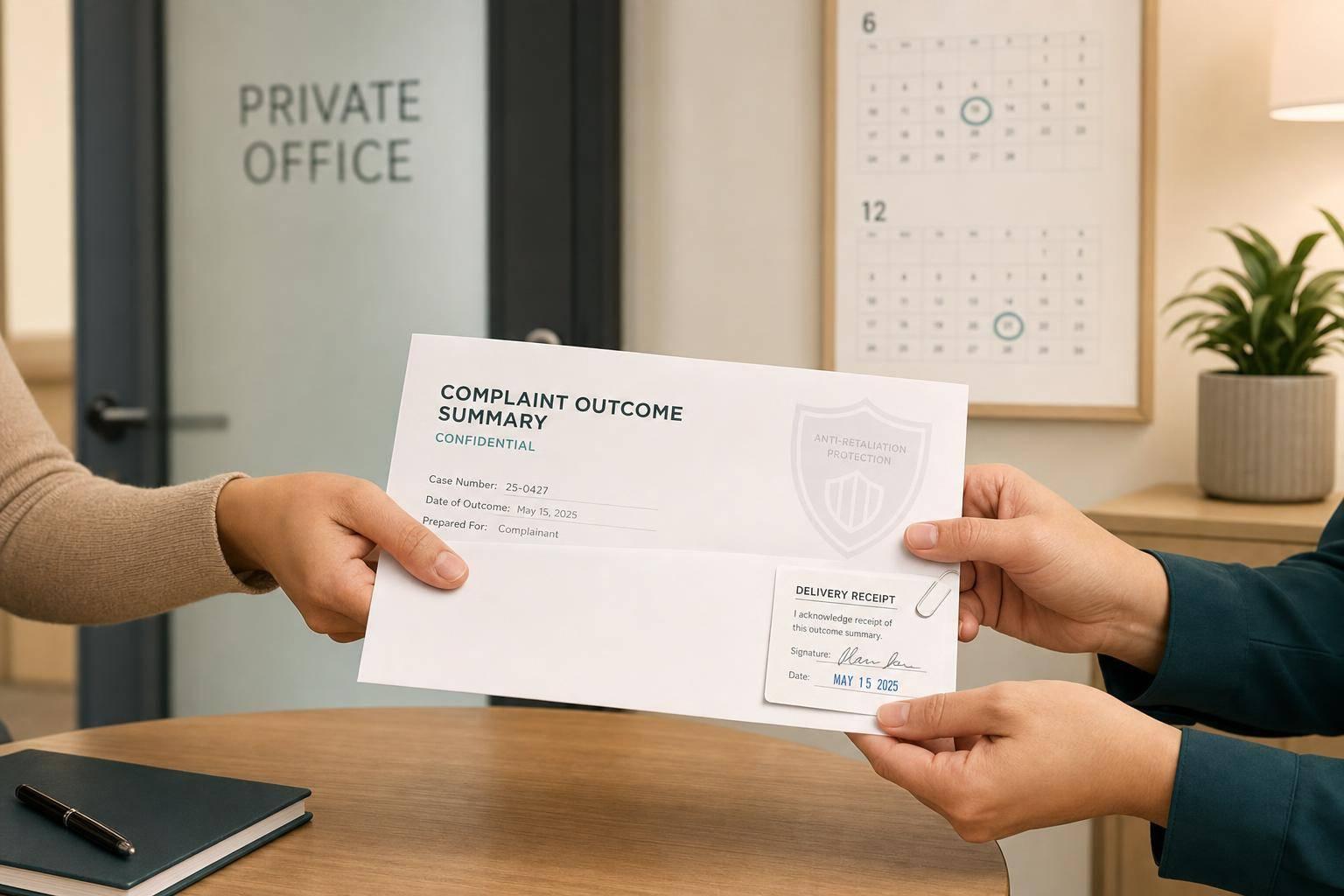
A complaint is not closed when the review ends. It is closed when the right people get the right message, in private, on time, and with follow-up in place.
If I had to boil this manual down, it would be this:
Here are the timing targets the article points to:
A few rules stand out. Do not use scheduling tools or schedule changes to announce an outcome. Do not share witness statements, private discipline details, or more than a client or scheduler needs. And do not promise total confidentiality. A better line is that information will be shared only as needed to address the matter.
In short, I read this as a process guide for keeping complaint closeout clear, private, and documented - especially in event staffing, where the next shift may be only days away and retaliation can show up in bookings, hours, or event access instead of a formal write-up.
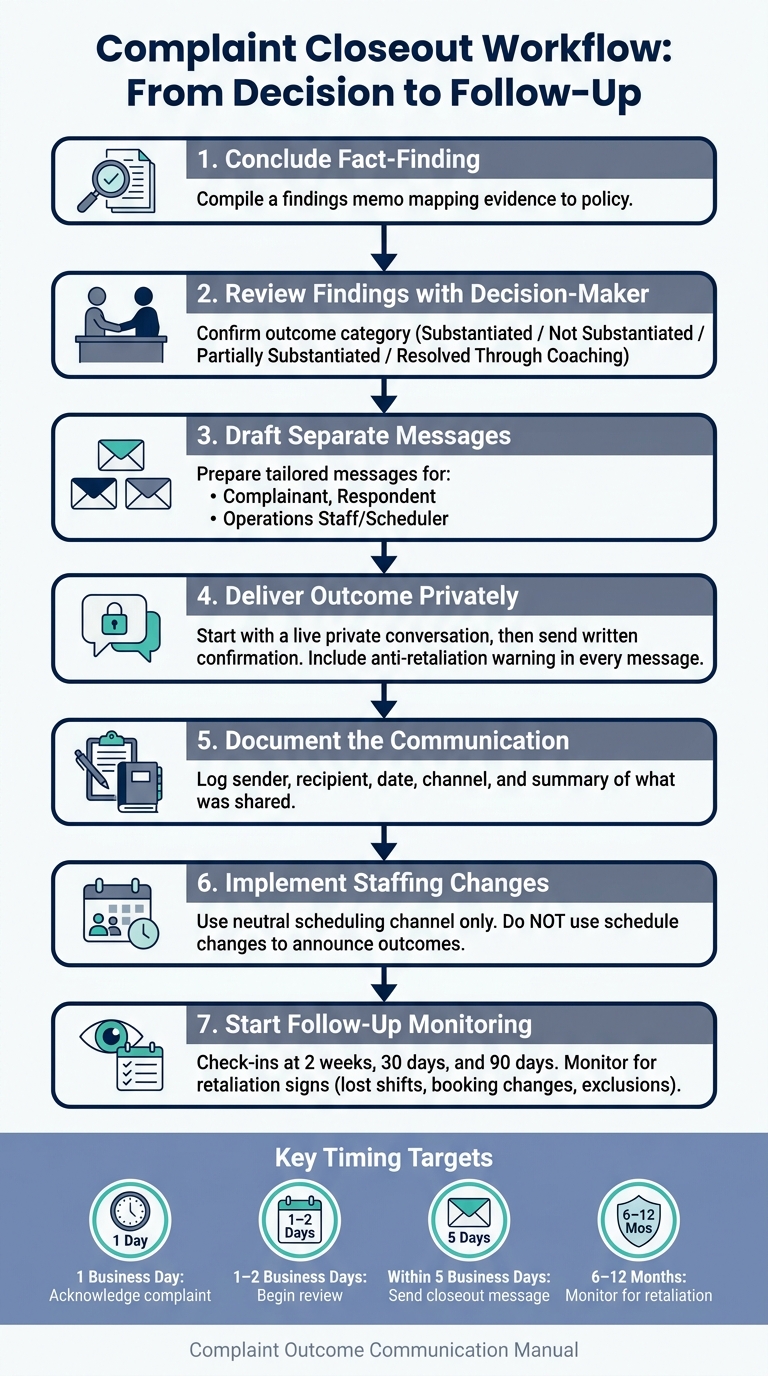
Complaint Closeout Workflow: From Decision to Follow-Up
Once disclosure limits are set, assign clear owners for findings, approval, and messaging. In small teams, one person may wear several hats across HR, operations, and scheduling. Even then, it helps to separate each step so the closeout stays consistent.
Here’s a clear split of responsibility:
| Role | Primary Responsibility |
|---|---|
| Complaint owner / HR lead | Coordinates the case, tracks deadlines, and makes sure the final communication is consistent and documented |
| Investigator | Gathers facts, interviews parties, and drafts the findings memo |
| Owner / general manager | Approves the final decision when policy or business risk calls for approval |
| Operations manager | Gets only the operational instructions needed to manage the team |
| Scheduler | Updates assignments and shift access without getting investigative details |
| Legal counsel | Reviews higher-risk matters such as harassment, retaliation, discrimination, or termination decisions |
One point matters more than it may seem: keep outcome recipients separate from the people drafting, approving, and routing the case. That separation helps prevent confusion and cuts down on loose internal sharing.
After fact-finding ends, the process should follow a fixed sequence. Skip the approval step or the documentation step, and legal risk can climb fast.
The working sequence looks like this:
For operational changes, address common scheduling problems using a neutral scheduling channel only. Quickstaff can handle shift reassignments, coverage updates, and manager reminders without mixing sensitive case details into shared event notes or broad team messages.
Don’t use a schedule change to announce an outcome. Tell the affected people first. Then update operations.
Once ownership and closeout steps are locked in, the next move is to set deadlines and pick the delivery channel.
Once a case is approved for closeout, timing becomes the last check that keeps the process on track. In event staffing, speed matters. If a complaint sits without a response, trust can fade fast - especially when the next event is only a few days away and schedules are already moving.
A solid baseline looks like this:
Faster acknowledgment and closeout can lower frustration and help stop the issue from getting worse.
Standard business-day timing works for most cases. Still, event staffing has a few pressure points where you need to move faster:
If a case takes longer than expected, send a status update. Keep it neutral. Explain the delay without oversharing, and give a revised date for the next update. Silence during a delay can look like neglect, even when the review is complex.
After timing is set, use the least visible channel that still reaches the worker fast.
Once the outcome is approved, the delivery channel shapes both privacy and speed. Match the method to the level of sensitivity and urgency. For serious cases, start with a private live conversation, then follow with written confirmation. Put simply: use the most private channel that still fits the moment.
| Channel | Best Use Case | Pros | Cons | Recordkeeping Notes |
|---|---|---|---|---|
| In-person meeting | Serious outcomes affecting employment status, scheduling access, or team relationships; worker is physically available in a safe, private setting | Allows real-time clarification; most respectful for high-stakes outcomes | Requires private space; not always possible for off-site staff | Log date, time, location, attendees, and a summary of what was communicated |
| Video call | Remote or off-site workers; urgent cases where in-person isn't feasible | Private, real-time, accessible from any location | Requires scheduling; technical issues possible | Follow up with written confirmation |
| Phone call | Urgent outcomes before the next shift; workers who are traveling or between events | Fast, private, accessible | No visual cues; harder to confirm receipt | Log call time and key points; send written confirmation |
| Formal email | Routine outcomes or written follow-up after a call | Creates a clear written record; easy to archive | Impersonal for serious matters; no guarantee of immediate reading | Retain the sent copy in the case file |
| Secure letter | Formal notices that need a durable record | High formality; strong audit trail | Slow delivery; not practical for urgent staffing changes | Note the date sent and delivery method; keep a copy in the secure case file |
| Verbal + written (combined) | Serious or complex outcomes; cases likely to prompt questions or emotional reactions | Balances empathy with documentation | Requires more coordination | Document the verbal conversation first, then attach the written follow-up to the same case record |
For after-hours event operations, the on-call manager should be able to make interim staffing decisions and communicate them right away through a private channel. The formal written outcome still follows the standard process, but interim communication cannot wait if the issue could affect the next shift.
Do not use a group message or shared channel. Operational updates, such as a shift reassignment, can move through scheduling tools after the affected people have been told in private. Quickstaff can route those updates cleanly, so shift changes and coverage adjustments stay separate from the sensitive case details.
After the decision is approved and the delivery channel is set, the message itself should be short, private, and easy to defend. Use these rules only after findings, approval, and corrective action are final.
Every outcome message should use the same basic structure. That keeps the response clear and easier to stand behind.
Seven elements belong in every outcome message:
Retaliation protections apply to people who take part in the process, so this reminder belongs in every outcome message.
Those elements give you the structure. The wording below helps make the message safer to send.
Share enough detail to explain the outcome, but not so much that you expose personnel records, witness identities, or legal strategy.
The table below shows what each party should and should not receive.
| Content Area | Complainant | Respondent | Witness |
|---|---|---|---|
| Outcome statement | Yes - substantiated, not substantiated, partially substantiated, or resolved | Yes - whether their conduct violated policy and what that means for next steps | Confirm only that the review is complete |
| Issue description | High-level type of concern raised | High-level description of allegations they were named in | General reference to a workplace conduct review |
| Corrective action detail | General terms only, such as appropriate corrective action is being taken | May include behavior expectations or training requirements; no formal discipline specifics | None |
| Witness statements | Not shared | Not shared | Not applicable |
| Other employee's discipline | Not disclosed | Not disclosed to others | Not disclosed |
| Anti-retaliation reminder | Yes - with contact info for reporting | Yes - with specific conduct expectations going forward | Yes - short and direct |
| Privacy note | Some details remain confidential. | Do not discuss this matter with coworkers or clients. | Your participation will be kept confidential. |
Don’t use false or lying language. If the concern was not substantiated, say there was not enough information to find a policy violation.
Don’t promise absolute confidentiality, either. Say information will be kept confidential to the extent possible. That wording is accurate and avoids promises you may not be able to keep.
That privacy standard should show up in every part of the final message.
Base every outcome message on dates, locations, roles, and behaviors - not personality judgments or guesses about intent.
For harassment complaints, you might say:
We reviewed your concerns about comments and behavior that occurred during the September 3, 2026 reception event. Based on interviews and other information gathered, we determined that certain conduct did not meet our anti-harassment and event conduct standards.
Where the concern was not substantiated, you might say:
We did not find enough information to conclude that policy was violated. We are reminding the team of our expectations for professional communication.
For attendance disputes:
We reviewed the attendance records and communications related to your shift on September 10, 2026. Based on our records, you were marked as a no-show because we did not receive notice within the required timeframe set out in our attendance and call-out policy.
For pay concerns, refer to timekeeping records and pay policies directly. Don’t suggest a wage violation unless that has already been confirmed.
Skip loaded phrases like outrageous, overblown, clearly malicious, and obviously lying. Plain, policy-based language is the safer and more respectful choice.
After delivery, document what was shared and move into follow-up monitoring.
Delivering the outcome isn't the finish line. What happens after closure tells you whether the issue stayed resolved or started to grow again. That means the next step is simple: monitor the situation and control the file.
For harassment, discrimination, safety, or repeat team conflict matters, set follow-up check-ins at about 2 weeks, 30 days, and 90 days after closure. If the matter carries more risk, check in more often. The two-week check helps confirm whether the employee still feels safe and whether the conduct changed right away. The 30-day check helps spot early warning signs, like missed shifts, assignment changes, or tension with supervisors. The 90-day check helps confirm that staffing decisions stayed steady and that retaliation did not surface later.
OSHA recommends periodic follow-up with the reporting employee to prevent retaliation.
In event staffing, retaliation often shows up in schedules and assignments, not in a formal personnel note. Watch for fewer bookings, lost repeat shifts, unexplained cancellations, exclusion from preferred events, or removal from client-facing work.
When you close a case, document the complainant's role, usual events, hours, pay rate, supervisor, and performance baseline. That baseline gives you something solid to compare against later. If a scheduling change happens, record the business reason. A valid change should be easy to explain and should match how similar staff are treated. A change that is sudden, unexplained, and out of step with past practice is much harder to defend.
For a set monitoring period - often six to twelve months after closure - require HR review and a written business reason before any materially adverse change affects the complainant or key witnesses. Quickstaff's scheduling visibility and reminder features can help managers flag follow-up tasks and watch whether an employee keeps receiving normal event assignments, while the complaint file stays in a separate, restricted system.
Once follow-up is set, lock the case file in a restricted repository. Keep investigation files out of scheduling tools, shared event folders, and regular personnel files. These records often include witness statements, disciplinary analysis, and privacy-protected details that supervisors, schedulers, and client contacts usually do not need to see.
The core file should include the outcome letter, follow-up log, staffing action notes, and evidence. Keep all of it in a restricted repository with role-based access.
A practical retention approach uses a clear written policy that matches legal requirements and internal record rules. Practical guides often place investigation files in a 3–7 year retention range, with legal review and litigation holds shaping the final timeline.
| Record Type | Recommended Retention Period |
|---|---|
| Intake notes and initial complaint | Per retention policy; often 3–7 years |
| Interview notes and witness statements | Per retention policy; often 3–7 years |
| Evidence (messages, schedules, client communications) | Per retention policy; longer if a litigation hold applies |
| Findings and outcome letters | Per retention policy; extend until final disposition of any charge or lawsuit if applicable |
| Staffing action notes | Per retention policy and personnel record rules |
| Follow-up logs | Per retention policy; often 3–7 years |
Store all complaint records in a restricted repository. Limit access to HR, investigators, legal counsel, and decision-makers when needed.
Set retention under a written policy, and stop destruction if a charge or lawsuit is filed.
Every complaint case should follow the same rules: a consistent workflow, prompt communication, privacy protection, anti-retaliation language in every message, documented follow-up, and secure record storage.
The final complaint outcome should come from the Response Owner listed in your escalation matrix. In most cases, that’s the event lead or the guest service captain for guest service complaints.
That person is responsible for deciding what happens next and for sharing the outcome based on the agreed escalation chain and response timelines.
If a complaint review is taking more time than expected, keep the complainant updated. That helps set clear expectations and shows the issue is still being handled.
Mark the issue as a carry-over item in your event logs so it stays visible and doesn't slip through the cracks.
Keep the record in chronological order. Log each update and every investigation step as it happens.
If the delay may affect the guest experience, use your escalation matrix to check whether added oversight or staffing changes are needed. Then document the final resolution in full.
Managers should keep an eye on what happens after a complaint closes. Trouble doesn't always show up in obvious ways. Sometimes it looks like being left off projects, getting worse shifts, or seeing performance ratings drop with no clear, objective reason.
Good documentation makes this much easier to spot. It lets you compare post-complaint treatment with the employee's earlier performance and day-to-day work history. That side-by-side view can help show whether something changed and when it changed.
It's also smart to watch for quieter signs, like lower engagement or team relationships starting to slip. And staff need a safe way to speak up if something feels off, so reporting channels should stay open and easy to use.