How to Document Intake for Job Bias Claims
September 3, 2026

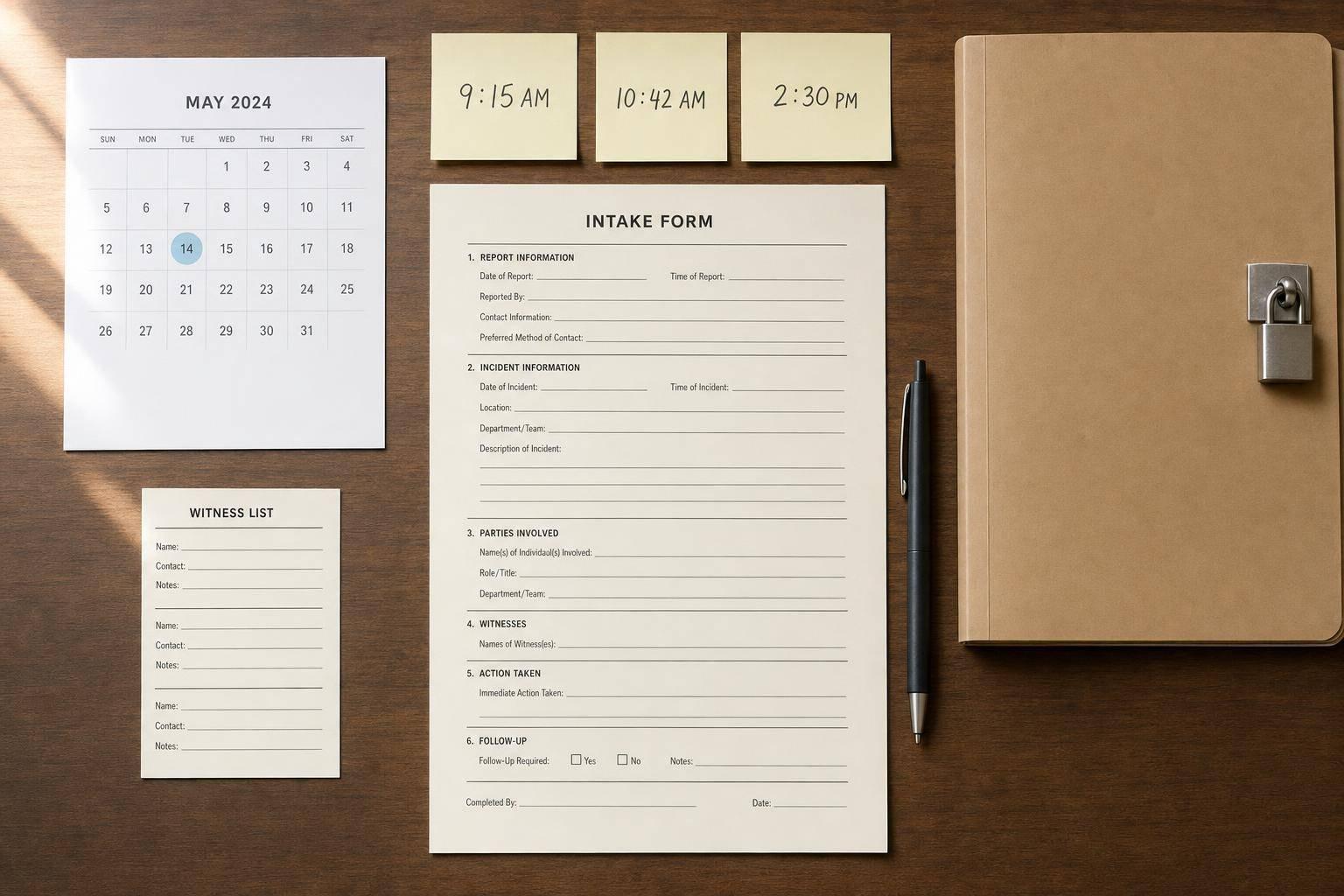
If the first complaint note is vague, the whole case can get harder to review. I’d treat intake notes as a formal record from day one: use one form, write only facts, log dates and actions in order, and keep all related records in one private file.
The article’s main point is simple: good intake documentation starts with a standard process. That means I would record the employee’s report in their words, note who, what, when, where, and any work impact, then connect that report to shift records, witness details, and follow-up steps. That matters even more in workplaces with changing venues, crews, and supervisors.
A few facts stand out:
At a glance, here’s what I’d do:
This gives you a clean starting record that can be checked against schedules, witness accounts, and later investigation notes.
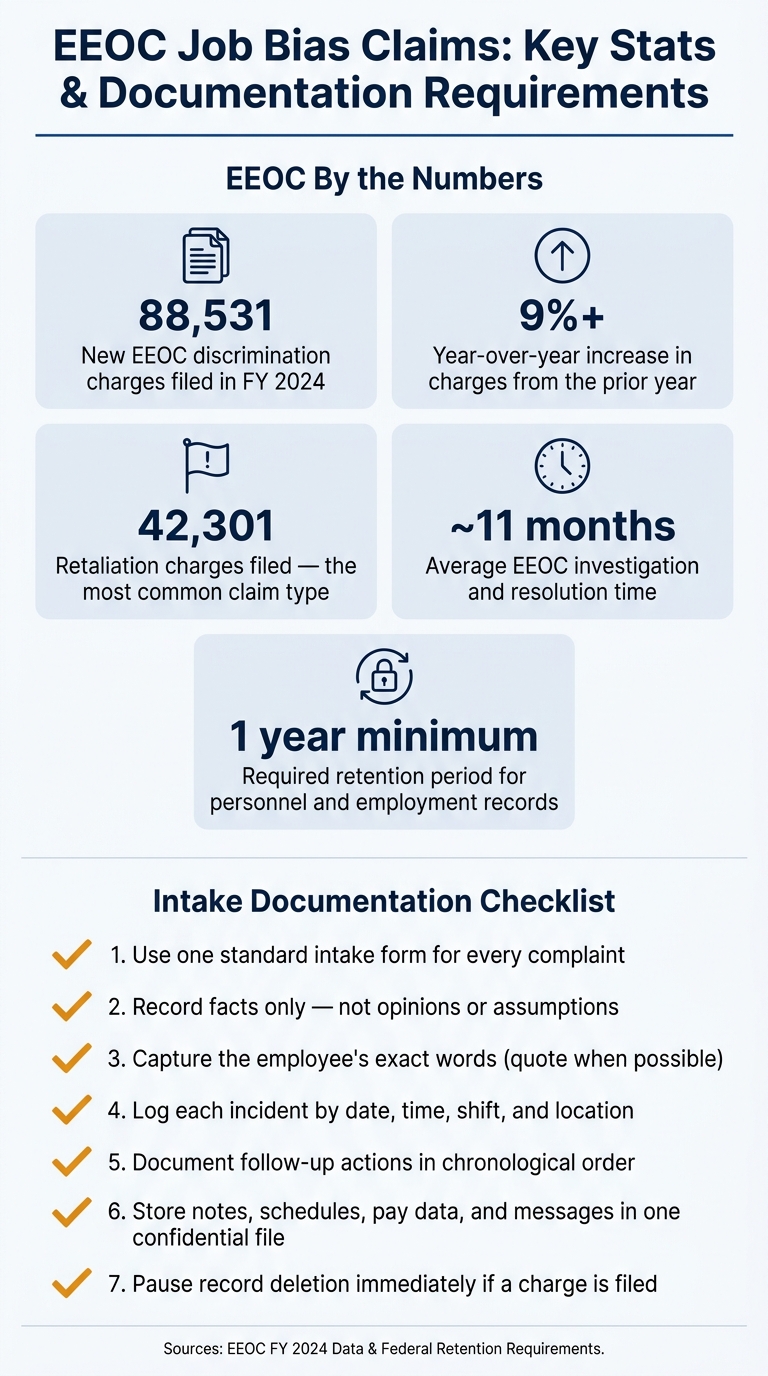
EEOC Job Bias Claims: Key Stats & Documentation Requirements
If you want the record to stay factual, use the same intake template for every complaint. One form for every report keeps the facts consistent and makes later comparisons much easier.
Every intake record should collect the same baseline details, no matter who receives the complaint or where the incident took place. Start with the complainant’s full name, job role, direct supervisor for that shift, and employment status, such as full-time employee, part-time employee, temporary agency staff, or independent contractor.
Then record the protected characteristic exactly as the complainant describes it, along with the alleged actor’s name and role. Add the exact date and time in U.S. format, such as 09/03/2026 at 7:10 p.m. Include the exact location too, like the venue name and the specific room, station, or work area.
Those details aren’t just paperwork. They help match the complaint to a specific shift, venue, and roster entry. That matters a lot in event-based workplaces, where staff and supervisors can change from one assignment to the next.
You should also capture witness names, roles, and contact details. Note whether each witness saw the incident firsthand or heard about it secondhand. If the complainant reports any effect on scheduling or pay, write that down as well, including removal from a high-tip event, loss of recurring bookings, or fewer hours after raising a concern. Those facts help connect the complaint to staffing records and event logs.
Free-form notes tend to miss the details that matter most. The exact event name may be left out. The date might be vague. Witness information, shift times, or pay and schedule effects can slip through the cracks.
A structured form fixes that by prompting the person taking the complaint to enter each required fact. Put simply, labeled fields lead to cleaner records.
A structured form also makes those facts easier to compare later.
| Field Category | Minimal Intake Fields | Preferred Comprehensive Fields |
|---|---|---|
| Complainant info | Name, role | Name, role, supervisor, employment status, agency or contracting company, assignment ID if applicable |
| Incident details | Date, brief description | Date (09/03/2026), time (7:10 p.m.), venue, room/station, event name |
| Bias context | General complaint type | Protected characteristic as stated by complainant, alleged actor's name and role |
| Witnesses | Names only | Names, roles, contact info, whether direct or secondhand |
| Prior reporting | Not captured | When, to whom, and how any prior concern was raised |
| Work impact | Not captured | Shift changes, assignment removal, pay discrepancy, reduced hours |
| Follow-up | Not captured | Who received the report, time HR was notified, interim actions taken |
For event-based businesses that manage staff across multiple venues and clients, the form should also connect each complaint to a specific event or shift record. Use Quickstaff or another centralized scheduling record to match the complaint to the correct event, shift, and roster.
Require that every complaint, no matter who receives it, be documented on the same form or digital template to avoid gaps and inconsistencies.
Once the intake form is complete, its fields should line up with the event log, schedule, and witness records.
Use the intake form to keep the bias complaint factual. Tell the employee you’re recording what they report, not making a judgment. Let them speak without interruption first. Then ask for a start-to-finish account and take brief notes.
After that first account, use follow-up questions to fill in the facts: who was there, what happened, when and where it happened, how often it happened, and how it affected the employee’s work. If it fits the situation, ask what identity factor the employee believes was involved and whether others in a similar role were treated differently.
Before you wrap up, summarize what you heard in neutral language and confirm that it’s accurate. Stick to the same field order used in the intake form so the notes stay easy to review side by side.
Your notes should clearly separate what you observed yourself from what the employee reported. Record the intake date and time, location, attendees, and any documents or records reviewed.
Use direct quotes when you can record the wording exactly. If the wording is exact, put it in quotes and attribute it to the employee’s statement. If you’re not sure the wording is exact, label it as paraphrased.
Be explicit when recording opinions, beliefs, and interpretations. Phrases like the employee stated, the employee reported, and the employee believes make it clear that the conclusion comes from the complainant, not the person taking notes.
Your notes should stay neutral. Avoid words that sound like a conclusion. Use neutral verbs such as reported, stated, described, alleged, denied, and observed.
If accounts conflict, document both versions without taking sides. For example, note that the employee alleged the supervisor made the statement, and that the supervisor denied making it and described the conversation in a different way. If later records change the picture, add a dated supplemental note instead of rewriting the original intake entry.
Treat this intake note as the baseline for the incident timeline. Later, you can match it against schedules, shifts, or venue records.
A bias complaint can stretch across several events, shifts, and supervisors. That can get messy fast. The fix is simple: document everything in chronological order so the record stays easy to follow.
After you finish the intake note, add it to a timeline alongside the matching shift records. That intake form should serve as the source document for the timeline.
Use three entry types: incident entries, report entries, and management action entries. Keep them in time order so a reviewer can move step by step from what happened, to when it was reported, to what management did next.
An incident entry should record:
A management action entry should track follow-up steps in the same way. Record the date and time for each action: when HR was notified, when witness interviews were scheduled, and when any interim staffing changes took effect. Each follow-up should appear as its own dated entry.
Each complaint entry should connect directly to the matching event and shift record. If the complaint covers three weekends, each event needs its own row with every field filled in.
Quickstaff can help keep event details, staff assignments, availability, and schedule changes in one place. Later, if management changes schedules - for example, moving the complainant to a different shift or separating staff tied to the complaint - those updates are logged in Quickstaff and can be used in the timeline as objective data points.
Use the timeline to line up the complaint with the schedule and any staffing changes. The table below shows how each event can be tied to the reported incident and the management response:
| Event / Shift | Alleged Incident | Management Action |
|---|---|---|
| 08/15/2026 – Smith Wedding, 6:30–10:30 PM, Ballroom (Banquet server) | Complainant reports captain assigned her bussing tasks while male servers handled table service. | 08/18/2026: Intake recorded; HR notified. 08/20/2026: Witness interviews scheduled. |
| 08/22/2026 – Jones Gala, 5:00–11:00 PM, Hotel Ballroom (Bartender) | Complainant states she was moved from front bar to back bar prep shortly after raising concern to captain. | 08/23/2026: Schedule updated to move the complainant off that shift. |
| 09/01/2026 – Thompson Reception, 5:00–10:00 PM, Hilton Grand Ballroom (Bartender) | Complainant reports she was again assigned to back bar prep while two male bartenders remained at guest-facing bar. | 09/03/2026: HR review started; pattern noted across three events. |
Update the table as new actions happen. The EEOC reports that the average time to investigate and resolve a charge was about 11 months in 2023. So this isn't paperwork you set aside and hope to find later. Keep the timeline current and easy to pull when needed.
Once the timeline is in place, keep the source records together in one confidential file. The goal is simple: protect the records, keep them unchanged, and hold them for the required time.
Keep one confidential complaint file separate from the general HR file. And don’t stop at the intake note. Save the records behind each timeline entry so anyone reviewing the matter later can see what happened and when.
That file should include the intake form, dated investigation notes, witness summaries, emails, texts, screenshots, event rosters, shift assignments, pay records, and hold notices.
A simple structure makes review much easier. Many teams use sections like:
Use one naming format every time, such as BiasComplaint_EmployeeName_YYYYMMDD. It sounds small, but it saves time when a file needs to be found fast.
For digital records, keep timestamped storage and version control in place. Save each update as a new version. Add dated addenda instead of replacing the original file. For finalized reports and key evidence, use a read-only format like a locked PDF so changes can’t be made without leaving a trail.
Access should be tight. Limit it to people with a need to know, such as HR, the investigating manager, legal counsel, and senior leadership when needed. Role-based permissions in your systems help keep that boundary in place.
Retention rules should apply to the entire complaint record, not just part of it. Keep records for at least the required minimum periods, and hold all related files if a charge or lawsuit is pending. Under EEOC rules, personnel and employment records must generally be kept for at least 1 year from the later of the date the record was created or the personnel action involved, and involuntary termination records must also be kept for 1 year from the termination date. If a charge is filed, keep all records tied to that charge - including complaint files, schedules, pay data, and communications - until final disposition of the charge or any related lawsuit.
Many employers set internal retention periods that go beyond the minimum and keep complaint and investigation files for several years. Any file linked to an active or anticipated charge should be tagged so it stays out of normal destruction cycles.
| Record Type | Baseline Retention | If EEOC Charge or Lawsuit Exists |
|---|---|---|
| Complaint-related personnel/employment records | At least 1 year from the later of record creation or the personnel action involved | Until final disposition |
| Involuntary termination records | 1 year from the termination date | Until final disposition if related to the charge |
| Complaint/investigation files | Keep in a separate confidential file | Preserve under litigation hold; do not destroy until cleared |
Use a standard intake form, record the facts, log dates and actions, and store the full file securely for the required retention period.
The employee filing the complaint should fill out the initial intake form. That helps keep the account firsthand and fact-based.
A manager or designated representative should review the form promptly and keep the write-up objective. Focus on clear details like scheduling, role, and shift information. If anything is missing or unclear, send the form back to the employee to complete before any further discussion.
Use objective records to check the employee’s account. Look at incident reports, security logs, AV timecodes, door counter data, photos, videos, and guest complaint records.
Start with the digital trail and build the timeline from that first. Then use staff input to fill in the blanks. Be clear about what came from hard records and what came from memory, and keep the raw source material with the final timeline.
Put a complaint file on hold when an appeal is pending.
If a worker disputes a charge or files an EEOC charge, keep the related personnel and employment records longer than the standard retention period.


