Staffing Agency vs Client: Joint Employer Rules
September 21, 2026

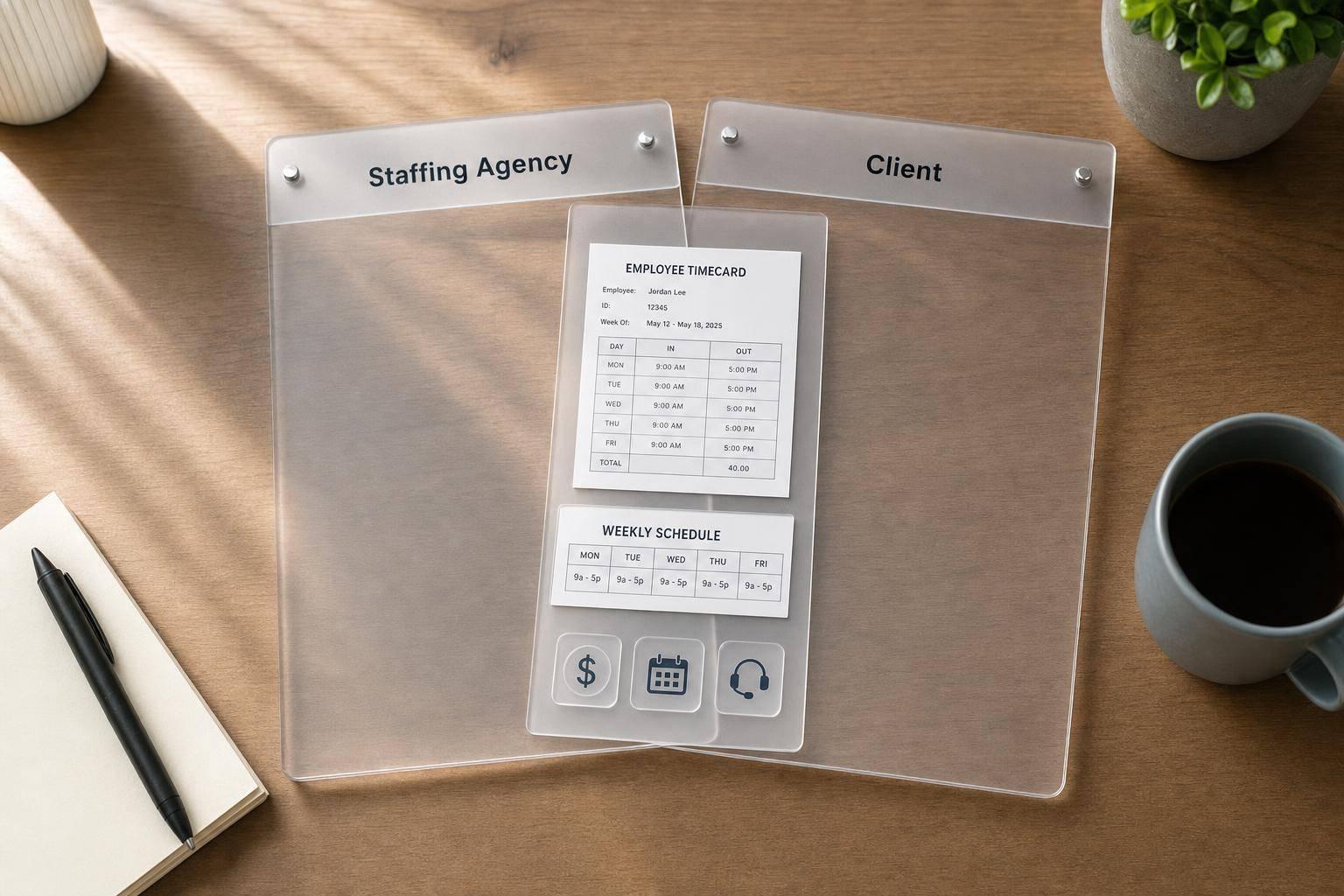
Yes - both the staffing agency and the client can be liable for the same temp worker. In the U.S., that usually turns on one thing: who controls the work. If the agency hires and pays the worker, but the client sets hours, directs tasks, controls breaks, or sends the worker home, both sides may be treated as employers.
Here’s the short version:
One data point stands out: OSHA’s temp worker review found citations against both parties in 42 of 54 cases. That shows the same pattern seen in wage and discrimination claims: when the handoff is messy, liability often lands on both sides.
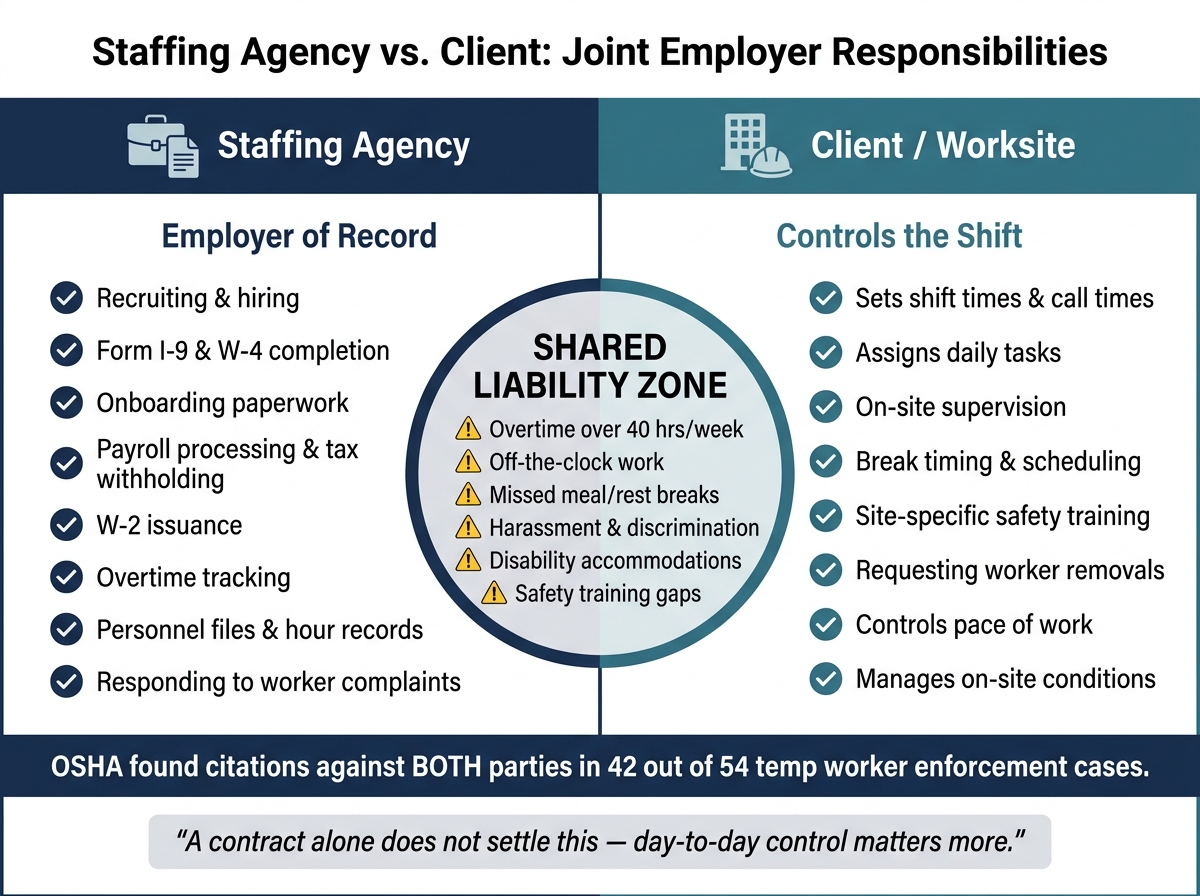
Staffing Agency vs. Client: Who Owns What in Joint Employment
| Topic | Staffing Agency | Client |
|---|---|---|
| Main role | Employer of record | Runs the worksite |
| Usually handles | Recruiting, hiring, forms, payroll, tax withholding, W-2s | Schedules, task assignments, break timing, on-site direction |
| Can trigger joint employer status? | Yes | Yes |
| Common exposure | Pay errors, bad records, poor follow-up on complaints | Off-the-clock work, missed breaks, harassment, unsafe site conditions |
| What courts and agencies look at | Control over pay and job terms | Control over daily work and conditions |
If I were explaining this to a team in one line, I’d say this: the agency often owns the paperwork, the client often owns the shift, and the law can treat both as responsible for the worker.
Joint employment means two separate businesses - such as a staffing agency and its client - can both count as the employer of the same worker at the same time. When that happens, both businesses share legal responsibility for following employment law, and each can be on the hook for the full claim amount, not just part of it. This can come up under several federal laws, including wage-and-hour, labor, discrimination, accommodation, and safety rules. At the center of all of it is one issue: control.
The main question is simple: who controls the work? Courts and enforcement agencies look at who sets pay, schedules, supervision, discipline, removal, and worksite safety. A client doesn't need total control to be treated as a joint employer. Shared control over key terms of the job can be enough.
With temporary event staff, this often shows up in plain day-to-day decisions. The agency may take care of hiring, payroll, and personnel files. But if the client sets shift start times and floor duties, and can send a worker home early, that level of control can support joint employer status even if the staffing agency runs payroll. That's often where liability starts to come into view.
The main risk areas are overtime and timekeeping mistakes, discrimination, accommodation failures, and unsafe worksite conditions. If records are missing or wrong, both the agency and the client can face liability. The next section separates agency duties from client duties.
The split usually comes down to control. The staffing agency handles the back-office employment work. The client runs the day-to-day job site. When those roles start to blur, joint employer risk starts to creep in.
Here’s how that split usually looks:
| Duty | Staffing Agency | Client | Notes |
|---|---|---|---|
| Recruiting | Usually leads sourcing and applicant flow | May request headcount and skill needs | Shared when client helps select workers |
| Hiring | Usually hires as employer of record | May approve or reject placements | Shared if client effectively controls selection |
| Onboarding paperwork | Usually handles forms and acknowledgments | May require site rules or badges | Shared when client adds required documents |
| Payroll | Usually processes payroll | May submit or confirm hours worked | Shared when client controls time reporting |
| Wage payment | Usually pays workers in U.S. dollars | Usually does not pay directly | Agency usually primary |
| Scheduling input | May offer worker availability and fill shifts | Often sets event dates, call times, and staffing levels | Shared |
| Break control | May provide policy guidance | Usually controls when breaks happen during the shift | Shared risk area |
| On-site supervision | Usually limited when not present | Usually directs daily work and task changes | Client often primary |
Start with the agency side, because that’s usually where hiring and pay begin.
The staffing agency is the employer of record. It recruits candidates, screens them, and formally hires them. It also handles onboarding paperwork, including Form W-4, policy acknowledgments, and any required consent forms. On top of that, the agency verifies work authorization by completing and keeping Form I-9 under federal immigration rules.
Pay duties usually sit with the agency too. The agency processes payroll, tracks overtime, withholds taxes, and issues W-2s. It also keeps personnel files, hour records, and injury logs for the time periods required under federal and state law.
Once that part is done, the client usually takes over at the worksite.
The client controls what happens on the ground. It sets event dates, call times, and staffing levels. It assigns tasks, changes those tasks mid-shift when needed, and enforces site rules.
Break control usually follows the same pattern. At the worksite, the client’s policies tend to drive when breaks happen. During busy service periods, the client’s floor manager often decides when workers can step away. That kind of on-site control is a big reason joint employer analysis often brings clients into shared wage-and-hour liability, even if they never process payroll.
Some duties don’t fit neatly on one side.
Safety training is shared. The agency gives general orientation. The client handles site-specific training, like hazards, exits, and PPE.
Discipline works the same way. The agency may discipline or terminate the worker’s employment. The client, though, controls whether that person remains on a certain assignment and can ask for removal from a site for performance or conduct reasons.
Equal treatment also falls on both parties. Temporary workers must get the same anti-harassment and accommodation protections as direct employees. If a client asks for a worker to be removed for a protected reason, the agency can’t just rubber-stamp it. It has to review the request before taking action.
Once duties are split, the next problem is simple: if no one keeps a close eye on them, things fall apart fast. In event staffing, unclear responsibility tends to show up in obvious places first - pay mistakes, ignored complaints, and safety problems.
Here are the main risk areas in event staffing:
| Risk area | Typical owner | Example in event staffing | Why liability can be shared |
|---|---|---|---|
| Timekeeping errors | Shared | Setup starts before clock-in | Client controls the start of work; agency keeps payroll records |
| Overtime miscalculation | Shared | Cleanup pushes hours over 40 | Agency pays wages; client controls added hours |
| Missed meal or rest breaks | Shared | Banquet staff miss breaks | Client controls the pace of work; both parties can fail to track it |
| Unpaid pre-shift or post-shift work | Shared | Required briefing before clock-in | Client may require the work; agency may fail to pay for it |
| Harassment at the venue | Primarily client, often shared | Supervisor harasses staff on-site | Client controls day-to-day conditions; agency must respond to complaints |
| Unequal assignments or removals | Shared | Worker removed from guest-facing roles for discriminatory reasons | Both parties may influence assignment decisions |
| Disability accommodation failure | Shared | No coordination on modified on-site task | Agency and client each control part of the process |
| Missing site-specific safety instructions | Primarily client, often shared | No warning about hot equipment or loading-dock hazards | Client knows site hazards; agency may still have training duties |
The biggest trouble spots usually start with time and pay, which can make it difficult to keep the best event staff. The most common disputes involve off-the-clock work, bad time records, and overtime mistakes. Under the FLSA, overtime is based on total hours worked across both employers in the same workweek. So if a worker goes over 40 hours, both joint employers can be liable for overtime pay.
This often begins with normal last-minute changes. An on-site supervisor tells staff to start setup before the shift, sit through a pre-event briefing, or stay late for cleanup. The client makes those calls in the moment, but the agency may not hear about them until much later.
That’s where the gap opens. If neither side has a clear way to record that extra time, those hours may never make it onto the timesheet. Then the unpaid time turns into a back-wage claim.
The same kind of gap shows up with complaints, accommodations, and safety at the venue. Harassment and discrimination claims often follow the same pattern: the client runs the day-to-day work setting, but the agency can still get pulled into the case. EEOC guidance makes clear that a staffing firm can be liable for a client's discriminatory conduct if it knew or should have known and failed to take corrective action. If a worker is removed for a discriminatory reason, both entities may face exposure.
Disability accommodations are one of the easiest places for things to go wrong. The agency may know a worker’s restrictions, while the client controls the layout of the site, the pace of work, and who does which task. If those two sides don’t talk before the event begins, the accommodation may not happen at all. A worker who needs to avoid heavy lifting may end up carrying trays for an entire shift because no one at the venue was told about the restriction.
Safety gaps work the same way. OSHA's Temporary Worker Initiative found citations against both parties in 42 of 54 enforcement cases. One side may assume the other handled the warning, the training, or the instructions. Meanwhile, temp workers end up near hot equipment, busy loading docks, or unstable staging without clear direction.
Those are the kinds of failures that happen when each side controls part of the job, but neither side owns the handoff.
Once the risk points are on the table, the next step is simple: document the handoff the way it happens in day-to-day work. The contract should match the workflow people actually follow, because courts look at real control, not just the label on the agreement.
Be specific about who handles recruiting, onboarding, payroll, schedule changes, break timing, supervision, and discipline. If a client manager gives workers their day-to-day assignments, say so plainly. Don’t dance around it.
It also helps to spell out how a client asks for a worker’s removal and how the agency responds. That part matters more than many teams think. If a removal is handled poorly, both sides can face retaliation risk.
Add indemnification language to sort out internal costs if there’s a dispute. Just don’t treat that as a shield. It does not remove joint-employer risk.
This is where scheduling software earns its keep. In event staffing, shift extensions, call-offs, and assignment changes happen on the fly. When those changes live in text messages or hallway conversations, the paper trail basically disappears.
A centralized scheduling platform fixes that problem. If schedule updates, reminders, and staff messages all run through one system, the agency and the client share a timestamped record of what was said, when it was sent, and who sent it. That record can matter a lot when there’s a dispute about late shifts or missed breaks.
For event staffing agencies handling temporary staff across many venues, Quickstaff puts scheduling, availability, waitlists, reminders, and staff messaging into one mobile-friendly system.
The cleanest split in event staffing usually looks like this:
That line can blur fast. And when it does, both sides may face liability for wage-and-hour mistakes, harassment claims, and safety issues at the worksite. The fix is to document who controls each decision, keep the handoff clear, and keep records of schedule changes, breaks, and removals.
A client becomes a joint employer when it controls the working relationship, no matter what the contract says.
This often happens when the client handles key parts of the job, such as schedules, on-site duties, tools, or discipline. When that happens, the client may share legal responsibility with the staffing agency for wage compliance, safety training, and anti-discrimination measures.
Yes. Under joint employer rules, both the staffing agency and the client or host employer can be liable for wage-and-hour violations, including unpaid overtime for non-exempt workers.
In plain terms, if both parties have a hand in things like scheduling, work conditions, or timekeeping, both can end up on the hook when overtime is missed or goes unpaid.
Under joint employer rules, both the staffing agency and the host employer are on the hook for preventing and addressing harassment and discrimination. If something happens, both sides need to act fast and take corrective action.
That duty also extends to harassment by non-employees, like guests or contractors. On top of that, employers should give workers more than one way to report issues and make sure investigations stay impartial.