5 Retention Metrics for Event Staff Management
March 25, 2026


Keeping event staff engaged and retained is a challenge many managers face. High turnover disrupts operations, increases costs, and impacts service quality, though scheduling software benefits can help mitigate these issues. This article outlines five key metrics that help you understand and improve staff retention:

5 Key Retention Metrics for Event Staff Management
Turnover rate measures how often event staff leave their roles, offering a clear signal of team stability - or lack thereof. A high turnover rate often points to deeper challenges, like staff burnout, mismatched expectations during hiring, or inadequate support from management. And it’s not just about finding replacements - it’s expensive. Replacing an event staff member can cost between 16% and 150% of their annual salary.
Tracking turnover is straightforward and can be done monthly, quarterly, or annually to uncover trends. For example, you might notice spikes during specific seasons or see that many employees leave within their first 90 days. Breaking this data down by role or event type can further pinpoint where retention efforts should focus. These insights directly influence daily operations and performance.
High turnover doesn’t just mean hiring headaches - it impacts the entire team. Remaining staff often take on extra responsibilities, which can lead to burnout and even more resignations. Plus, when experienced team members leave, they take valuable knowledge with them - like how the company operates or what specific clients prefer. This loss can slow onboarding for new hires and disrupt overall team efficiency.
Given the scheduling complexities in event management, tackling turnover is a priority. Monitoring patterns can help you act strategically. For instance, if many employees quit within their first 90 days, it might be time to rethink onboarding or introduce mentorship programs. If turnover spikes after major events, it could signal issues like poor communication or insufficient staffing levels. Becki Cross, Managing Director of Events Northern Ltd, highlights the importance of clear pre-event communication:
"This [pre-event briefing] will include practical and logistical information such as what to wear, directions... who to ring in case of problems... We also outline their anticipated tasks with a chronological timeline of the day and their responsibilities".
Implementing such strategies can address underlying issues before turnover spirals out of control.
Retention rate is essentially the flip side of turnover - it reflects the percentage of employees who stay with an organization over a specific time frame. In event staffing, it tracks how many team members return for subsequent assignments or seasons. A high retention rate shows that staff feel appreciated, satisfied with their work environment, pay, and the support they receive. Considering that the turnover rate for temporary and contract staff in 2022 hit a staggering 419%, achieving a retention rate of 90% or higher is seen as a strong benchmark in the industry. This metric plays a key role in maintaining operational stability and managing costs effectively.
Retention rate is straightforward to calculate: divide the number of employees at the end of a period by the number at the start, then multiply by 100. Alternatively, for event-specific metrics, divide the number of returning staff by the total staff from the previous event or season. Monitoring this metric annually or seasonally can reveal trends in staff loyalty and help identify areas for improvement. Tools like Quickstaff make tracking even easier by managing talent profiles and return rates digitally.
Keeping experienced event staff on board is a money-saver. It cuts down on recruitment and training expenses while also streamlining operations. Returning staff are already familiar with event protocols, which shortens onboarding time and reduces mistakes. Lisa Schwarz, Senior Director of Global Product Marketing at NetSuite, sums it up well:
"The retention rate is the inverse of the turnover rate, as it measures the percentage of employees who remain with an organization over a certain period".
If retention rates are low, it’s a clear sign to evaluate areas like management practices, onboarding experiences, and pay structures. For example, employees with less than two years of tenure are 38% more likely to leave within the next 12 months. To address this, focus on engaging employees early. Strategies like buddy systems and offering professional development opportunities can help build stronger connections and encourage long-term commitment.
The eNPS survey asks a simple but powerful question: "How likely are you to recommend this company as a great place to work?" Employees respond on a 0–10 scale, and their answers fall into three categories: Promoters (9–10), Passives (7–8), and Detractors (0–6). This metric acts as an early warning system for potential retention problems, identifying dissatisfaction before it leads to resignations. In industries where feeling undervalued doubles an employee's likelihood of leaving within a year, spotting these patterns early can save substantial turnover costs. As Jim Schiel from Artisan Agility highlights, "eNPS is a leading indicator of retention issues before people quit".
Calculating eNPS is straightforward: subtract the percentage of Detractors from the percentage of Promoters. Short online surveys, conducted after events or at the end of a season, make it easy to collect feedback without burdening employees. Breaking down the results by event type, location, or supervisor can reveal specific problem areas. For example, if one supervisor's team consistently scores poorly, it may signal a leadership issue that needs immediate attention.
Employee sentiment directly impacts productivity. Research shows that satisfied employees are 13% more productive. Given that 79% of event professionals report their jobs are more stressful than ever, monitoring emotional engagement is critical to avoiding burnout. High eNPS scores reflect a committed and stable workforce, creating a foundation for better performance and smoother operations.
When eNPS scores dip, it's crucial to act quickly. Conducting stay interviews with top-performing employees can uncover concerns early. Pair surveys with open-ended questions or individual conversations to understand the reasons behind the scores. The key is to follow through - employees are far more motivated when their feedback drives real change. In fact, 78% of workers report putting in more effort when their contributions are recognized. If recognition is a recurring issue, consider implementing structured acknowledgment programs. Employees are more likely to stay when their voices lead to meaningful improvements in how events are managed.
Tools like Quickstaff can help streamline survey distribution and ensure timely follow-ups, making it easier to act on feedback effectively.
Employee engagement scores reflect how connected and committed your team feels to their work and the organization. This metric digs deeper than basic job satisfaction - it reveals whether employees take pride in their roles and view themselves as essential to the company's mission rather than just placeholders. Engaged employees are more inclined to stick around and even recommend your company to others. In the high-pressure world of event management, where 79% of professionals report escalating stress levels, tracking engagement becomes critical to spotting morale issues before they lead to turnover.
To determine your employee engagement score, use this formula: (Number of satisfied responses ÷ Total responses) × 100. A healthy range typically falls between 75% and 85%. Collect data through quick pulse surveys after events, personal check-ins, and supervisor observations. Asking straightforward questions like, "What do you enjoy most and least about your job?" can help uncover hidden stressors, such as unpredictable scheduling. Digital platforms can simplify the process by centralizing feedback and monitoring recognition trends across various event sites.
A direct link exists between employee engagement and performance: engaged workers deliver a 13% productivity increase. When staff feel appreciated and connected, they approach tasks with more energy and focus, ensuring smoother event operations and improved guest satisfaction. On the flip side, low engagement can result in unexpected absences, which drive up costs. Even for freelance or project-based event staff, fostering engagement builds loyalty, encouraging them to return for future assignments.
If engagement scores dip, act quickly. Encourage top-performing employees to lead briefings or training sessions to highlight growth opportunities, and introduce recognition programs to boost morale. Offer detailed pre-event briefings that cover timelines, transportation details, and reporting structures to minimize stress. Maintain a staff utilization rate of 70% to 80% instead of overloading workers at 100%, which can help prevent burnout.
Tools like Quickstaff simplify team communication and scheduling, ensuring consistent engagement across your workforce. By prioritizing engagement, you lay the groundwork for tracking retention through metrics like average employment duration.
When assessing workforce stability, the average length of employment provides a valuable lens. This metric reflects how long employees typically stay, offering insights into overall staff retention. For example, in the leisure and hospitality sector, the median employee tenure was just 2.3 years as of early 2020. This matters because employees with less than two years of tenure are 38% more likely to leave within the next year. Retaining long-term employees isn’t just about loyalty - it’s about safeguarding institutional knowledge that ensures consistent service quality while reducing the need for constant retraining.
Calculating average tenure is straightforward: take the total years of employment for all current employees and divide it by the number of employees. Many event managers rely on Human Resource Management Systems to track hiring and termination trends in real time. Additionally, CRM tools can monitor performance history for temporary staff assignments. Lisa Schwarz, Senior Director of Global Product Marketing at NetSuite, highlights the importance of this metric:
"The average tenure of an organization's employees is another metric that can provide insight into an organization's human resources initiatives".
By integrating this data with other retention metrics, businesses can make informed decisions to improve operations.
Longer employee tenure doesn’t just stabilize the workforce - it also boosts operational efficiency. As Mohau Vuma from Encore Nationwide explains:
"Returning workers are familiar with your agency's standards, client expectations, and event protocols, leading to smoother operations and fewer errors".
Experienced staff reduce the need for supervision, maintain higher service standards, and help cut operational costs.
A decline in average tenure can signal underlying issues like weak onboarding practices or uncompetitive compensation. To counteract this, you can take steps to show appreciation for your long-term, high-performing staff. For example, invite them to train new hires or lead team meetings - this reinforces their value. Offering professional growth opportunities, such as online courses, mentorship programs, or clear career advancement paths, can also encourage employees to stay. Tools like Quickstaff help streamline communication and scheduling, reducing the stress that can lead to turnover. Additionally, tracking performance allows you to provide tailored opportunities for temporary staff, making them feel like integral members of the team.
Tracking retention metrics helps create a more stable workforce while keeping costs under control. By focusing on key indicators like turnover rates, retention rates, employee net promoter scores (eNPS), engagement scores, and average employment length, managers can replace guesswork with data-driven decisions.
The benefits are hard to ignore. For instance, engaged employees can increase productivity by 13%, while unplanned absences can eat up as much as 8.7% of annual payroll. Retaining experienced staff ensures smoother event operations, fewer mistakes, and a stronger reputation with clients.
Quickstaff tackles common hurdles like scheduling and communication challenges. Since 2013, Quickstaff has been used to organize staffing for over 20,000 events. By centralizing event details, schedules, and assignments, it eliminates confusion about roles and responsibilities. This clarity leads to happier employees who are more likely to stick around. Better communication naturally boosts retention metrics over time.
Tracking the turnover rate is a simple yet effective way to gauge staff retention. By monitoring this metric, you can spot trends and pinpoint areas that may need attention to better retain your event staff.
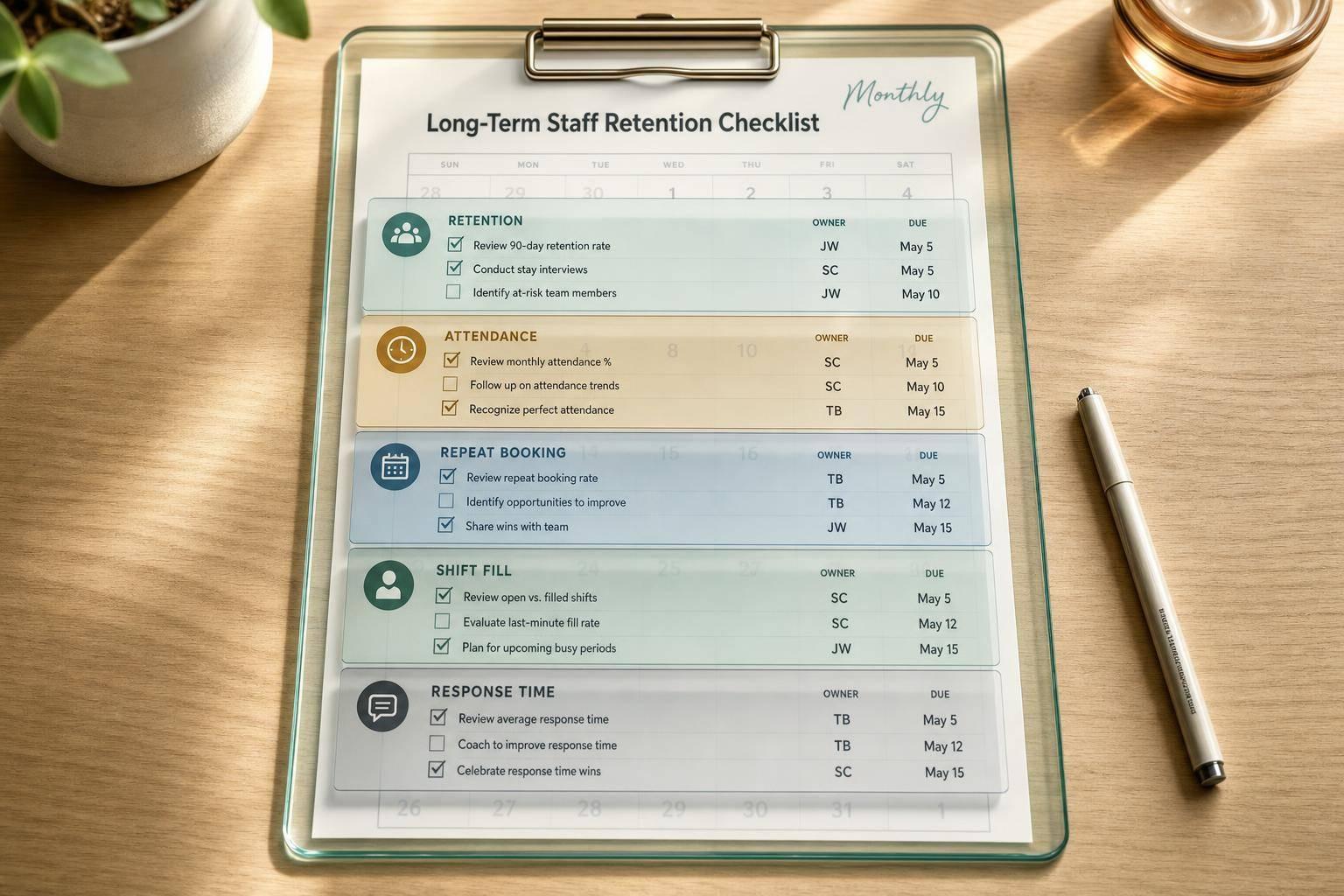
To manage event staff effectively, it's important to keep an eye on key metrics like retention, turnover, and performance KPIs. These should be tracked regularly, such as monthly or after each event, to identify patterns and make timely adjustments.
Retention metrics are typically reviewed on a monthly basis, while performance KPIs are often assessed per event or weekly. This approach helps ensure steady improvement and allows you to address any issues before they escalate.
If you notice a drop in eNPS or employee engagement, it might be time to reassess a few key areas. Start by refining your recruitment process to ensure you're bringing in candidates who align well with your company culture and values. Offering opportunities for professional growth and assigning meaningful responsibilities can also inspire and energize your team.
On the retention side, consider strategies like improving compensation or benefits packages. Building trust and maintaining open communication from day one can go a long way in creating a positive work environment. These actions can help tackle the root causes of dissatisfaction and improve overall employee morale.