Post-Emergency Review Methods for Event Managers
August 3, 2026

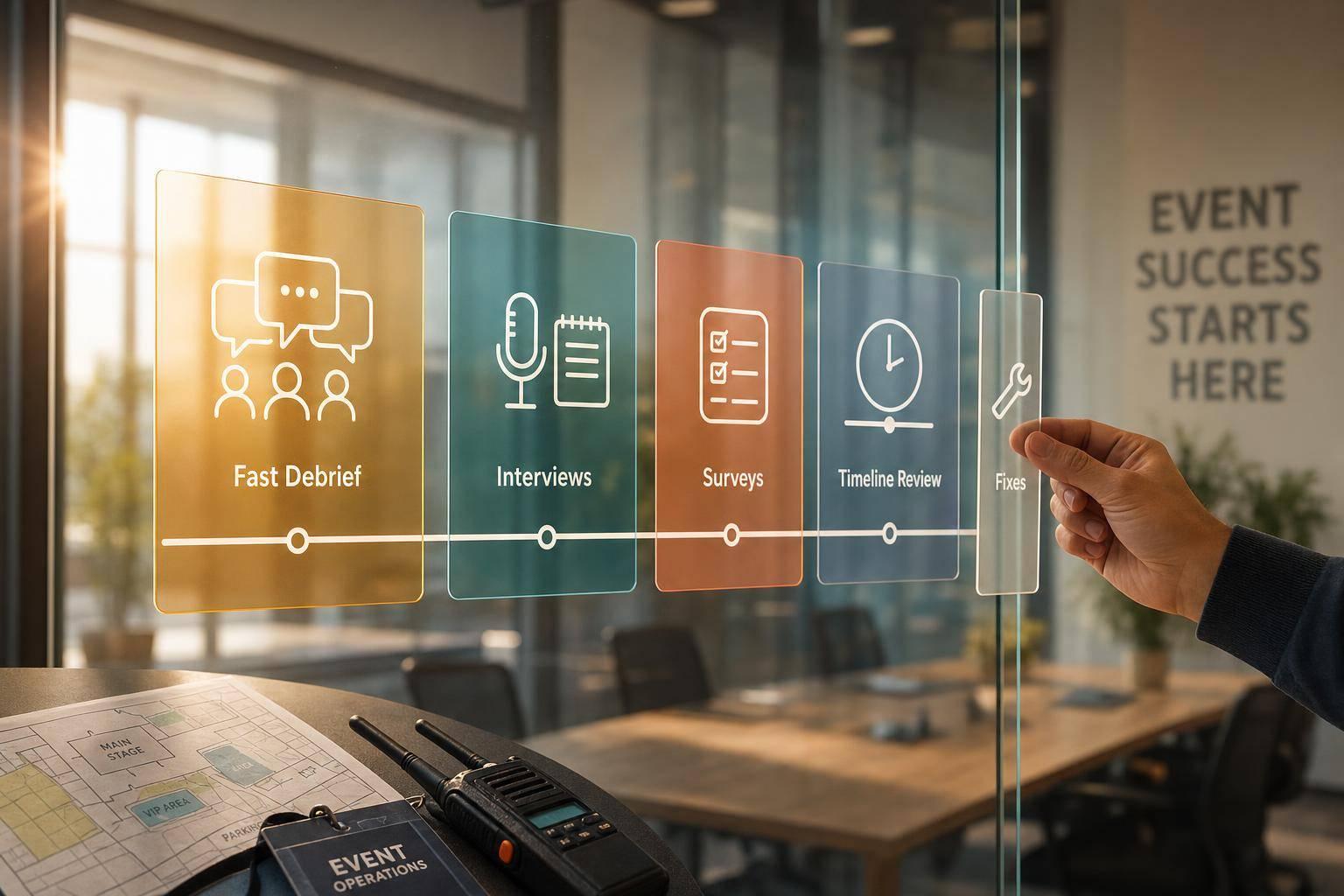
If you only do one thing after an event emergency, review it fast and use more than one method. For most U.S. event teams, the best path is simple: run a group debrief within 24–72 hours, then add interviews, surveys, or a timeline review based on how serious the incident was and how much proof you need.
Here’s the short version:
The article’s main point is simple: no single review method does everything well. Debriefs are fast but can miss quiet voices. Interviews go deeper but take more time. Surveys scale well but can stay surface-level. Timeline reviews are strongest when you need a dated record for insurance, legal, or venue follow-up.
One figure stands out: 94% of respondents in one study wanted reviews within 24 hours and wanted both written and face-to-face review formats. Another finding: teams that used debriefs saw about a 25% lift in team performance compared with no debrief.
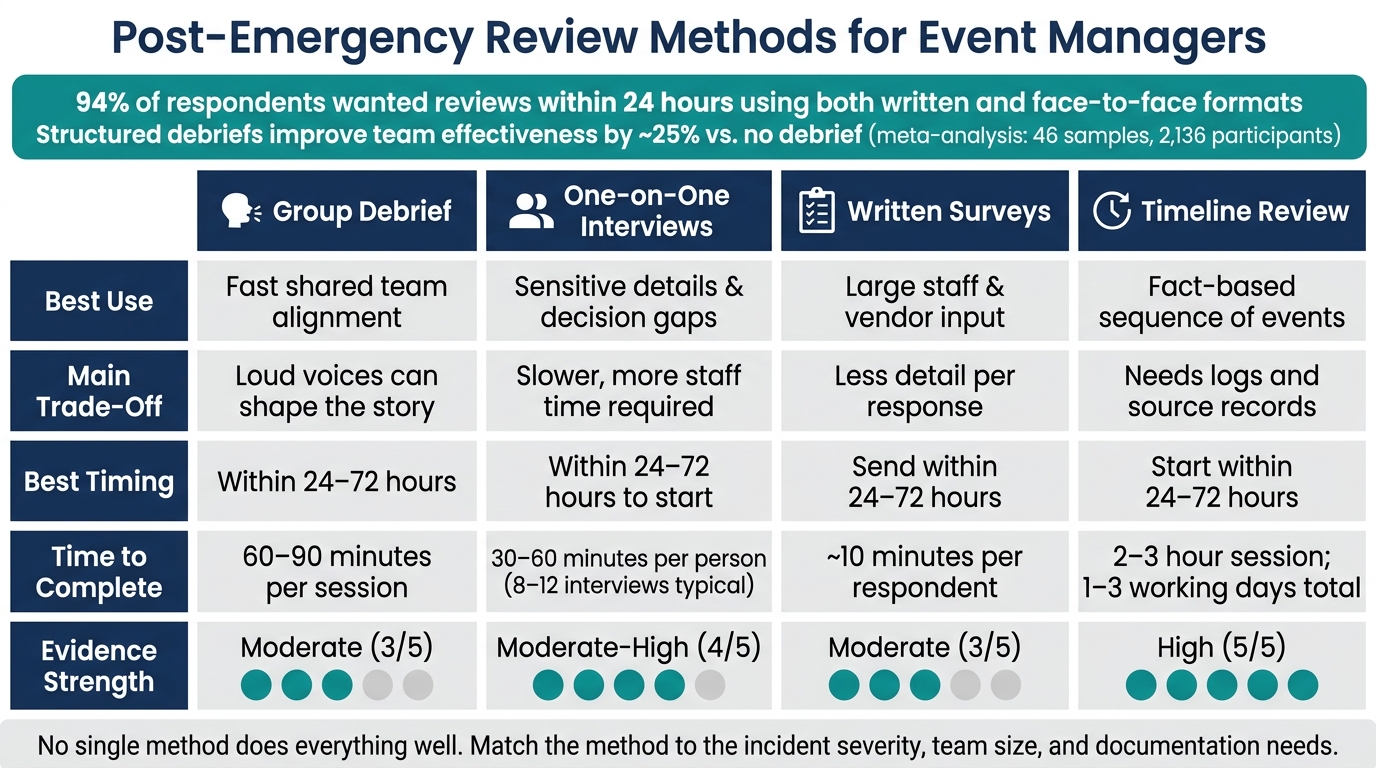
Post-Emergency Review Methods: Quick Comparison Guide for Event Managers
| Method | Best Use | Main Trade-Off | Best Timing |
|---|---|---|---|
| Group debrief | Fast shared review | Loud voices can shape the story | Within 24–72 hours |
| One-on-one interviews | Sensitive details and decision gaps | Slower, more staff time | Within 24–72 hours to start |
| Written surveys | Large staff and vendor input | Less detail per response | Send within 24–72 hours |
| Timeline review | Fact-based sequence of events | Needs logs and source records | Start within 24–72 hours |
If I were choosing a review plan, I’d keep it practical: use the lightest method that still gives you the facts you need. For a small medical issue, a debrief and short survey may be enough. For a security issue, weather evacuation, or reportable incident, I’d use a mixed approach with a timeline review at the center.
A group debrief is a structured conversation with your event team and key partners after an emergency. The goal is simple: rebuild what happened, confirm what worked, and name what needs to change. Keep it focused on facts, not blame, so the team can move fast. This works best as a first-pass review, while the incident is still fresh in everyone's mind.
Group debriefs are one of the fastest review methods. You can pull many viewpoints into one session and turn shared memory into an initial action list without dragging the process out.
A focused debrief usually lasts 60–90 minutes and should take place within 24–72 hours of the incident. That timing matters. Wait too long, and details start to blur. Several event management sources back this short, early format because it helps teams capture lessons fast without adding too much strain to staff, especially when using event staff scheduling software to manage rotations. Studies also found that group debriefs can produce learning results similar to one-on-one sessions in less time.
One big strength of a group debrief is that it brings many roles into the same room. Operations, security, medical, venue, and production staff can compare notes side by side. That shared view often helps the team spot where handoffs worked and where they broke down.
For larger incidents, it can help to split the debrief into internal and external sessions so each discussion stays focused. Even then, this format has limits. Junior staff may stay quiet in front of supervisors. And if the facilitator doesn't manage the room well, louder voices can take over while quieter people get lost in the shuffle.
Group debriefs can produce strong insight, especially around communication flow and decision-making under pressure. One person remembers the radio call. Another remembers the delayed handoff. A third points out that two teams were solving the same problem without knowing it. Put those accounts together, and the bigger picture starts to show.
That said, the depth of the discussion depends a lot on how safe people feel. If staff think they're being judged, watched, or second-guessed, the conversation usually stays shallow. A simple four-question structure helps keep the room grounded:
Group debriefs rely on memory and live discussion, so their evidence strength is moderate. They are useful for spotting patterns, surfacing perceived failures, and hearing how people experienced the incident. But memory has blind spots. Hindsight bias can creep in, and groupthink can push the room toward a neat story that misses key details.
Even with those limits, debriefs still matter. A meta-analysis across 46 samples and 2,136 participants found that debriefs improve team effectiveness by about 25% compared with no debrief at all.
To make the discussion more useful, check it against hard records when you can, such as:
When the room leaves gaps or people hold back, one-on-one interviews can help pull out the missing detail.
Use one-on-one interviews to dig into decisions, delays, and sensitive failures that a group debrief may miss. These are private, structured conversations between you - or a designated reviewer - and individual staff members, vendors, or partners who played a key role during the emergency. In private, people are often more willing to talk about confusion, mistakes, and process gaps.
One-on-one interviews work best when you need more than a simple recap. They help you understand why people made certain calls.
For example, you can ask a security supervisor why they waited to trigger an evacuation if the radio channel was jammed. Or you can ask a catering manager whether it was unclear who had the authority to stop food service during the incident. In a group setting, details like that often stay buried.
Comparative research backs this up: individual interviews can surface more relevant and more distinct ideas than group discussions, and they tend to work well for sensitive topics where people may not want to speak openly in front of others. In an emergency review, that makes interviews useful for spotting small but important breakdowns - like a blocked exit door, a first-aid kit with poor labeling, or an all-clear signal that sounded too much like a normal show cue.
For event managers, those details can shape updates to emergency action plans, training, signage, and communication protocols.
One-on-one interviews usually take more time than group debriefs or short surveys. A structured interview often runs 30–60 minutes per person. For a mid-size event, 8–12 interviews can add up to several hours spread across a few days.
To keep things moving, start with the people who made safety calls or handled communications during the incident. Try to schedule those conversations within 24–72 hours, when memories are still clear but the immediate crisis has settled down.
A few format options can help:
That flexibility makes it easier to include temporary staff and outside vendors. If you use a staff scheduling platform like Quickstaff, its contact lists and shift records can help you spot who was on-site during specific time blocks.
One-on-one interviews can't include everyone, so begin with decision-makers and staff in critical roles. Then expand to supervisors and frontline workers who saw key parts of the incident.
Outside parties can be especially useful too. Venue security contractors, local fire liaison officers, and third-party medical providers may catch venue or authority-related issues your internal team missed.
If you need broader input, combine a smaller interview set with a written survey sent to all staff and vendors. That gives you depth where it matters most, while still hearing from the full team.
Interview data is rich, but it's still subjective. Memory fades. People may try to protect themselves. Emotions can shape what they remember.
The fix is cross-checking. Compare what people say with incident reports, security logs, AV timecodes, door counter data, photos, videos, and guest complaint records. When several people describe the same issue on their own, that pattern carries more weight.
Structure matters too. A consistent interview guide with neutral, open-ended questions makes answers easier to compare and lowers the risk of leading bias.
"Use a written survey next to check whether the interview findings were widespread."
Record each interview promptly, date it in U.S. format, and store notes securely. In the U.S., interview notes may later matter in insurance claims or legal proceedings, so careful handling from day one is important.
If interviews help you understand why something happened, surveys help you see how far the issue spread. They work well when you need input fast from a large, mixed group across shifts, locations, and vendors. That makes them a strong fit for large events, multi-venue conferences, and recurring programs where you want feedback you can compare over time.
Survey depth sits in the middle. You won’t get the same detail you’d get from interviews, but you can hear from far more people. A simple setup works best: use closed-ended ratings for topics like communication clarity or evacuation instructions, then add one open-ended prompt about the main moment of confusion. Role-based prompts also help sort out how different teams experienced the incident.
Surveys are fast to send and fast to review. Use prebuilt templates based on incident type, and send them within 24–72 hours while details are still fresh. Keep the survey to about 10 minutes or less if you want more people to finish it. One reminder before the 72-hour deadline can also improve response rates.
This is where surveys shine. They can reach temporary staff, outside vendors, overnight crews, and remote support teams who may never join a group debrief. Anonymous or de-identified options can lead to more honest feedback about safety issues or communication problems, since people are often more candid when their name isn’t attached. If you use Quickstaff to manage rosters, send the survey to the people who were scheduled and checked in.
Surveys give you a written record that can support insurance, legal, compliance, and after-action work. You can turn responses into plain metrics, like the share of staff who said the response plan was clear, and then use those results to adjust training, signage, or briefing updates. It also helps to compare survey findings with incident logs, timeline reviews, and debrief notes to check whether a problem was isolated or showed up across more than one source. Use survey results to test whether the same issue appears in the timeline review.
If surveys tell you how far a problem spread, a timeline review tells you when it happened. It rebuilds the emergency step by step, in chronological order. You map who did what, what they knew, and what happened next. In high-pressure incidents, that can mean tracking events minute by minute. The aim is simple: create one shared factual record that everyone can use.
Timeline reviews can show system failures that a normal debrief might miss. Say the timeline shows that 12 minutes passed between the first report of a medical emergency and the call to EMS, with three handoffs in the middle. That kind of gap points straight to a protocol change, like letting floor managers call 911 right away instead of waiting for sign-off.
They can also bring early warning signs into view. You may spot scattered guest complaints about heat or crowding before the main incident, such as a mass fainting event. That matters, because those small signals often get brushed aside in the moment.
Start the reconstruction within 24–72 hours of the incident, while memories are still fresh. Begin with digital records like radio logs, check-ins, and message exports. Then use staff input to fill in what those records don't show.
If you use Quickstaff to manage staff assignments, its time-stamped schedules and messages can help anchor the reconstruction. For most medium-scale emergencies, a focused 2–3 hour session with the key roles can produce a usable timeline within 1–3 working days. That setup makes the review faster and the final record easier to check.
Timeline reviews are selective on purpose. You don't need every person in the building. You need the people closest to the incident and the records. That usually includes:
You can also use 5–10 minute check-ins with staff members who can fill a specific gap. For temporary or contracted workers, pull details from scheduling and communication logs.
This method stands out because the record is time-based and easy to verify. When entries come from records you can check - radio logs, access control data, incident reports, and scheduling exports - the result holds up much better under scrutiny.
A few habits make a big difference here:
That paper trail can do more for insurance claims, compliance reviews, or policy updates than debrief notes or survey data on their own. It also makes it much easier to compare the trade-offs of each review method.
Every review method gives you a different mix of speed, detail, and coverage. The best pick depends on the incident itself and the records you can get your hands on.
| Method | Strengths | Limitations | Ideal Timing | Staffing & Resource Demands |
|---|---|---|---|---|
| Group Debriefs | Fast cross-team alignment | Dominant voices can skew results; junior or temp staff may stay silent | Within 24–72 hours post-incident | Requires a facilitator and a meeting space; 30–90 minutes per session; scalable event scheduling tools can help coordinate attendance |
| One-on-One Interviews | Deep individual insight; supports candor | Time-intensive; can miss temp or subcontracted staff; notes can be used in legal review | 2–7 days after the incident | High time commitment; requires calendar blocks, tracking, and reminders for staff working multiple events |
| Written Surveys | Scalable; reaches dispersed staff; quantifies trends | Response quality varies; temp staff may not respond; poor wording weakens results | Distribute within 24–48 hours; allow 3–7 days to complete | Moderate setup; 5–15 minutes per respondent; distribution and reminders can be automated |
| Timeline Reviews | Objective, time-based reconstruction; verifiable against logs | Missing logs distort the record; external records such as venue CCTV can be slow to obtain | Begin 3–7 days post-incident; refine over 2–4 weeks | Requires a data-collection lead; multi-hour to multi-day effort depending on incident complexity |
A simple way to think about it: use the fastest method that still gets you the evidence you need. If a short debrief will do the job, use it. If the case is messy, spread across teams, or tied to logs and footage, you may need interviews, surveys, a timeline review, or a mix.
That choice matters. Structured post-incident reviews improved effectiveness by about 25% on average compared with control groups. But that bump doesn’t come from doing any review. It comes from using the right one for the situation.
There’s also an important boundary here. Group debriefs should stay focused on operations, decisions, and facts. They are not a stand-in for mental health care. One-off psychological debriefing does not reliably prevent PTSD and can worsen symptoms.
Across all four methods, the biggest problem is weak follow-through. A review that sits in a folder is dead weight. The findings need to change something on the ground, such as plans, training, and staffing protocols.
So the better question isn’t which method wins in general. It’s which method fits this incident, these staff, and the data you can still collect.
Choose the review method based on the kind of incident, the size of the event, and how much documentation you need.
The matrix below helps match each situation to the right review approach.
| Incident Type | Event Size | Primary Goal | Recommended Methods |
|---|---|---|---|
| Medical emergency (minor) | Small (<250 attendees) | Internal learning | Group debrief within 24 hours + brief written survey |
| Medical emergency (serious) | Large (>1,000 attendees) | Insurance / regulatory | Timeline review + one-on-one interviews with medical and security leads + written surveys to frontline staff |
| Security threat (fight, disorderly conduct) | Medium (250–1,000 attendees) | Insurance / internal | Timeline review + one-on-one interviews + group debrief by team |
| Weather-related disruption | Large (>1,000 attendees) | Regulatory / internal | Timeline review (forecast monitoring, decision triggers) + group debriefs with operations and vendors |
| Technical failure (power, AV, POS) | Small (<250 attendees) | Internal learning | Short group debrief + targeted one-on-one with technical staff + brief timeline note |
| Near-miss or crowd safety concern | Any size | Legal / regulatory | Mixed-method: timeline review + interviews + written surveys + formal after-action report |
After that, run the incident through two simple filters: exposure and team structure.
For small incidents with low exposure, lighter methods usually do the job. A short debrief and a few written notes may be enough. But when the incident is large, disputed, or reportable, you’ll want more than memory and gut feel. That’s when timeline reviews, interviews, and surveys make a lot more sense.
Team structure matters too. If several departments or vendors shared responsibility, don’t cram everyone into one room and hope for the best. Split debriefs by function so each group can walk through what happened from its own angle. That usually leads to cleaner notes and fewer crossed wires.
Quickstaff's timestamped assignments and shift records help you see who was on-site, who should be interviewed, and who belongs in each debrief.
These four methods vary by speed, depth, coverage, and evidence quality. No single option does it all. In practice, it helps to pair methods so you cover speed, candor, reach, and chronology. The table below sums up those trade-offs.
| Method | Best For | Watch Out For |
|---|---|---|
| Group debrief | Fast alignment, shared lessons | Groupthink, uneven participation |
| One-on-one interviews | Sensitive issues, candid insight | Time-intensive, hard to scale |
| Written surveys | Large teams, broad input | Shallow feedback, low response rates |
| Timeline review | Documentation, decision sequencing | Requires reliable records |
The best mix depends on the severity of the incident, the complexity of the event, team size, and how much documentation you need. A minor incident may only call for a short debrief and brief notes. A more serious or complex event may call for all four methods, along with a formal after-action report.
Timeline reviews give you the clearest chronology. Written surveys give you a lasting record of staff and vendor input. That record helps teams decide what to change in staffing, communication, and response plans.
Post-emergency reviews should drive fixes, not blame.
Start with a team debrief within 48 hours of the event. That short window matters. People still remember what happened, so you get clearer notes on timing, workload, and communication before the details start to blur.
A quick group discussion can surface patterns fast. One-on-one conversations can help too, especially when team members are more likely to share honest feedback in private.
If you use Quickstaff, look at performance data like acknowledgment rates and delivery delays alongside staff feedback. That gives you more than gut reactions. It keeps the review tied to what actually happened and makes the next steps easier to act on.
Use a timeline review as part of your formal post-event evaluation to compare what actually happened against what you planned. It’s especially useful for emergency responses and large-scale operations.
Looking at events in sequence can show where coordination broke down, where emergency alerts were delayed, and whether resources were assigned well. It also helps turn anecdotal feedback into more data-driven insights.
Yes. Combining review methods gives you a more complete feedback system.
If you rely on just one method, it's easy to miss behavior patterns or different team points of view. A mix of one-on-one interviews, group debriefs, and written surveys gives you a fuller picture of event performance and team dynamics.
Quickstaff can help keep communication, responses, and documentation organized in one place.