Host Employer Safety Training for New Temps
September 16, 2026

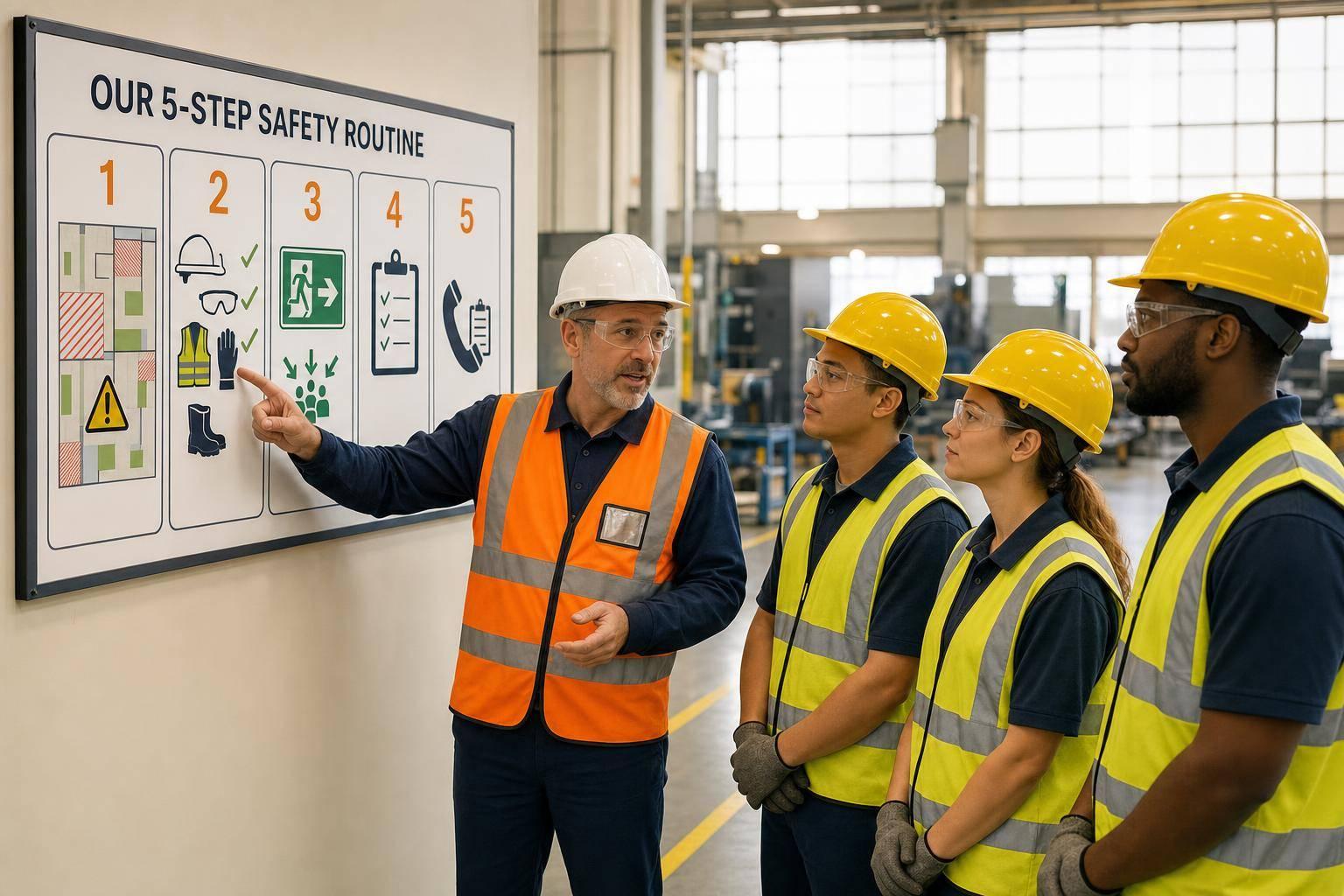
If I need to train new temps fast, I should do five things before they start work: assign safety duties, give a 5–15 minute pre-shift talk, add a short role huddle, walk the site, and finish with a supervisor handoff.
That’s the whole system. It keeps training short, but it still covers the job-site risks that temp workers need to know before setup, service, or breakdown begins. And that matters: one CDC/NIOSH-cited Ohio study found temp workers had a much higher injury rate than permanent workers.
Here’s the short version:
A simple process like this is easier to use when the day gets busy. Short does not mean vague. It means giving people the exact safety details they need, right before work starts.
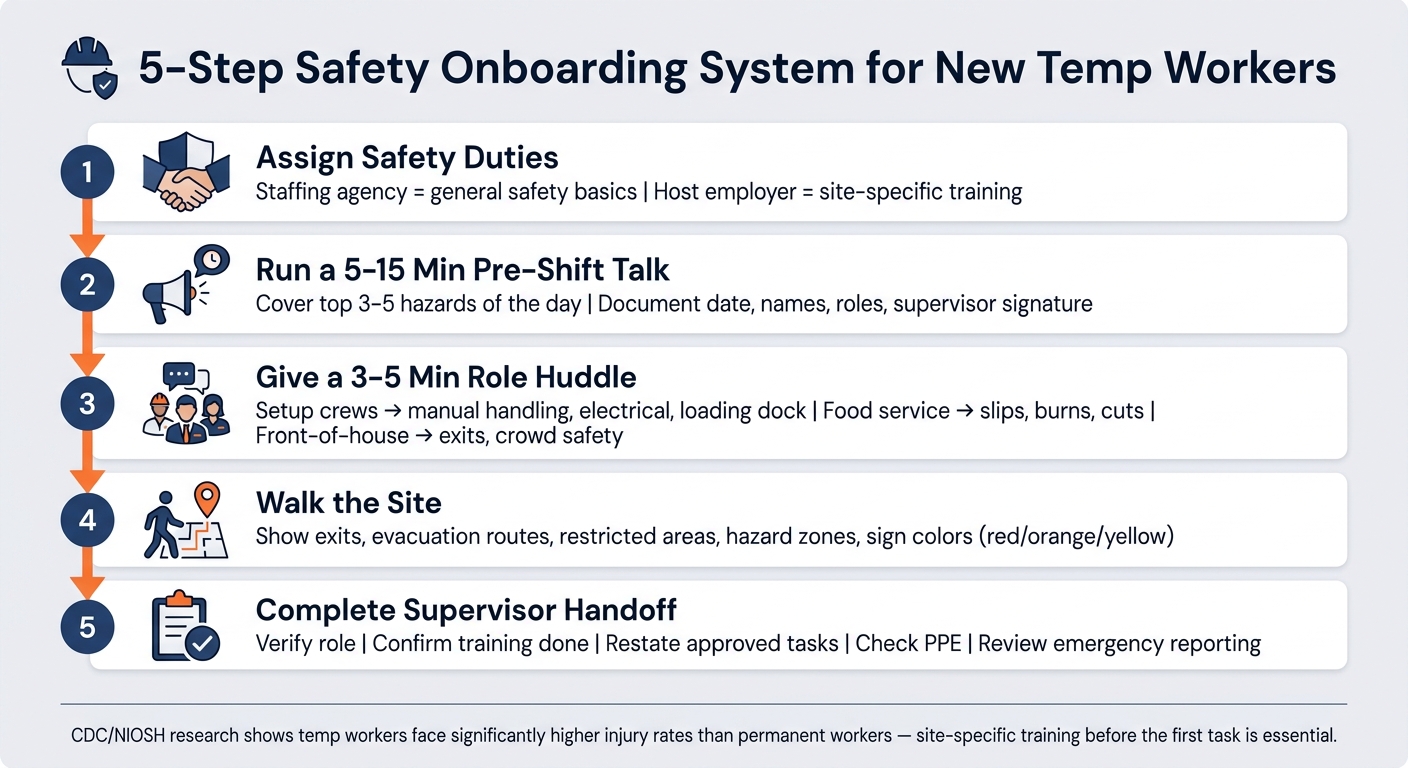
5-Step Safety Onboarding System for New Temp Workers
Before temps show up, get clear on who handles what. The staffing agency and the host employer both have a role in temp safety. The agency handles general safety training. The host employer handles the parts tied to the actual job site: site hazards, job tasks, PPE, emergency routes, and day-to-day supervision.
That matters because generic agency training can't teach people the exact risks on your site.
A simple split like this keeps each topic assigned once, instead of bouncing between teams.
| Training Topic | Generic/Agency | Site-Specific/Host Employer |
|---|---|---|
| General safety | Provides baseline safety orientation and worker rights | Reinforces it in your venue and tasks. |
| Hazard communication (HazCom) | Covers broad chemical hazard concepts and basic label/SDS awareness | Identifies site chemicals, label locations, SDS access, and exposure controls |
| PPE | Explains general PPE concepts | Selects, provides, and trains on PPE for your specific operations |
| Task and equipment training | Screens for basic qualifications and experience | Trains on approved tasks, equipment, restricted areas, and site procedures |
| Emergency response | Covers general emergency concepts | Explains exits, alarms, muster points, and site evacuation routes |
| On-site supervision | Limited to placement and follow-up | Provides day-to-day supervision and manages task or hazard changes |
Once that split is set, the next step is simple: spell out the exact work areas and tasks temps need to understand before they begin.
For event work, site-specific training should walk temps through the exact places they'll use: service corridors, loading docks, kitchen and prep zones, bar stations, staging areas, and any elevated platforms or risers. Show the real routes, work zones, and off-limits areas they'll run into on the job, and use location names they can spot fast.
Be specific in the way you describe those places. Say "north loading dock by the parking lot", "service corridor behind Ballroom A", or "Section 110–120 concourse." That's a lot more useful than vague directions, and it helps temps move safely when the pace picks up. This is even more important during late-night breakdowns, when fatigue can push injury risk higher.
OSHA and NIOSH expect host employers to cover five core areas before temps start work:
Cover these basics before the shift begins, then roll them into a short pre-shift talk.
Use the pre-shift talk to cover hazards everyone shares. Then break crews into short role huddles for the risks tied to the job they’ll do.
Keep the talk to 5–15 minutes, cover the day’s top three to five hazards, and document it.
For example, if wet floors near bars are a hazard today, explain why it matters today. Tight setup windows and crowded back-of-house corridors leave almost no room to recover from a slip. Then give the matching safe step: require non-slip footwear and clean spills at once before moving on.
End with one check-for-understanding question. It’s a simple way to catch confusion before the shift starts.
Document:
After the general talk, give each crew a 3–5 minute role huddle.
Setup crews should focus on manual handling, loading dock safety, and electrical cord management. That means taping cords, avoiding overloaded outlets, and staying clear of moving equipment. Require high-vis vests in loading areas and use clear hand signals for large moves.
Food service staff deal with slip hazards from spills, burns from chafers and coffee urns, and cuts from knives in prep areas. Their huddle should cover non-slip footwear, spill cleanup right away, and heat-resistant and cut-resistant gloves for the right tasks.
Front-of-house workers need to keep exits and aisles clear, route guests away from restricted areas, and know evacuation directions.
Use this quick matrix to check role-level coverage.
| Role | Manual Handling | Electrical Safety | HazCom | Crowd Safety | Emergency Procedures | Required PPE |
|---|---|---|---|---|---|---|
| Setup Crew | ✓ | ✓ | ✓ | - | ✓ | High-vis vest, safety shoes |
| Banquet Server | ✓ | - | ✓ | - | ✓ | Non-slip shoes, cut-resistant gloves as needed |
| Bartender | ✓ | - | ✓ | - | ✓ | Non-slip shoes, cut-resistant gloves as needed |
| Front-of-House Usher | - | - | - | ✓ | ✓ | Professional attire and visibility gear for outdoor events |
| AV Tech | ✓ | ✓ | - | - | ✓ | Safety shoes, gloves as needed |
Attach the same safety notes to each scheduled role so workers can see them before they arrive.
Use those same role notes again when you move to signs, exits, and the supervisor handoff.
Verbal instructions fade fast. That’s why a short site walk and supervisor handoff matter. They give temps a clear picture of what to do next, right where the work happens.
After role-based instruction, walk temps through the signs and paths tied to what they just learned. Seeing the space in person helps them remember directions, spot hazards faster, and follow instructions in loud, busy venues.
Use the site walk to turn instructions into physical landmarks.
Start with exits, evacuation routes, assembly points, first aid kits, fire extinguishers, and restricted areas. Then point out event-specific hazards, like loading dock boundaries, back-of-house corridors, wet-floor areas, overhead equipment zones, and traffic lanes marked with floor tape, cones, or barricades.
Standard sign colors also help workers make snap decisions: red for danger or emergency equipment, orange for warning, and yellow for caution. If a temp is moving fast through a back-of-house corridor, they need to spot a yellow caution sign right away, not try to remember it from a handout. OSHA also requires exit routes to stay completely clear - no materials or equipment may be placed in them, even temporarily - so new temps should be able to identify every exit path without obstruction.
At each key location, stop and use a simple three-part format:
For example, at a loading dock, explain that the area is restricted because vehicles move through it. Tell the worker to stay behind the marked line and never cross without direction. Then point out the main risk: backing trucks and carts.
Ask the temp to repeat the action back in their own words. It’s a small step, but it turns passive listening into active confirmation and helps catch confusion before it turns into an incident.
Once temps can identify the critical signs and routes, confirm the assignment before work starts. The host supervisor should handle the final check before the shift begins. It should take no more than two minutes and cover five items:
Document the handoff with the date, start time, worker name, assigned role, and supervisor name.
Treat the handoff as a safety check.
A fast safety system only works when the same steps happen in the same order, every single time. That's the whole point. Each step sets up the next one, so the process doesn't fall apart when the shift gets busy.
A CDC/NIOSH-cited Ohio study found temporary workers had a much higher injury rate than permanent workers. That's exactly why site-specific training from the host employer needs to happen before the first task starts.
This kind of setup also makes onboarding new event staff easier to repeat. When supervisors already have standard tools in place, they don't need to make things up on the fly at the start of a shift.
The goal isn't perfection. It's consistency: structured enough to cover the basics, specific enough to help on the job, and simple enough to do again and again.
The host employer is responsible for site-specific safety training.
In most cases, the staffing agency handles general safety training. But once temporary workers arrive on site, the host employer needs to train them on the hazards tied to that location.
That includes things like:
These responsibilities should be clearly spelled out in a written agreement between the host employer and the staffing agency.
Use active checks, not just passive listening. During the pre-shift briefing, ask staff to repeat back key instructions such as station assignments, evacuation routes, and emergency contacts.
You can also use a short digital form or a brief role-play to make sure the message landed. Then document the results for your safety training records.
Before a temporary worker starts, document the basics right away:
You’ll also want to keep records of certifications, training completion, and signed acknowledgments for the handbook, code of conduct, and safety policies.
Quickstaff can help keep all of this in one place, along with schedules and role assignments.