


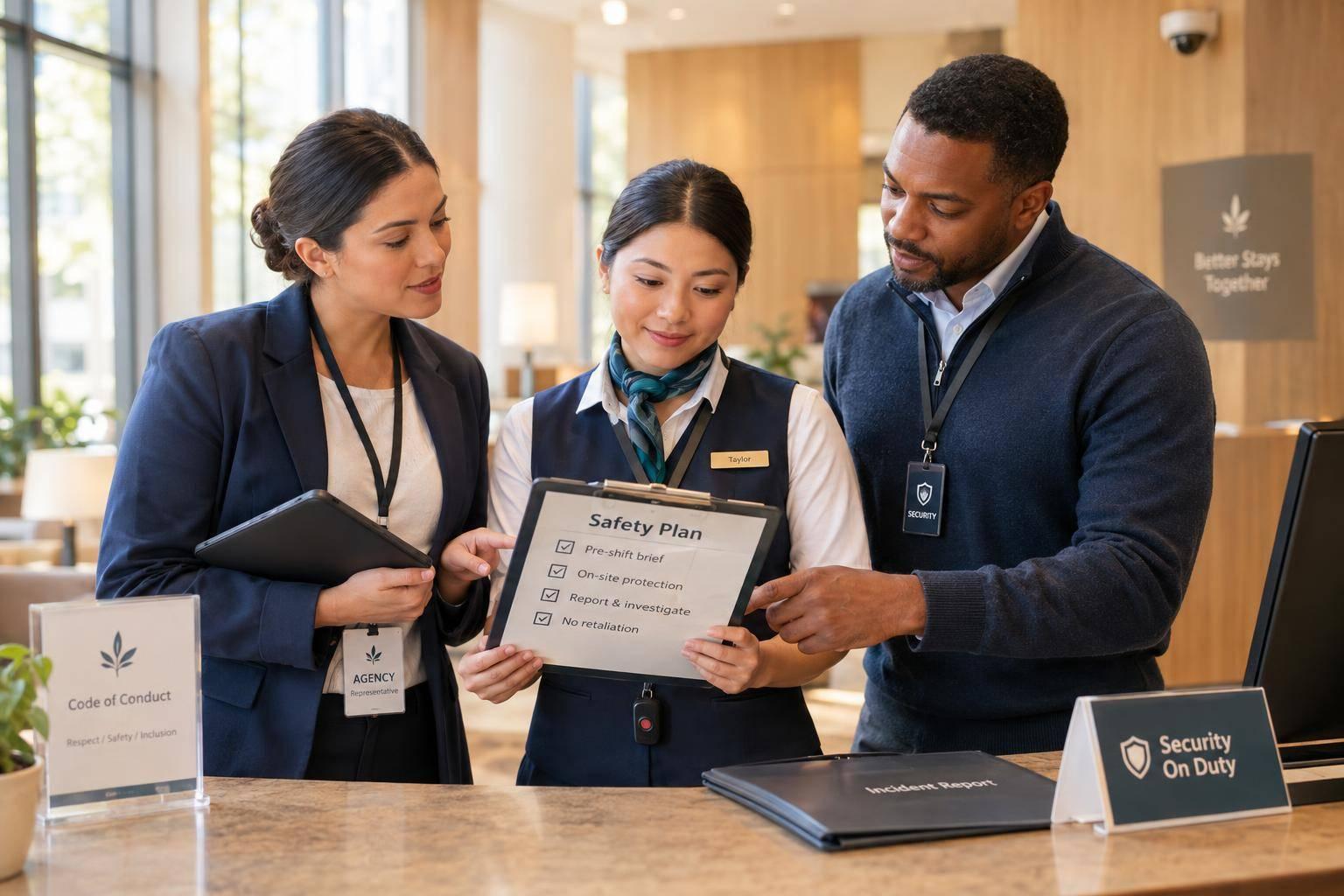
When a guest harasses a worker, the staffing agency and host should act - not wait for each other. The first steps are to separate the worker from the alleged harasser, notify both organizations, and contact whoever can stop the conduct.
A shared response plan should cover 3 stages:
Legal duties depend on employer status, notice, and control - not just who issues the paycheck. A contract does not, by itself, shift those duties.
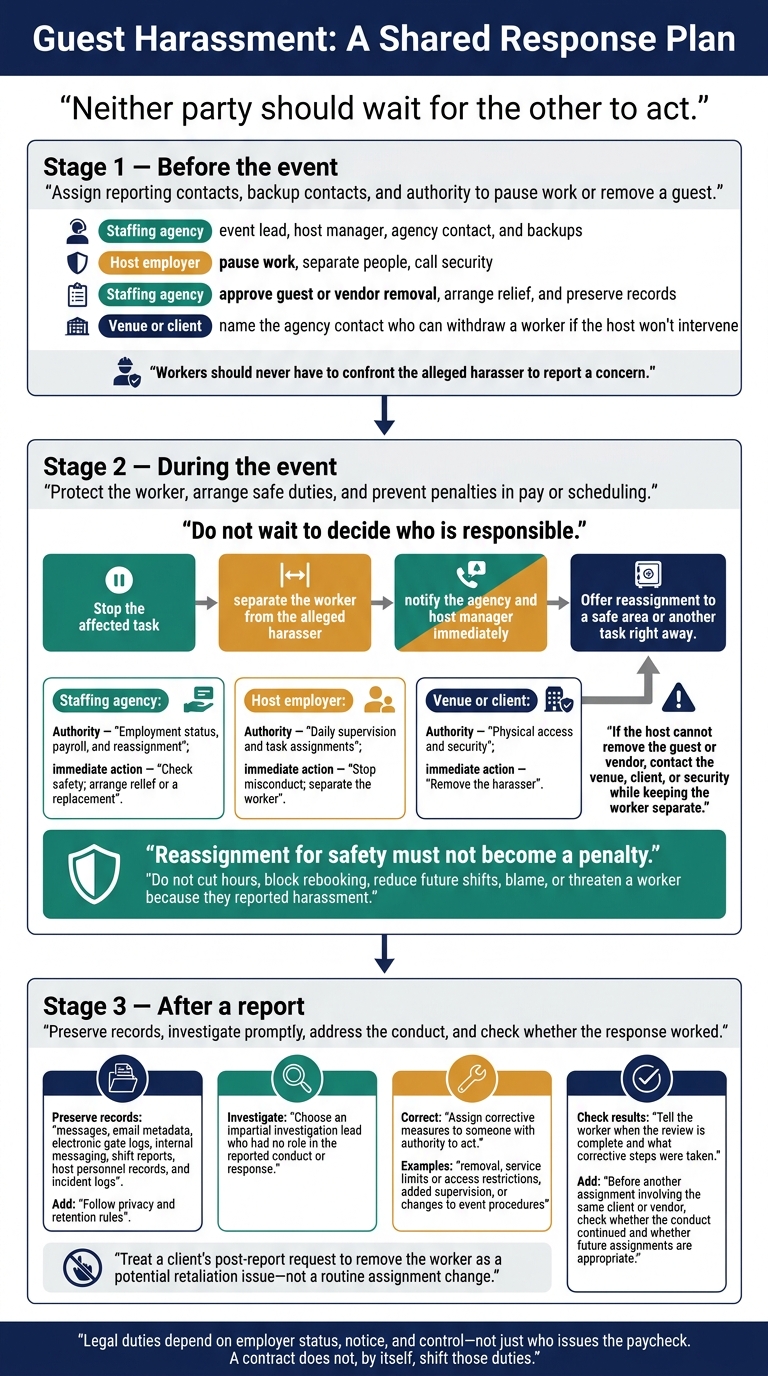
Guest Harassment: A Shared Response Plan
Include response duties in the assignment agreement and on-site briefing. Both the agency and the host site should be ready to preserve complaint and performance records.
Use a simple response map so each party knows who decides and what to do first.
| Party | Who decides | Immediate action | Follow-up | Documentation |
|---|---|---|---|---|
| Staffing agency | Employment status, payroll, and reassignment | Check safety; arrange relief or a replacement | Investigate and coordinate corrective action with the host | Assignment and complaint logs |
| Host employer | Daily supervision and task assignments | Stop misconduct; separate the worker | Investigate and discipline as needed | Shift reports and internal messaging logs |
| Venue or client | Physical access and security | Remove the harasser | Review access and security measures | Gate logs and security footage |
Before workers arrive, give them names and phone numbers for the event lead, host manager, agency contact, and backups. Provide a direct line to both organizations that bypasses any supervisor involved in the complaint or unavailable to help. Workers should never have to confront the alleged harasser to report a concern.
Confirm with the venue or client who can pause work, separate people, call security, approve guest or vendor removal, arrange relief, and preserve records. Also name the agency contact who can withdraw a worker if the host won't intervene.
Use Quickstaff to share role assignments, event details, reporting contacts, and escalation steps before the shift. Keep complaint reporting separate from scheduling messages, and update any changes immediately.
Once roles and contacts are set, the on-site response is straightforward: move the worker to safety, notify the right people, and escalate to those with authority to act.
Ask whether the worker is safe and where the alleged harasser is. Stop the affected task, separate the worker from the alleged harasser, and notify the agency and host manager immediately. Do not wait to decide who is responsible.
Offer reassignment to a safe area or another task right away. Do not require the worker to keep serving the alleged harasser or confront them.
When the reported harassment involves wedding guests, catering clients, vendors, or other nonemployees, start with whoever has authority on site. Then escalate to those who control access, security, or removal.
| Conduct | Immediate protection | Who can act now | Agency notification | Possible follow-up |
|---|---|---|---|---|
| Guest harasses a worker | Separate the worker from the guest | Host manager; venue manager or security | Report the incident and protection already taken | Restricted access or removal |
| Client harasses assigned staff | Stop the affected service | Host manager; agency | Request coordination on safe work | Safe reassignment or different duties |
| Vendor harasses a worker | Separate work areas | Venue manager; contracting party | Report the incident and continued exposure | Restricted vendor access or removal |
If the host cannot remove the guest or vendor, contact the venue, client, or security while keeping the worker separate. Limited control over the venue is not a reason for the agency to leave a worker exposed.
Do not cut hours, block rebooking, reduce future shifts, blame, or threaten a worker because they reported harassment. Reassignment for safety must not become a penalty.
Review pay, scheduled hours, early departures, and reassignments for retaliation risks, and document those reviews. That record becomes part of the investigation and any corrective action.
Once the worker is safe, review the report promptly and impartially. The agency, host, and venue or client should coordinate documentation and decide who will handle each follow-up task.
Choose an impartial investigation lead who had no role in the reported conduct or response. Coordinate interviews and share the records each review requires.
Start with the incident notes, messages, and shift reports gathered during the event. Before routine deletion, preserve relevant messages, email metadata, electronic gate logs, internal messaging, shift reports, host personnel records, and incident logs. These records are often managed through scheduling tools for caterers that track shift history and communication. Follow privacy and retention rules, and track who received the report and which managers had authority to intervene.
Use the preserved records to determine the next corrective step.
Base findings on a fair review of interviews and records. Keep any needed interim protections in place during the review.
Assign corrective measures to someone with authority to act. These may include removal, service limits or access restrictions, added supervision, or changes to event procedures. Tell the worker when the review is complete and what corrective steps were taken.
Before another assignment involving the same client or vendor, check whether the conduct continued and whether future assignments are appropriate. Treat a client’s post-report request to remove the worker as a potential retaliation issue - not a routine assignment change.
Neither party should wait for the other to act. The host separates people and addresses guest conduct. The agency confirms safety and protects pay and scheduling. Notify both organizations promptly and record each action.
Make that shared response plan the pre-shift standard.
Before the next assignment, check that policies have been delivered, contacts named, escalation authority confirmed, safe separation planned, records secured, and retaliation checked.
Finish with four questions: Who controlled the condition? Who knew or should have known? What protection was available? What action was taken?
Yes. Both the staffing agency and the host employer can be liable for guest harassment [2][3]. Under the joint employer doctrine, liability typically turns on actual control over working conditions - not contract labels. That includes who supervises workers, sets schedules, and has the authority to discipline or remove them [2][3][4].
Both share responsibility for preventing and addressing harassment. They must coordinate to protect workers immediately and take prompt corrective action [3].
A client’s request to remove you from an assignment after you report harassment may be unlawful retaliation [2]. Under laws like FEHA, staffing agencies must check whether removal requests are retaliatory - not simply approve them [3]. Both the agency and the host employer must keep assignment and removal decisions free of bias. Both may face liability if the removal is retaliatory [2][3].
Whether you can leave depends on your employment agreement and local labor laws. Joint employers share responsibility for workplace safety. But leaving could affect your pay or be treated as job abandonment or refusal to perform your duties.
Document the safety concern and report it to both your agency and host employer right away. In California, final-pay and waiting-time penalty rules apply when an assignment ends.


