Event Safety Legal Guide for Staff Managers
October 8, 2026

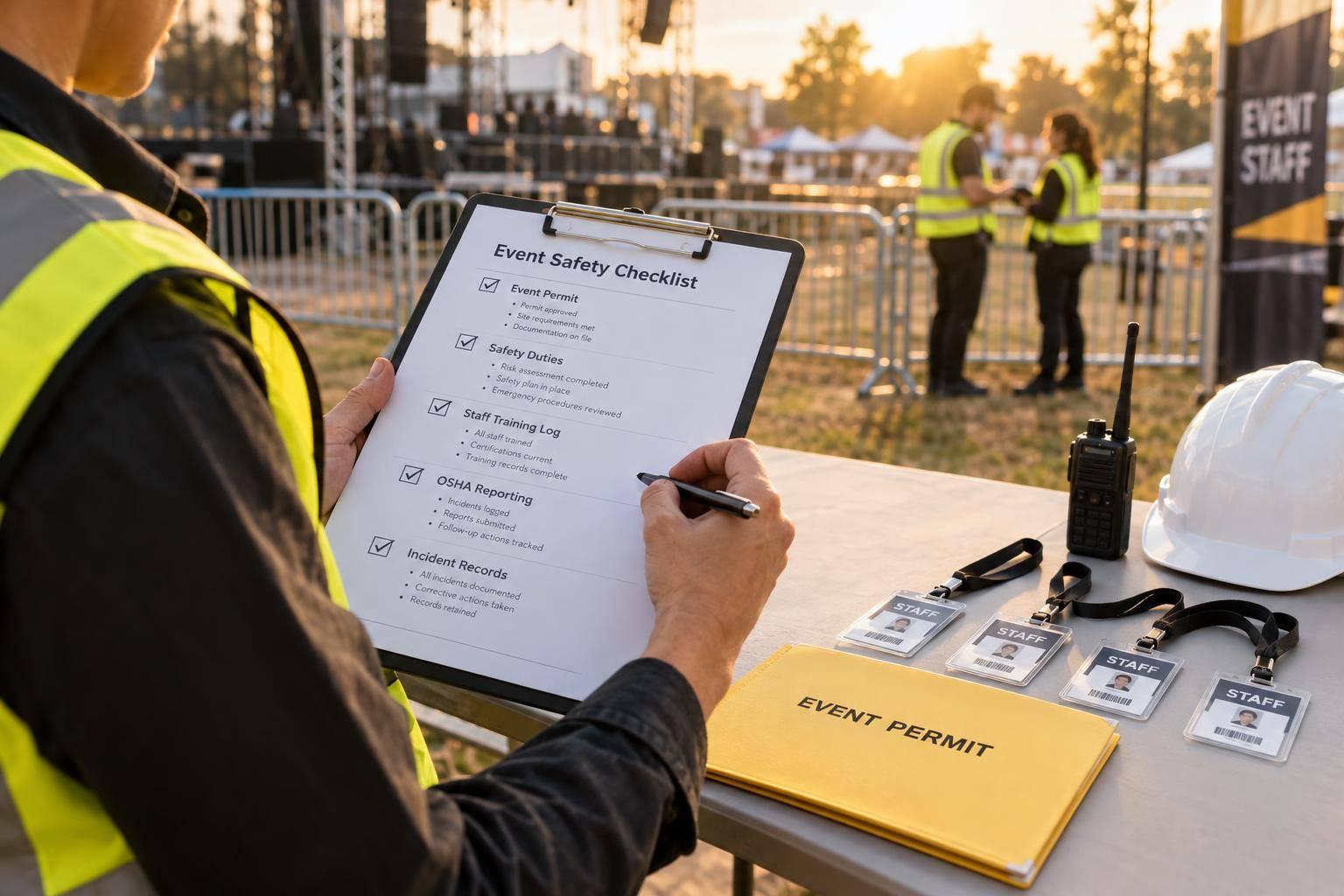
I start event safety planning by naming who handles each duty - not assuming the venue handles it all. Before work begins, I confirm permits, assign supervisors, check training, and set emergency contacts. Contracts can divide tasks, but they do not erase legal duties.
Here’s what I check from setup through closeout:
My rule: <u>Every safety duty needs an owner and a completion check.</u> Scalable staffing software can help organize people and messages, but it does not replace compliance checks.
This guide is general information, not legal advice. Requirements vary by location, event, and employment relationship.
For each requirement, identify who enforces it and who on your team owns it. Laws and regulations are enforceable. Agency guidance explains how to apply safety practices, while venue rules govern site use. Contracts assign tasks, and internal procedures set company controls.
FEMA materials support emergency planning; they are not event-safety law. Crowd-management guidance becomes mandatory only when a code, permit, contract, or policy requires it.
Match OSHA requirements to the work your team performs: lifting, loading traffic, hot equipment, electrical hazards, chemicals, and weather exposure. Verify controls, training, PPE, chemical information, emergency planning, reporting, and records with OSHA or the state safety agency. Coverage and recordkeeping exemptions vary.
Host employers and staffing agencies should coordinate site-specific protections, general training, and verification. Chemical hazard training is required at initial assignment and whenever a new chemical hazard is introduced.
Keep public-access rules separate from employee accommodation rules. Accessible guest routes, accommodation requests, and crowd-barrier plans follow different standards. Then connect those federal duties to the local permits and code rules that apply to the site.
Ask the fire marshal and the building, health, alcohol, and labor authorities which rules apply to your site, headcount, services, and worker status. Check occupancy, exits, temporary structures, food hygiene, allergen controls, alcohol service, labor rules, and required notifications. Identify the governing health code before recording food-temperature limits in Fahrenheit. Managers can also use event staffing apps to monitor team availability for these specific roles.
Use exact authority names, permit titles, deadlines, and owners in the table. Assign each requirement and verify it before opening, perhaps using event staff scheduling software to track owners. The checkpoints below are not universal filing deadlines.
| Requirement | Obligation type | Responsible party | Verification document | Deadline (operational checkpoint, not universal filing deadline) | Manager owner |
|---|---|---|---|---|---|
| Assembly occupancy and exit capacity | Fire/building code | Venue and event organizer | Occupancy approval, floor plan, inspection record | Before public admission | Operations manager |
| Temporary food-service approval | Health code | Caterer or food vendor | Permit, inspection result, approved menu or food plan | Before food service | Catering manager |
| Alcohol authorization | State/local permit | Licensed alcohol provider or organizer | License, permit, service plan | Before alcohol service | Event director |
| Site-specific hazard assessment | OSHA/workplace controls | Host employer, with staffing agency coordination | Signed assessment and corrective-action log | Before worker assignment | Safety lead |
| General and site-specific training | Employer duty | Staffing agency and host employer | Attendance, materials, acknowledgments | Before work begins | Staffing manager |
| PPE and chemical information | OSHA controls and hazard communication | Host employer and staffing agency as assigned | PPE issuance record, SDS access, training record | Before exposure or task start | Site supervisor |
| Emergency action and evacuation plan | Applicable workplace and local requirements | Venue and event organizer | Written plan and briefing record | Before opening and after material changes | Venue liaison |
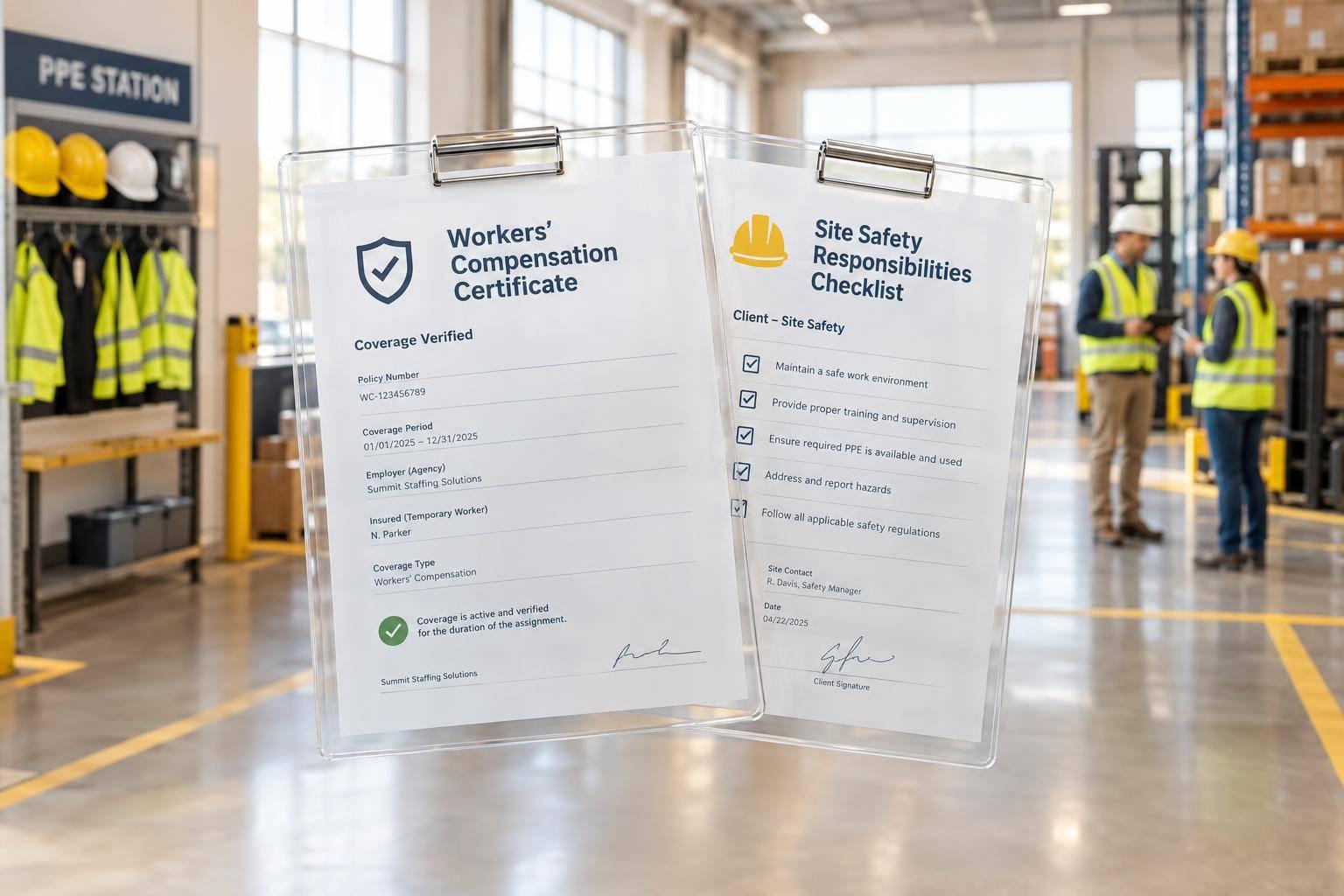
| Insurance and contractual certificates | Contract or venue requirement | Organizer, vendor, or staffing firm | Certificate of insurance, contract, endorsements | By venue’s stated deadline | Contract owner |
| Injury and illness reporting process | OSHA coordination and internal procedure | Host employer and staffing agency | Written instructions and incident form | Before workers arrive | HR or safety manager |
Once permits are assigned, compare the approved plan with the actual site before doors open. The manager should have authority to delay opening, suspend a task, or escalate an issue to the venue when a condition cannot be safely corrected.
Check exits, accessible evacuation routes, responder access, loading areas, equipment, utility shutoffs, credentials, insurance, and venue rules. Also check vendor and emergency contacts, weather thresholds, and shelter locations. Make sure worker instructions match the venue plan, and give every unresolved hazard an owner and deadline.
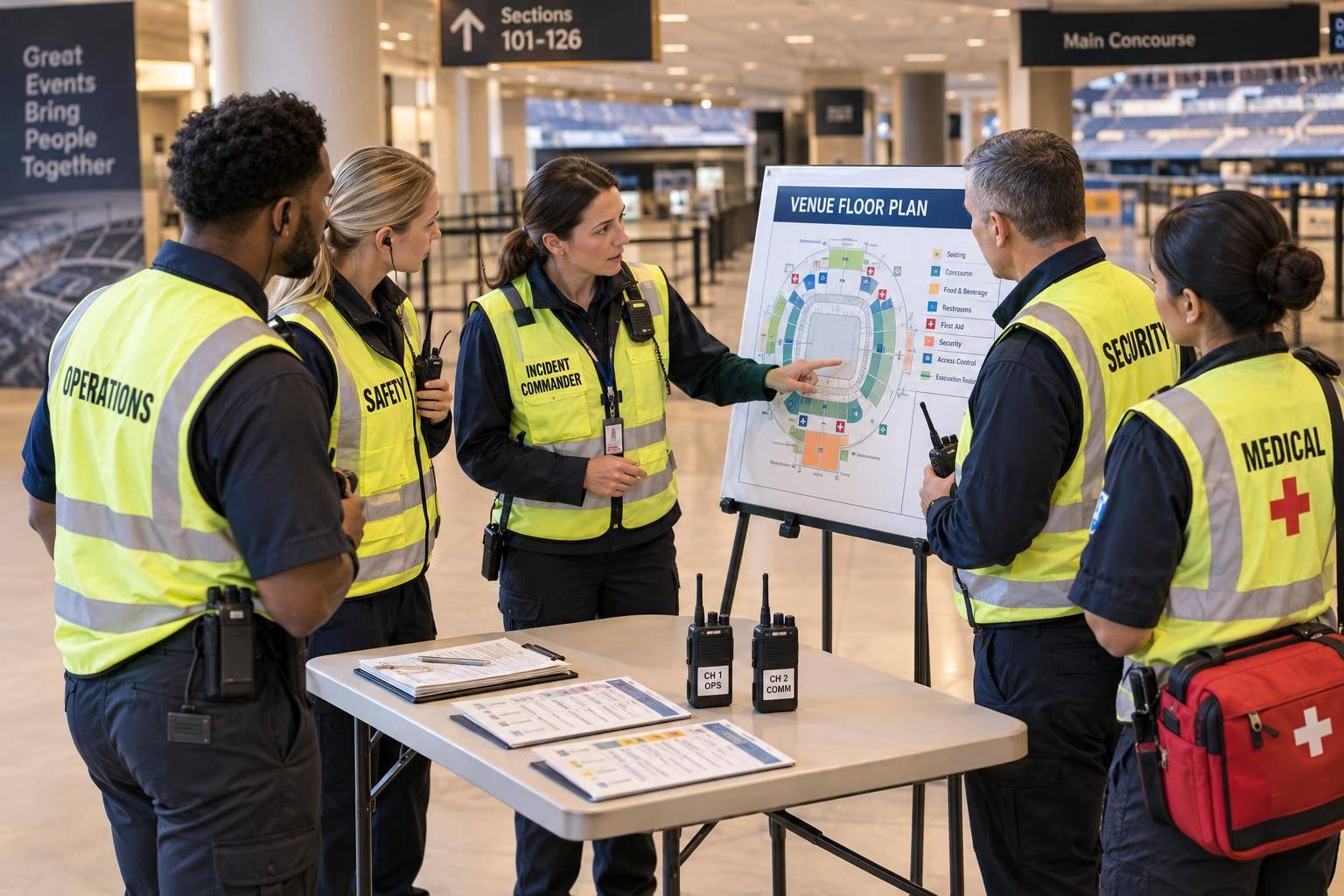
Before opening, assign stop-work, service-suspension, and evacuation authority. Define how supervisors, the event manager, venue security, and responders will coordinate. Use the checklist below to record names, times, and initials.
| Venue contact | Inspection time | Hazard or scenario | Corrective action | Responsible person | Completion time | Sign-off |
|---|---|---|---|---|---|---|
| __________ | __________ | Evacuation: blocked exit, alarm, assembly area, accountability process | Clear exit; brief staff; confirm assembly and roll call | __________ | __________ | __________ |
| __________ | __________ | Shelter-in-place: severe weather or external hazard | Identify shelter; communicate instructions; secure access | __________ | __________ | __________ |
| __________ | __________ | Active threat or violent incident | Confirm emergency call process, lockdown or evacuation instructions, and responder liaison | __________ | __________ | __________ |
| __________ | __________ | Missing child or vulnerable person | Confirm reporting point, description process, search boundaries, and privacy controls | __________ | __________ | __________ |
| __________ | __________ | Severe weather: heat, lightning, wind, flooding, or tornado risk | Set monitoring trigger, pause criteria, shelter, water, and resumption authority | __________ | __________ | __________ |
| __________ | __________ | Utility failure: power, gas, water, refrigeration, or communications | Isolate hazard; contact venue; protect food and guests; determine service suspension | __________ | __________ | __________ |
| __________ | __________ | Worksite hazard: electrical cords, hot equipment, chemicals, vehicles, slips, or temporary structures | Remove exposure, barricade area, provide PPE, or stop the task | __________ | __________ | __________ |
Recheck requirements before publication, after material event changes, and whenever authorities or venues revise their rules. Record the reviewer, jurisdictions, sources, unresolved questions, and next review trigger. Add a “Legal and regulatory review date” only after an actual qualified review - the current date alone does not establish verification.
Once the venue plan is set, assign the people who will put it into action.
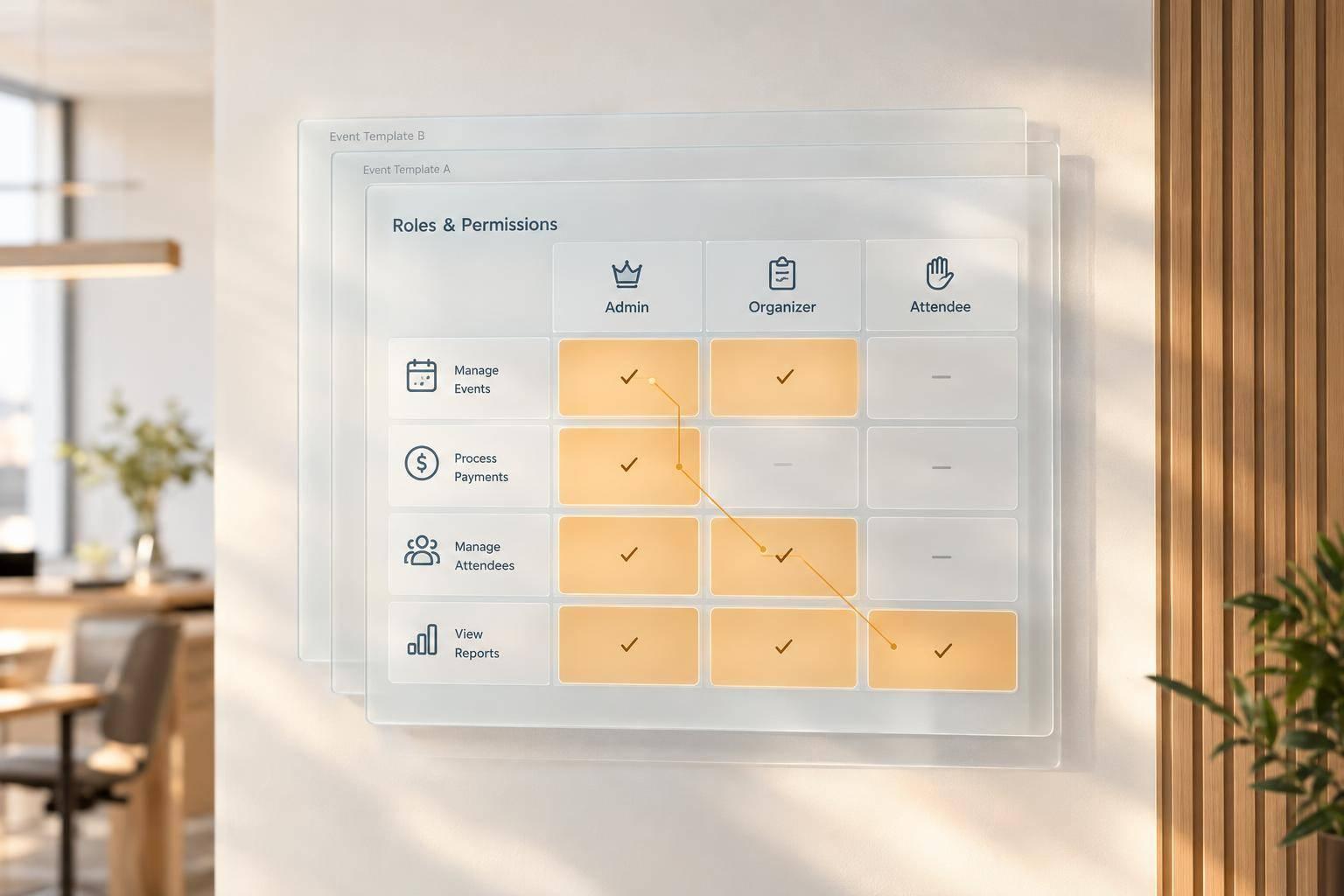
Before finalizing the schedule, build a named responsibility matrix that lists each duty, owner, backup, supervisor, and escalation contact. Assign responsibility for briefings, inspections, emergency communications, incident reports, corrective-action follow-up, and stop-work authority.
Match duties to each role:
The kitchen lead owns temperature checks, ingredient verification, and allergen controls; the setup lead owns safe lifting practices, equipment checks, cart use, and loading-zone controls. Ushers maintain accessible routes, orderly queues, and guest assistance; the bar lead oversees age and identification checks and refusal escalation; venue-authorized security staff maintain crowd controls and emergency access.
Do not assign specialized work without verified training, license, certification, and employer authorization. Before assignment, check required credentials, their scope and expiration dates, and employer authorization. If you cannot verify a required credential, move the worker to a permitted task or stop the work until an authorized worker is available.
For temporary workers, document who provides training, supervises the work, and corrects hazards on site. The host generally handles site- and task-specific instruction. The staffing agency provides general safety information and confirms that workers are suitable for the assignment. Use the same matrix to coordinate training, records, and incident follow-up.
Use the brief-demonstrate-verify method: explain the task, show the safe method, and watch the worker perform it. Cover equipment, PPE, chemical labels and SDS access, emergency routes, weather procedures, de-escalation, and crowd hazards. Choose language and vocabulary workers understand.
Record more than signatures. Document the role, topics, date and time, instructor, attendees, language or format, competency checks, and follow-up coaching. Update instructions whenever assignments, equipment, layouts, or conditions change.
Food-service training must cover the nine major allergens: milk, egg, fish, crustacean shellfish, tree nuts, peanuts, wheat, soy, and sesame. Staff need to know ingredient sources, cross-contact controls, and when to stop service and escalate. Never guess about ingredients. Training should also cover how to recognize and escalate suspected allergic reactions, including getting emergency assistance for suspected severe reactions.
Record these checks in the same system used for staffing and safety logs.
Set retention periods for each record type. Keep work instructions accessible, but limit access to medical, identification, personnel, and witness information. When a claim, investigation, or dispute is reasonably foreseeable, place relevant photos, video, messages, witness statements, equipment data, and inspection records under legal hold.
If your team uses Quickstaff, use it to keep event details, role assignments, availability, messages, and reminders in one place. Store authoritative compliance records in the designated file system. Scheduling software does not verify qualifications or replace OSHA, workers’ compensation, health-department, or insurance records.
| Record | Responsible person | Storage location | Retention requirement | Access permissions | Review date |
|---|---|---|---|---|---|
| Staffing roster and role matrix | Event manager | Restricted event workspace | Contract, payroll, and company requirements | Managers and authorized staffing leads | Before each event |
| Training attendance, competency checks, and credentials | Training or compliance lead | Training-record folder | OSHA, health, licensing, and company requirements | Authorized managers, HR, safety staff, and auditors | Before assignment; check expirations |
| Permits, insurance, and food-safety records | Compliance owner and food-safety lead | Compliance and food-safety folders | Jurisdiction, permit, contract, and insurer requirements | Authorized managers and inspectors | Before event; after menu or permit changes |
| Inspections, equipment checks, and briefings | Operations or shift lead | Event safety folder | Regulatory, contract, insurance, and preservation requirements | Operations, safety, and venue contacts | Before opening; after changes |
| Safety communications and corrective actions | Shift lead or safety manager | Communications archive and action log | Company, contract, and incident-preservation requirements | Event leadership and action owners | End of shift; at action closure |
| Incident, witness, and workers’ compensation records | Incident manager or HR | Restricted incident folder | State, insurer, privacy, and legal-hold requirements | Need-to-know personnel | After incident; at follow-up |
| OSHA Forms 300, 301, and 300A, when required | Employer responsible for recordkeeping | Secure OSHA records system | Generally five years after the covered calendar year. | Authorized safety, HR, and government personnel | Per OSHA deadlines |
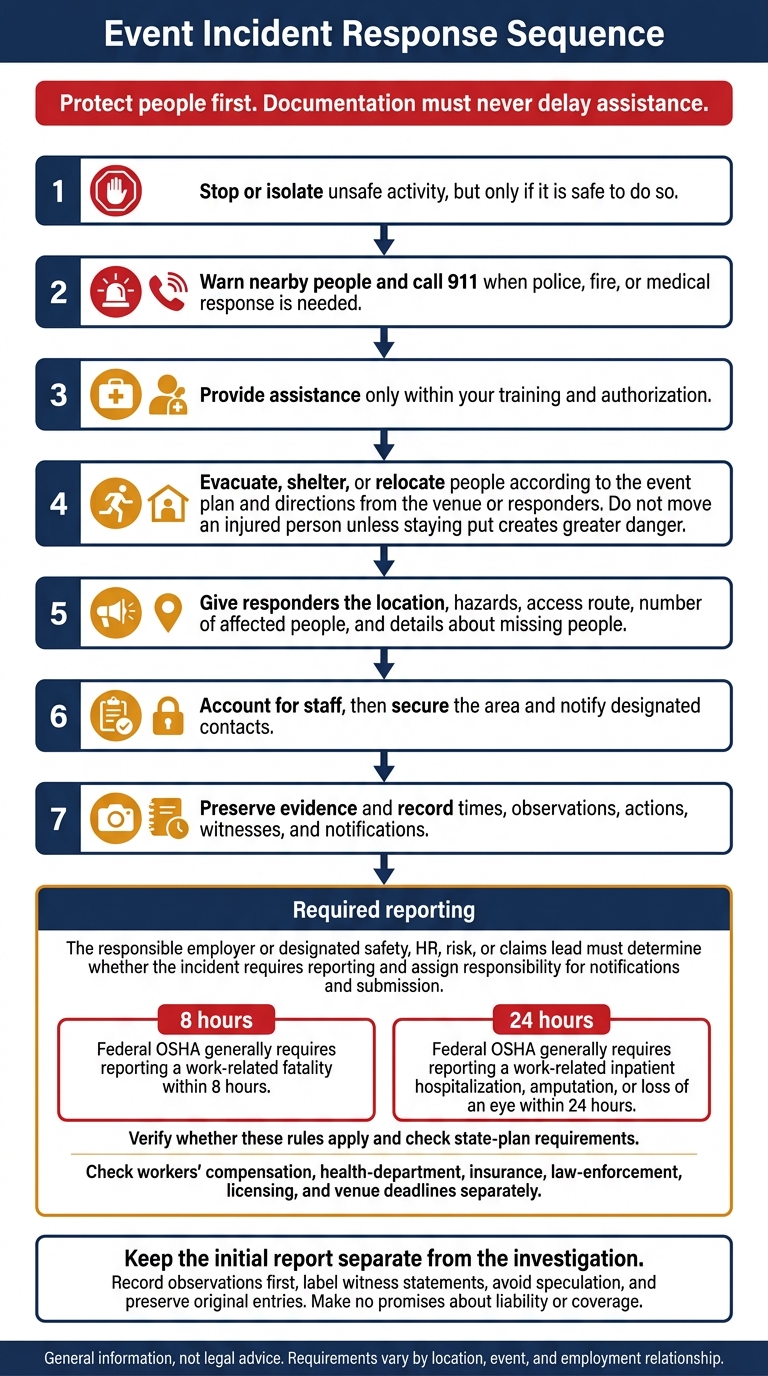
Event Safety Incident Response Steps
Once roles, permits, and the site plan are set, check for problems after setup and before service begins.
Run two readiness checks against the approved plan. Before staff arrive, confirm the live roster, role assignments, training status, credentials, equipment needs, weather forecast, venue contacts, and escalation chain.
At check-in, verify each worker’s identity, assignment, credentials, and attendance at the shift briefing. Update the live roster whenever someone arrives, leaves, or changes assignments so you can account for staff during an evacuation. Confirm who has authority to stop work, contact emergency services, communicate with the venue, submit required reports, and approve reopening.
After setup, recheck exit and accessible routes, crowd-control positions, loading areas, equipment, cords, lighting, surfaces, and first-aid supplies. Test radios, phones, and other communication tools. Record unresolved hazards, who owns each issue, and when it will be checked again.
If a hazard cannot be fixed before opening, isolate it, change the layout, assign qualified controls, delay the activity, or hold opening until it is safe. During service, repeat checks when crowds grow, weather changes, equipment moves, spills occur, staff take breaks, or other conditions change. Keep qualified relief staff available for safety-critical posts. Communicate promptly if coverage or controls fall short.
If a check reveals immediate danger, stop the task and begin the incident response.
Protect people first. Documentation must never delay assistance. Follow this sequence:
The responsible employer or designated safety, HR, risk, or claims lead must determine whether the incident requires reporting and assign responsibility for notifications and submission. Federal OSHA generally requires reporting a work-related fatality within 8 hours, or a work-related inpatient hospitalization, amputation, or loss of an eye within 24 hours. Verify whether these rules apply and check state-plan requirements.
Check workers’ compensation, health-department, insurance, law-enforcement, licensing, and venue deadlines separately. Keep the initial report separate from the investigation. Record observations first, label witness statements, avoid speculation, and preserve original entries. Make no promises about liability or coverage.
As the event slows or ends, move from response to closeout and corrective follow-up.
Secure equipment, inspect loading and storage areas, confirm staff checkout, and collect incident and near-miss reports before releasing the team. Review staffing, fatigue, training, equipment, communications, layout, and venue controls.
In the corrective-action log, assign each correction one owner, a deadline, a verification method, and an escalation contact. Update the risk assessment and staffing plan, then verify that corrections are complete.
Manager sign-off should confirm the plan, assignments, training checks, inspections, incident records, required notifications, site security, and ownership of unresolved actions. Include the manager’s name, signed approval, date, time, event ID, and exceptions. Sign-off does not end continuing reporting obligations.
At closeout, confirm that every legal and safety duty has been assigned, documented, and completed. Before each event, check federal, state, and local requirements against permits, contracts, insurance, and venue rules. Cover laws, permits, staffing duties, records, and incident response.
Use the requirements matrix to assign each duty, its deadline, and the proof needed to confirm completion. Verify that work at closeout. If responsibilities are unclear, resolve them with the venue, authorities, insurers, or qualified legal or safety professionals.
Managers must keep legal duties active from setup through closeout. During the event, coordinate supervision and safety controls, protect people, and complete required notifications. Store permits, training acknowledgments, inspections, and incident documentation securely for the required retention period - not just until the event ends.
For the final review, update the matrix for each venue and jurisdiction. Use the inspection checklist during operations, the records table for evidence, and sign-off to confirm review. Sign-off does not eliminate liability.
Quickstaff can help with staffing, availability, reminders, and event communication, but it does not replace compliance steps.
Follow the standard that gives employees the most protection. If venue rules offer less protection than applicable federal, state, or local safety laws, follow the law to protect staff and avoid liability.
Staffing agencies and host employers are often considered joint employers. That means both share responsibility for keeping the workplace safe.
Temporary staff should report injuries immediately to both the staffing agency and the host employer. The host employer must record the injury or illness in its OSHA 300 Log, promptly notify the staffing agency, and share the documented record.
Set clear reporting procedures ahead of time so workers know how to report safety concerns or injuries to both parties.
Yes. Under OSHA guidelines, host employers and staffing agencies are often considered joint employers. That means they share responsibility for workplace safety, training, and compliance.
To reduce risk, spell out each party’s safety duties in a written agreement. As the host employer, you provide site-specific safety training and daily oversight. The vendor or staffing agency typically provides general training. Before work starts, verify and document the vendor’s qualifications.