FLSA Tip Pool Rules for Caterers Paying Full Wages
November 13, 2026


Caterers can include nonmanagerial cooks and dishwashers in a mandatory tip pool if they pay the full applicable minimum wage without a tip credit - and state or local law allows it. The federal minimum is $7.25 per hour, but a higher rate may apply where the event takes place.
The key rules:
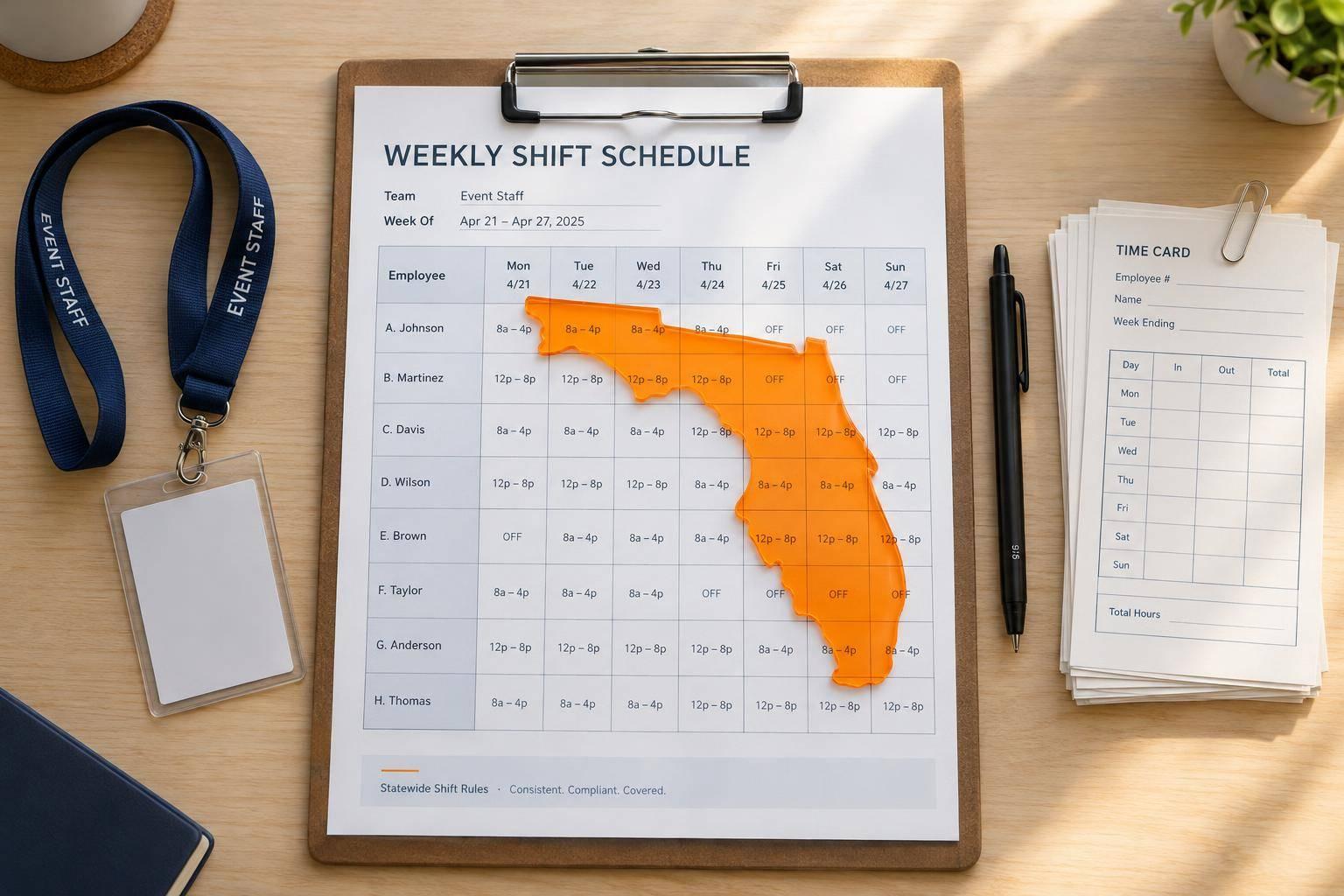
Scheduling tools such as Quickstaff can help check event assignments, but separate time, tip, and payroll records are still needed.
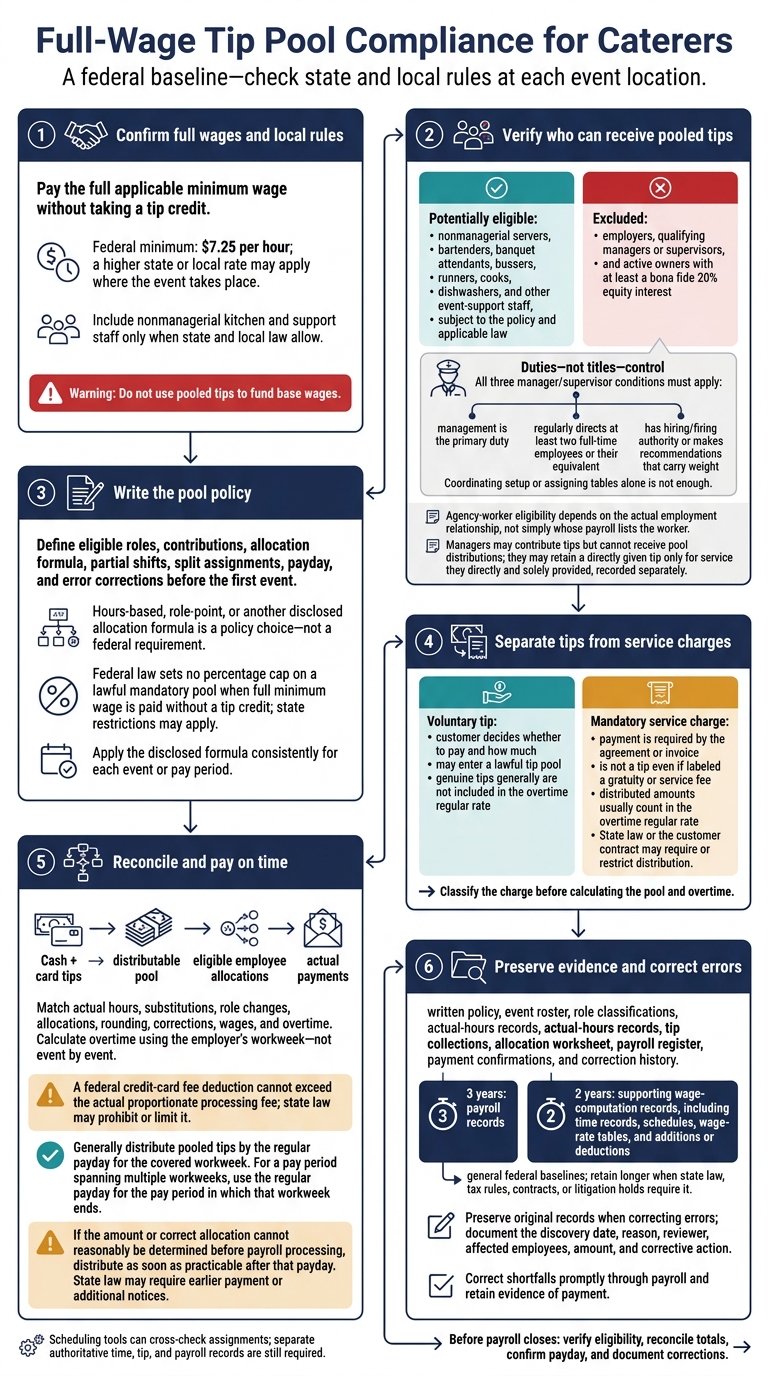
Full-Wage Tip Pool Compliance for Caterers
After setting the full-wage rule, decide who can share in the pool using a catering staff scheduling checklist. Eligible nonmanagerial employees may participate under the written policy. Tie eligibility to the event, shift, service period, or hours worked, and explain how partial shifts and split assignments count.
Participants may include servers, bartenders, banquet attendants, bussers, runners, cooks, dishwashers, and other nonmanagerial event-support staff. Check stricter state or local limits at each event location before including kitchen or support staff. Use event-level rules rather than generic job titles to help prevent payroll errors and manage labor costs.
For agency-supplied workers, make sure the staffing agreement reflects the actual employment relationship. Assign responsibility for handling tips, and reconcile agency timesheets with event records. A worker’s absence from the caterer’s regular payroll does not, by itself, make them ineligible.
Treat a captain or lead as a manager or supervisor only when all three conditions apply: management is their primary duty, they regularly direct at least two full-time employees or their equivalent, and they have hiring or firing authority or make recommendations that carry weight. The title alone does not decide eligibility. Coordinating setup or assigning tables is not enough.
An active owner with at least a bona fide 20% equity interest also cannot receive pool distributions. Before approving participation, document ownership, actual responsibilities, employees regularly directed, and personnel authority.
Keep pool distributions separate from tips customers give directly. A manager or supervisor may keep a tip only if the customer gives it directly for service that the manager or supervisor directly and solely provided. Managers may contribute tips to a mandatory pool, but they cannot receive distributions from it. Record permitted direct-service tips separately so they stay out of the pool.
Once eligibility is set, put the pool rules in writing before the first event. Give employees a policy that explains the contribution formula, allocation method, payday, and process for reporting errors.
Explain how cash and card tips enter the pool. Verify cash counts and match charged tips to processor records. Record any corrections, the allocations they affect, and payment dates.
Federal law sets no percentage cap on a lawful mandatory tip pool when the employer pays full minimum wage and takes no tip credit. State restrictions may still apply. Allocating tips by hours, role-based points, or another disclosed formula is an employer policy choice - not a federal requirement.
Use one disclosed formula consistently for each event or pay period.
With the formula in place, focus on payment timing. Employer-collected tips for a mandatory pool generally must be fully distributed by the regular payday for the workweek in which they were collected. If a pay period covers more than one workweek, distribute the tips by the regular payday for the pay period in which that workweek ends.
If the employer cannot reasonably determine the amount collected or the correct allocation before processing payroll, it must distribute the tips as soon as practicable after that payday.
Assign someone to resolve unpaid amounts. Using event staff scheduling software can help track these assignments and ensure communication with the team. Do not move them into a later payroll cycle without notice. State wage-payment laws may require earlier payment or additional notices.
Separate pooled tips from mandatory event fees before calculating payroll. A customer-controlled gratuity is generally a tip. A mandatory fee imposed by the business is a service charge - not a tip - even if the invoice calls it a “gratuity” or “service fee.”
Review event contracts and customer disclosures to confirm whether charges are mandatory and how the business treats them. Check state law and the customer contract before deciding how to distribute service charges.
Misclassifying a fee can throw off both the tip pool and overtime pay.
| Issue | Voluntary tip | Mandatory service charge |
|---|---|---|
| Customer discretion | Customer decides whether to pay and how much | Payment is required under the event agreement or invoice |
| Federal classification | A customer gratuity for service | Not a tip, even if labeled a “gratuity” or “service fee” |
| Employee distribution | A lawful pool policy may distribute the tip among eligible employees | Federal law does not treat the charge as tips; state law or the customer contract may require or restrict distribution |
| Overtime treatment | Genuine tips generally are not included in the regular rate | Distributed amounts usually count in the overtime regular rate. |
Then match each charge against the tip pool and payroll records.
For each event, reconcile cash and card tips, any legally permitted processing-fee deduction, the distributable pool, employee allocations, and actual payments. Explain rounding and later adjustments so the totals match. Do not use pooled tips to fund base wages.
Under federal law, an employer may deduct from charged tips only the actual proportionate credit-card processing fee charged by the card company. State law may prohibit or limit that deduction. Verify direct wages and overtime separately against the applicable federal, state, and local rules.
Once you set the pool rules, the compliance file needs to show who worked, what they did, and how tips were paid.
Record each worker’s identity, job classification, event date, work location, scheduled and actual start and end times, required breaks, substitutions, and role changes. Keep daily hours, wage rates, overtime calculations, and wages paid. Track total hours for the employer’s workweek - not event by event.
For a mandatory pool without a tip credit, identify every tip recipient and keep their reported tip amounts linked to the allocation worksheet.
Use scheduling records to cross-check payroll. Quickstaff brings together event schedules, staff assignments, availability, waitlists, reminders, and schedule-change communications. Compare those records with staffing history to flag substitutions and changes in pool participation.
Quickstaff does not determine legal tip-pool eligibility, verify actual hours, calculate tip allocations, apply overtime rules, or provide payroll compliance. Keep separate authoritative records for actual time, tip calculations, wage computations, and payments.
Link records by event and pay period. Keep the written tip-pool policy, employee acknowledgments, event rosters, role classifications, actual-hours records, required break records, and substitution and role-change logs.
Also retain tip collection evidence, allocation calculations, reported tip amounts, payroll records, payment confirmations, correction history, and relevant communications. Required wage and tip records establish the figures; supporting documents show how you calculated them.
Federal retention baselines are generally three years for payroll records and two years for supporting wage-computation records. Supporting records include time records, work schedules, wage-rate tables, and additions or deductions. Keep records longer when state law, tax rules, contracts, or litigation holds require it.
To prepare for an audit, cross-check rosters against manager and supervisor classifications, agency or temp-worker assignments, direct wage rates, actual hours, overtime, breaks, substitutions, and role changes. Also check total tips collected, eligible recipients, the allocation method, and payment deadlines.
When reviewing event captain status, check duties, not titles, and exclude any disqualified role from the pool.
Resolve discrepancies before closing payroll whenever possible so the final records match the pool distribution. If you make a correction later, preserve the original schedule, time record, allocation worksheet, and payroll register. Document the discovery date, reason, reviewer, affected employees, amount, and corrective action. Issue any required adjustment through payroll, and retain the original records.
Use this checklist to check full-wage tip-pool compliance before payroll closes.
Pay full cash wages without taking a tip credit. Before including cooks or dishwashers in the pool, check local law at each event location.
Keep the employer, owners, managers, and supervisors out of pool distributions. Put the eligible roles, contribution formula, allocation formula, partial-shift rules, and correction steps in writing.
Distribute pooled tips by the regular payday for the covered workweek. Before payroll closes, reconcile event assignments, hours, allocations, and payments.
Audit pools periodically across locations and pay periods. Review local rules before entering a new market. Stop the practice immediately if ineligible workers received pooled tips, a tip credit was used, wages fell short, or allocations don’t reconcile. Preserve records, calculate the shortfall, and promptly issue any required back pay. If any check fails, correct the pool through payroll and document the fix.
Follow federal FLSA requirements and the highest applicable state or city wage standard where each employee performs tipped work. Employers, managers, and supervisors can’t keep pooled tips. Pools that use a tip credit may include only employees who customarily and regularly receive tips.
Keep tip records for each event or shift linked to actual hours worked, roles, and event IDs. Calculate any tip-credit shortfall by workweek - don’t average across events.
Yes. An event captain’s eligibility can change from one shift to the next, depending on their actual duties and the employer’s written tip-pool policy. Federal rules consider whether they “customarily and regularly” receive tips and whether they qualify as a manager or supervisor. Managers and supervisors cannot receive pooled tips.
Keep records for each shift that link every worker’s role, hours, and tipped versus non-tipped work to the correct event ID and payroll calculation.
Managers and supervisors cannot participate in employee tip pools. Stop all tip-pool distributions to them immediately.
Review the event’s tip-pool records to find any misallocated amounts, calculate what eligible staff members are owed, and redistribute those tips. In your event records, document the discrepancy, each correction, and the reason for each adjustment. Keep those records for compliance.