FIFO Training for Catering Crews
September 25, 2026

FIFO only works when your crew uses the oldest safe item first, labels everything the same way, and checks storage at receiving, prep, and close. If I had to boil this article down, that’s it.
Here’s the short version:
A few numbers matter here:
One point matters most: FIFO controls order of use. It does not decide whether food is safe. If something is damaged, expired, missing a date, or held at the wrong temperature, I pull it from use.
So if you want FIFO to stick, I keep it simple: set fixed storage zones, use one label system, drill the process before service, and log problems at close.
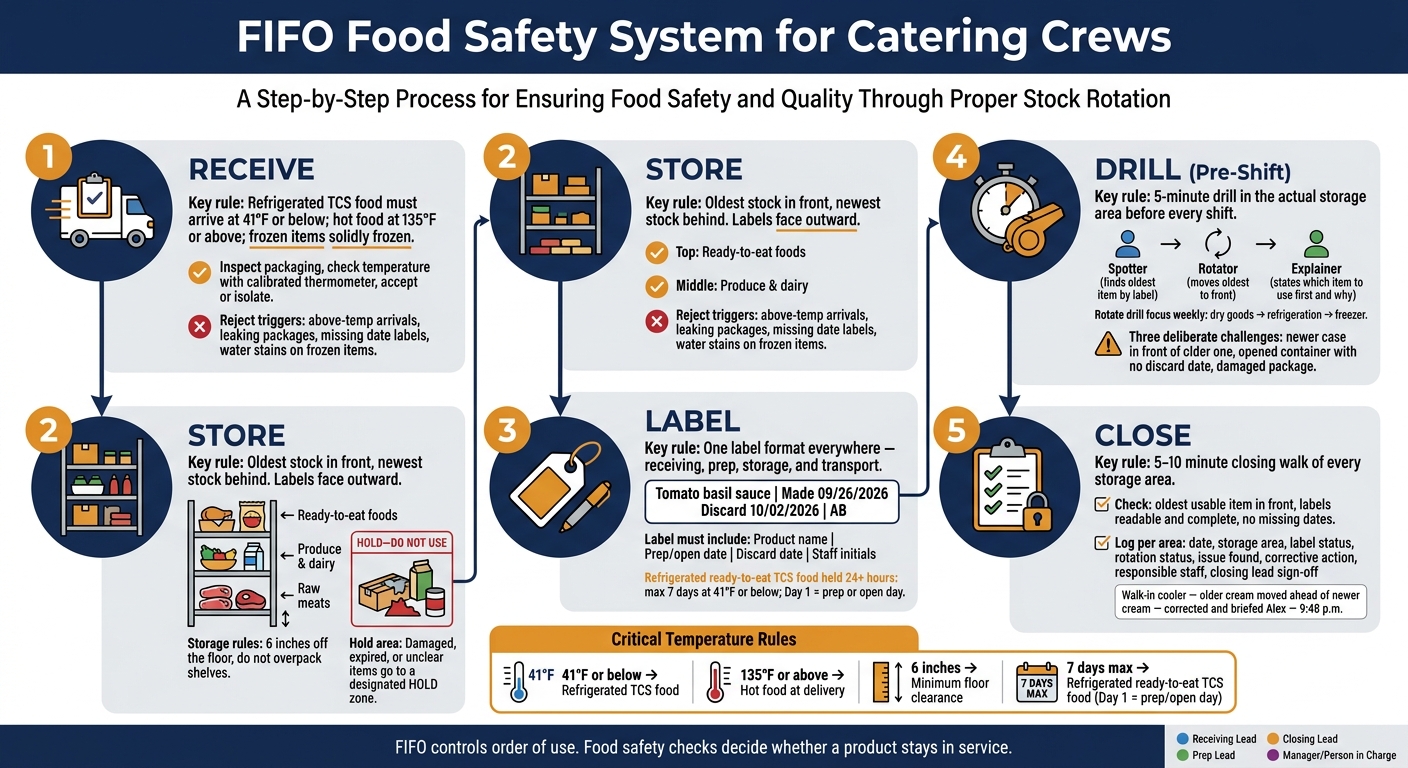
FIFO Food Safety System: 5-Step Process for Catering Crews
Once FIFO is clear, build the storage layout so the rule is easy to spot at a glance. When the setup is clean and obvious, FIFO is much easier to follow, even for new hires, especially when using event staff scheduling software to manage team assignments.
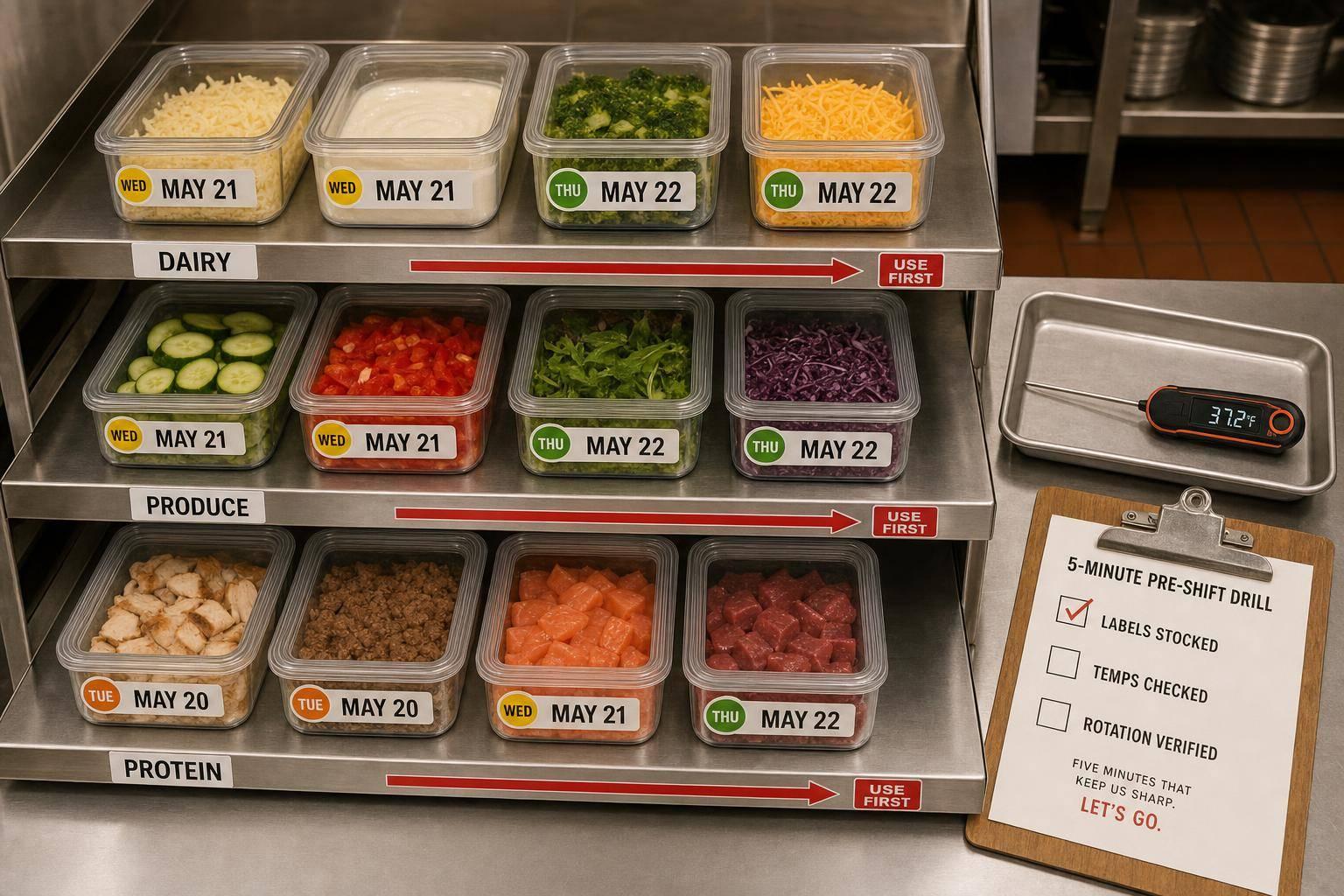
Split storage into five zones: dry goods, refrigerated raw ingredients, frozen products, ready-to-eat foods, and opened products. Keep each group in its own area. Put older stock in front or at the top access point, with newer stock behind or below it. Make sure labels face out.
Use a simple shelf map. Place ready-to-eat foods on top, produce and dairy in the middle, and raw meats below. Keep older cases in front, and store freezer stock in labeled lanes or baskets. In transport coolers, put the oldest usable items closest to the opening.
Set aside a hold area for anything waiting for disposal or manager review.
Mixed label styles slow FIFO down. Use one date format on every label.
Use the same format everywhere: receiving, prep, storage, and transport coolers. A label like Tomato basil sauce | Made 09/26/2026 | Discard 10/02/2026 | AB shows the product, the prep date, the discard date, and who labeled it. Refrigerated ready-to-eat TCS foods held longer than 24 hours must be date marked and kept at 41°F or below within the allowed hold time set by your local code.
Keep food-safe labels and permanent markers anywhere food changes status. That means receiving, prep, storage, and transport. A label added right after prep or receiving is far more dependable than one filled out later from memory.
Before service, a manager should be able to scan any shelf and answer three questions fast:
If any answer isn't clear, relabel the item before it goes into prep.
With zones and labels in place, crews can receive and pull stock without breaking rotation.
FIFO starts at receiving, not on the shelf. If someone sets new cases in front of older ones because they’re easier to unload, rotation is broken before service even starts.
Train every receiver to follow the same steps on every delivery: confirm identity and quantity, inspect packaging, check temperature, then accept or isolate. Refrigerated TCS food should arrive at 41°F or below. Hot food should arrive at 135°F or above. Frozen items should be solidly frozen, with no large ice crystals, water stains, or liquid in the package. Use a clean, calibrated food thermometer. Don’t try to judge temperature by touching the package.
Use the same shelf map and label format already used across storage areas. After acceptance, move older inventory forward and place new cases behind it. Keep food at least 6 inches off the floor, and don’t overpack shelves. When shelves are crammed, labels get harder to see and temperature control gets weaker.
Don’t shelve failed deliveries. Isolate them in the hold area and tell the person in charge right away. A leaking package, a missing date, or a product received above the temperature limit does not become okay just because it was set aside quietly.
| Situation | Correct action |
|---|---|
| Refrigerated TCS food arrives above 41°F | Reject or isolate; notify manager |
| Frozen item has water stains or liquid in package | Reject or isolate for review |
| Package is leaking or seal is broken | Isolate and report; do not rotate into inventory |
Run that same process again in a short pre-shift drill. Repetition matters here. The goal is simple: make the right sequence feel automatic.
During prep and service, staff should repeat a quick check before opening any new case. Before opening a new case or starting a new batch, check for an older acceptable item, confirm the label and package condition, and pull the oldest usable stock first. Older stock still needs a label, condition, and temperature check.
When crews can spot the oldest acceptable stock fast, a five-minute drill helps keep the habit in place.
Run this drill right after the briefing and before prep begins. Do it in the actual storage area the team will use for service, not in some side setup. Use the same shelf map, labels, and hold area from the earlier setup. Stick to one storage area per shift, then rotate through areas during the week: dry goods, refrigeration, and then freezer.
That way, the drill stays short and practical. It’s not theory. It’s a quick check of the exact system the crew will rely on once service starts.
Pick three roles from whoever is on hand: spotter, rotator, and explainer. Have them use the same label checks and shelf order they already follow during service. Give them one shelf, one bin, one cooler section, or one dry-storage rack.
Use the last minute to fix mistakes right there. Set up three deliberate challenges: a newer case placed in front of an older one, an opened container with no discard date, and a damaged package. Each one checks a different call: rotate, hold for manager review, or discard.
For refrigerated ready-to-eat TCS foods held for more than 24 hours, count the prep or opening day as Day 1 and use or discard the food within 7 days at 41°F or below. Make sure the crew knows that rule before service begins.
FIFO falls apart when nobody owns the check. Give each stage one person who’s responsible.
| Stage | Owner | Primary responsibility |
|---|---|---|
| Delivery intake | Receiving lead | Checks delivery condition, labels, dates, temperatures, and places stock behind existing inventory |
| Prep | Prep lead | Pulls oldest suitable stock first; makes sure opened or prepared items are labeled |
| End of shift | Closing lead | Confirms rotation, removes expired or damaged food, records exceptions |
| Throughout | Manager or person in charge | Resolves unclear status; confirms food-safety procedures were followed |
Put these roles on the event prep sheet or in the shift briefing so temp staff know exactly who to ask when something looks off. Quickstaff can assign these roles and send reminders for the pre-service FIFO walkthrough. The same people who own these checks should also verify rotation at close.
After the drill, log the date, event or shift, storage area inspected, employees who took part, problems found, corrective action taken, and the manager’s sign-off. Then use that same log again at closing to confirm rotation and note any exceptions.
Use the closing check to keep FIFO in place between events. Set aside 5 to 10 minutes to walk each storage area, and follow the same path every time. That small bit of repetition matters. It helps the team spot issues fast instead of starting from scratch at each close.
At this stage, you don't need a long report. Just log the exceptions and what was fixed.
Check each shelf from front to back and make sure the oldest usable item stays in front. Use the same shelf order and label checks the crew followed during service. If a delivery showed up mid-service, check the receiving area and any staging carts too. Those in-between spots are often where rotation slips.
For prepared foods, make sure the product name, prep/open date, and required use-by date are all there and easy to read.
If an item has a missing label, an unreadable date, a damaged package, signs of contamination, or an unclear identity, send it to HOLD - DO NOT USE for manager review. The closing lead should note what was found, what action was taken, and who fixed it, then sign the final record.
Keep the sign-off log short. One line per area, filled out on the spot, is enough. Use the same short log at every close:
| Field | What to record |
|---|---|
| Date | Closing date |
| Event or kitchen location | Event name, venue, or kitchen site |
| Storage area | Walk-in cooler, dry storage, freezer, prep cooler, or service station |
| Label and date-marking status | Labels readable, outward-facing, and complete |
| Rotation status | Older stock in front of newer stock |
| Issue found | Poor rotation, missing date, damaged package, uncovered food, or expired product |
| Corrective action | Rotated, relabeled, discarded, moved to hold, covered, or reported |
| Responsible staff member | Employee who corrected or escalated the issue |
| Sign-off | Closing lead initials and time completed |
Here’s what a finished line can look like: Walk-in cooler - older cream moved ahead of newer cream - corrected and briefed Alex - 9:48 p.m.
Put together, these steps help FIFO hold up when service gets busy. It only works when storage, labeling, rotation, drills, and closing checks all stay in sync. Make the oldest safe item the easiest one to see and grab, and crews can move fast without breaking the order.
That only works if unsafe stock gets pulled out, not merely moved around. Older stock is still unsafe if it's damaged, expired, or temperature-abused. FIFO decides the order of use; food-safety checks decide whether a product stays in service.
One final reminder on rotation order: use the earliest end date first, even if a similar item arrived later.
Quickstaff can help keep receiving, prep, and closing assignments clear across events.
In FIFO, the oldest safe item is the one with the earliest prep or opening date. That’s the item you use first.
Label each container with:
For refrigerated ready-to-eat TCS foods kept at 41°F or below, throw them out after 7 days. Count the prep day as Day 1.
When putting away new deliveries, place them behind older stock and pull items from the front first.
Staff need to make sure every container has a label with:
If someone finds an unlabeled item, they should tell a supervisor or kitchen lead right away so they can confirm what it is and whether it’s safe to use.
They shouldn’t guess. Proper labeling helps prevent food safety problems and allergen risks.
FIFO checks should happen three times during a shift: at opening, mid-shift, and closing.
That rhythm gives staff regular chances to rotate stock the right way. New deliveries go behind older items, and staff pull product from the front first. This matters most for high-turnover items, where stock moves fast and it’s easy for older product to get skipped.
It also helps to add FIFO checks to written checklists. That way, the process doesn’t depend on memory or luck - it becomes part of the routine.