Catering Safety Guide: Storage, Waste, Hazards
September 18, 2026

If catering food slips into the danger zone for too long, it has to be thrown out. That’s the core rule. In most cases, cold TCS food must stay at 41°F or below, hot food must stay at 135°F or above, and food that spends about 4 total hours in the 41°F to 135°F range is no longer safe to serve.
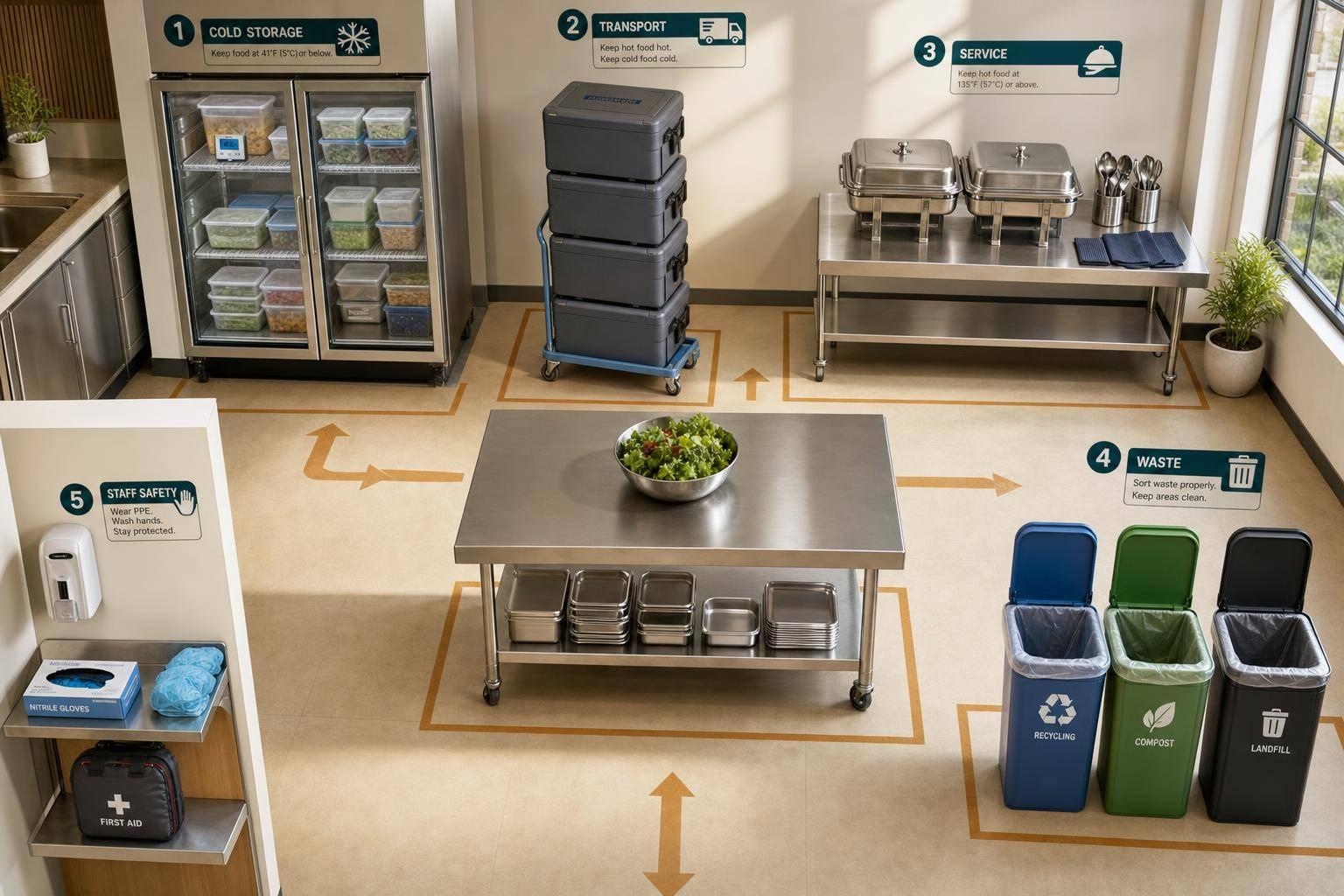
Here’s the short version: I need to control storage, transport, service, and cleanup as one connected system. If I miss one step - like bad shelf order, weak cooler prep, missing temperature logs, or poor waste handling - the risk carries into the next stage.
What matters most:
A few numbers stand out. In one review of 64,661 inspections, 45% had cold-holding violations. In 2024, food service and drinking places reported 178,200 nonfatal injuries and illnesses, with a rate of 2.4 cases per 100 full-time workers. So this is not just about food. It’s also about crew safety.
Put simply, I’d treat this guide as a system for one job: keep food safe, keep staff safe, and document each step from prep to cleanup.
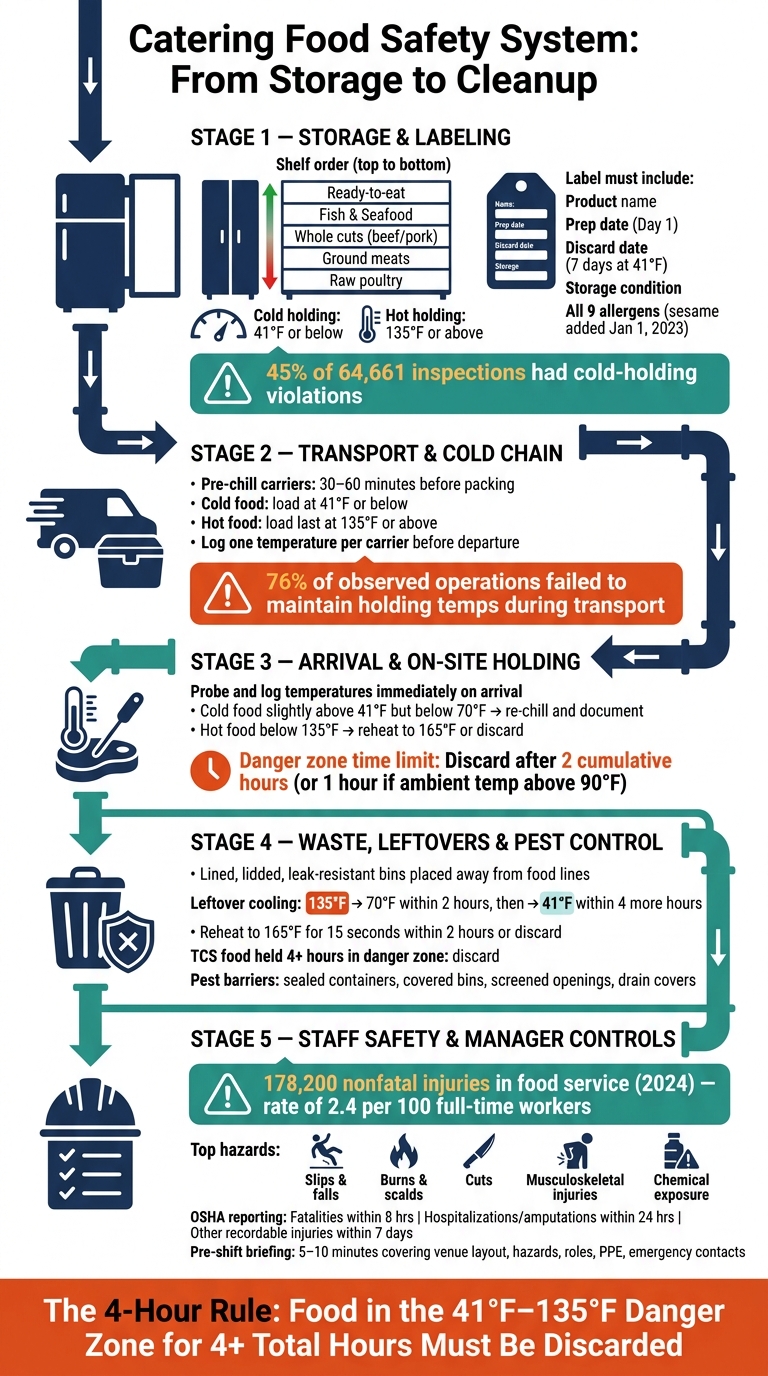
Catering Food Safety System: From Storage to Cleanup
Every catering kitchen needs tight control over cold, frozen, hot, and dry storage. Start with shelf order. Put ready-to-eat foods on top, then fish and seafood, then whole cuts of beef and pork, then ground meats, and raw poultry on the bottom shelf. That setup helps stop raw drips from landing on food that won’t be cooked again. Keep all food off the floor, covered, and stored away from chemicals.
Cold holding is one of the food safety rules kitchens break most often in U.S. food service. A New York City analysis of 64,661 inspections found cold holding violations in 45% of inspections, and the rate climbed 20% on days when temperatures reached 93°F or higher. For caterers handling outdoor summer events, that’s not small stuff. Heat puts pressure on every cooler, every prep table, and every handoff.
Dry storage needs the same kind of care. Keep it away from heat, moisture, and direct sunlight so packaged goods don’t spoil or pick up contamination. Log temperatures at opening, mid-shift, and closing. That way, staff are working from records instead of memory. If a unit goes out of range, move the food at once, track how long it was exposed, and write down what was done to fix it. Once storage is under control, labeling helps keep that control in place during prep, staging, and transport.
The next checkpoint is simple: every container should tell staff what it is, when it was made, and when it has to go. Under FDA Food Code §3-501.17, refrigerated ready-to-eat TCS foods held for more than 24 hours must be clearly date marked. Count the prep day as Day 1, and discard refrigerated ready-to-eat TCS food after 7 days at 41°F or below.
Use waterproof, smudge-resistant labels. A printed label template helps a lot, especially when temp staff are moving fast and don’t know your kitchen’s habits yet. It cuts down on guessing during busy prep shifts, especially when containers move from walk-ins to transfer coolers for event delivery.
FIFO matters too. Put new deliveries behind older stock and pull from the front. This matters most for items used across more than one event, like sauces, cooked proteins, and portioned vegetables. Those are the foods that tend to blur together when the kitchen gets hectic.
The FASTER Act took effect on January 1, 2023, adding sesame as the ninth major food allergen. Labels need to account for all nine major allergens, including sesame. In shared prep areas, color-coded bins or bold allergen notes on labels can help stop mix-ups before food leaves for the event site.
| Label Field | What to Include |
|---|---|
| Product name | Exact dish or ingredient name |
| Prep date | Date prepared or opened (Day 1) |
| Discard date | 7 days from prep date at 41°F or below |
| Storage condition | "Refrigerate at or below 41°F" or "Keep frozen at 0°F or below" |
| Allergen note | List any of the 9 major food allergens present |
When product is labeled, rotated, and sealed the right way, it’s much easier to load, track, and verify on arrival. It also speeds up loading and cold-chain checks at departure.
Once storage is sealed and labeled, transport becomes the next control point. At this stage, the goal is simple: hold safe food at safe temperatures. Transport keeps temperature steady; it does not fix food that was already unsafe.
Load cold food only when the vehicle is ready to go. Keep it at 41°F or below. Load hot food last, and place it in preheated insulated hot boxes or warming cabinets held at 135°F or above. Pre-chill coolers and insulated carriers for 30 to 60 minutes before packing.
Before departure, log one temperature from each carrier. That single check gives you a record in case someone later asks whether the cold chain held from kitchen to site.
Research on bulk food preparation found that 76% (13/17) of observed operations failed to maintain holding temperatures after preparation and during transport to customers or business units. That’s a clear warning: even if kitchen prep goes well, transport can still undo the work. The same care has to carry through at the venue.
As soon as food arrives, probe and log temperatures right away. Use a sanitized, calibrated probe thermometer, and record the item, temperature, time, and reader.
If cold food is only a little above 41°F and still below 70°F, re-chill it fast and document what you did. If hot food drops below 135°F, reheat it to 165°F or discard it if the time spent in the danger zone is unclear.
Once temperatures are confirmed, move food straight into holding equipment:
After the temperature check, sanitation becomes the next control point. At temporary sites, set up handwashing before service starts. Put covered waste bins away from food lines, and protect service stations with lids, tongs, or sneeze guards.
Temporary sites often go off track when sanitation is treated like an afterthought. Discard TCS food after 2 cumulative hours in the danger zone, or after 1 hour when temperatures are above 90°F. Label each station with its start time so staff can track that limit without guessing.
Safety problems tend to show up when no one knows who owns the task. Clear assignments and simple reminders help prevent missed temperature logs, late sanitation setup, and waste mistakes. Quickstaff can keep roles, load-out times, and service windows in one place.
After food leaves the line, waste control stops being “just cleanup” and becomes a food safety job. Every waste bin should be lined, lidded, leak-resistant, and clearly labeled so food waste stays separate from recyclables and general trash. Place bins away from buffet lines, plating stations, and prep surfaces, and keep lids closed when the bins aren’t being used.
During service, take waste out on a set schedule or once bins reach about two-thirds full. When bins overflow, they spill, pull in pests, and create cross-contamination risks right next to food. If there’s a spill, clean it right away: remove solids, apply cleaner, then sanitize the surface. Liquid waste, like melted ice or sauces, should go into approved sinks or floor drains meant for waste. Grease and fryer oil should go into dedicated, labeled containers for recycling or approved disposal. Never pour waste into storm drains or outdoor landscaping.
Waste reduction starts before service begins. Portion reviews and waste logs help managers spot repeat overproduction. If a dish keeps coming back half-full, that production target is too high. Track what gets thrown out, why, and how much. That gives you useful data for the next event and helps keep cleanup from turning into another contamination risk.
When service ends, the next call is simple in theory but strict in practice: can the leftovers be saved, or do they need to go? The answer depends on what temperature the food was held at and how long it stayed there. Any TCS food held more than 4 hours under time as a safety control must be discarded. Food from uncontrolled buffets, or passed hors d'oeuvres handled a lot without utensils, should also be discarded after service because there’s no clear, safe handling history.
If hot food stayed at 135°F or above during service and came back within safe time limits, it can be cooled for later use. Cool hot leftovers from 135°F to 70°F within 2 hours, then to 41°F within 4 more hours. Reheat to 165°F for 15 seconds within 2 hours or discard. Use shallow pans no more than about 2 inches deep, ice baths, or a blast chiller. Don’t stack pans or cover them tightly during the first cooling stage. Label cooled leftovers with the cooling start time, date, and intended use.
Donation can work, but only when food stayed under strict temperature control and wasn’t exposed to guest handling. Work with food recovery groups that spell out which foods they accept, how they want them packed, and when pickup happens. Label donated items with the product name, production date, and the time they were removed from hot or cold holding. Check local health rules before donating food, and put the process in a written SOP so the decision doesn’t change from one event to the next.
Poor waste control is one of the fastest ways to bring in pests. Rodents, cockroaches, flies, ants, and stored-product insects go straight for food residue, trash, and standing water. The barriers that help keep them out are simple: sealed containers, covered bins, tight doors with sweeps, and screened openings. Drain covers help block entry through plumbing. In transport vehicles, clean food spills after every run and keep doors closed during loading whenever possible.
Outdoor events need extra attention. Covered food displays, chafers with lids, and closed beverage dispensers help cut down pest attraction. Flies and bees are drawn to open food, especially sugary items and drinks. Routine inspections should check under and behind equipment, in dry storage, around trash areas, and near drains. Look for droppings, gnaw marks, live or dead insects, and harborage conditions like clutter or unsealed gaps.
If pest activity shows up, act at once. Stop service in the affected area if needed, isolate or discard any food that may have been contaminated, and then clean and sanitize all affected surfaces and equipment. After that, fix the cause. Maybe it’s a leaking pipe, overflowing trash, or an unsealed crack. If the activity is serious or keeps coming back, call a licensed pest-control professional. Document each incident, every corrective action, and every pest-control visit. Those records help teams adjust layout, waste placement, or cleanup routes for the next event.
Food safety tends to fall apart fastest when crews are rushed, hurt, or unsure who owns what. And catering work comes with plain, physical risk.
In food services and drinking places, the Bureau of Labor Statistics reported 178,200 nonfatal injuries and illnesses in 2024, with a rate of 2.4 cases per 100 full-time workers.
The hazards show up in the same places again and again:
These risks stay under control only when managers bake controls into every shift instead of hoping staff will figure it out on the fly.
Safety needs to live inside the workflow, not in someone's head. Under event pressure, memory is shaky. A short 5–10 minute pre-shift briefing can make a big difference if it covers the venue layout, known hazards, role assignments, PPE, and emergency contacts. It also needs to fit the event in front of the team, not come from a generic script no one listens to.
Clear role ownership matters just as much. When a safety-heavy task belongs to "everyone", it often belongs to no one. A transport safety lead can verify loading and temperature checks. A service lead can handle chafer fuel and cable placement. That kind of direct ownership cuts down on missed steps.
Written checklists help turn those duties into repeatable action. They should cover loading, arrival setup, temperature checks, and end-of-event closeout. Quickstaff can assign roles, attach safety notes, and centralize event communication so staff get their responsibilities before they arrive on site.
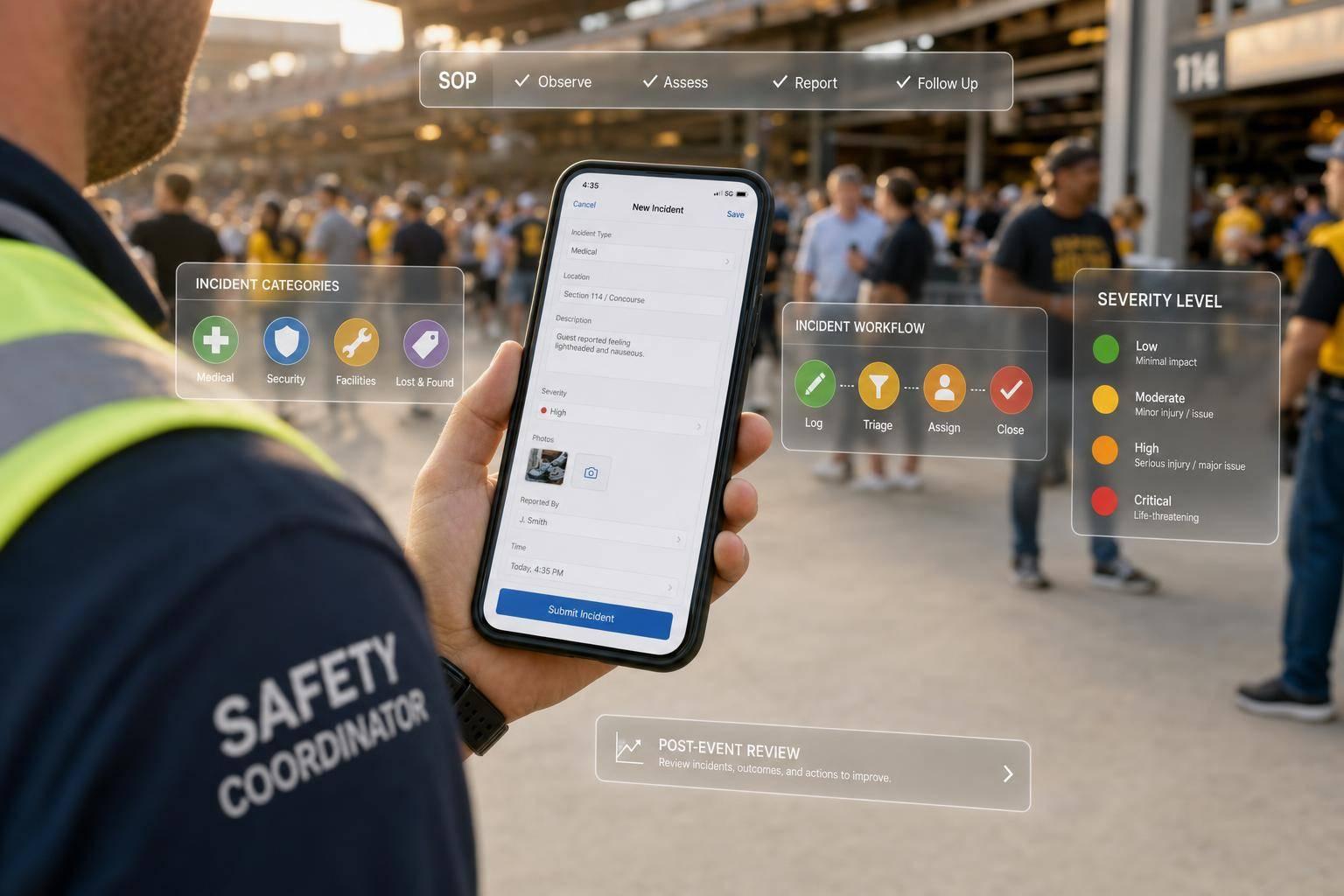
Incident reporting also needs to be simple, standard, and non-punitive. If people think reporting an issue will get them blamed, they stay quiet. A basic paper or digital form that logs the date, location, task, equipment involved, and type of incident gives managers something useful to work with. If burns keep happening around one piece of equipment, or slips keep showing up at the same venue, that's a pattern worth fixing.
OSHA requires fatalities to be reported within 8 hours and inpatient hospitalizations, amputations, or loss of an eye within 24 hours. Other recordable injuries must be logged within 7 calendar days. Staying up to date on those rules is the floor, not the finish line.
The big point is simple: storage, cold chain, waste, hazards, and manager controls all work as one system. When one part slips, the risk moves downstream. A missed temperature log can lead to food safety trouble. An unclear role can lead to skipped setup checks. An overflowing waste bin can turn into a slip hazard in minutes.
That's why checklists, documented checks, role assignments, and centralized communication matter. They turn manager knowledge into team action. Consistency is what keeps catering safe, not last-second reminders.
The danger zone is the temperature range between 40°F and 140°F. In that window, bacteria can multiply fast on food, which increases the risk of foodborne illness.
For catering managers, that means keeping a close eye on temperatures during prep, transport, and service so food spends as little time as possible in this zone.
Cool and label catered leftovers based on your venue’s rules. There isn’t one set disposal window in the guidance here, so stick with your venue’s food safety and waste procedures.
Quickstaff can help keep event details in one place so your team stays clear on cleanup steps.
Managers can cut down safety mistakes with short pre-shift and pre-service briefings, clear role assignments, and a quick fact check before service starts. That means everyone knows their job, knows who to ask, and isn't guessing when things get busy.
They also need to stop cross-contact and cross-contamination before it starts. Use labeled, sealed storage, keep tools separate, and enforce strict handwashing. Small slips here can turn into big problems fast.
The run sheet should spell out the emergency chain in plain terms. Include muster points, response times, and exactly who calls 911 or stops service. In a tense moment, no one should have to figure it out on the fly.
Setup routes and service zones need control too. Keep traffic patterns clear, limit mix-ups between teams, and make sure the layout supports safe movement.
After each event, review logs and near-miss records. That's often where the weak spots show up - before they turn into actual incidents.