How to Train Event Staff for Better Productivity
May 22, 2026

Well-trained event staff can make or break an event's success. Proper training not only improves efficiency but also enhances guest satisfaction and reduces costs. Here's what you need to know:

How to Train Event Staff for Better Productivity: A Step-by-Step Framework
To boost your team's effectiveness, start by defining what "productive" looks like for your event staff. Then, assess how they're currently performing. Accurate measurement helps you create targeted training that can make a real difference.
Goals like "work faster" or "be more efficient" are too vague to be actionable. Instead, focus on clear, measurable outcomes. Here are some metrics that can help you evaluate event staff performance:
| Metric | What It Measures | Event Example |
|---|---|---|
| Planned-to-Done Ratio | Tasks completed vs. tasks assigned | How many setup checklist items are finished before doors open |
| Utilization Rate | Active work time vs. total shift hours | Time spent on guest-facing tasks compared to idle time |
| Output Ratio | Total output per worker-hour | Number of guests checked in or meals served per hour |
| First-Contact Resolution (FCR) | Issues resolved without escalation | Guest questions answered without needing a supervisor |
| Quality of Work | Guest satisfaction and error rates | Feedback scores from registration or service stations |
"Don't confuse activity with productivity. Many people are simply busy being busy." - Robin Sharma, Author
By combining quantitative metrics like output ratios with qualitative data such as guest feedback, you'll get a more complete view of your team's performance. Numbers show what happened, while feedback reveals how well it was done.
Use these benchmarks to analyze past performance and pinpoint areas for improvement.
Once you've nailed down your metrics, it's time to review past event data. Look for patterns in shift logs or supervisor notes that highlight inefficiencies, like staff waiting for materials or unclear instructions. Using scheduling tools for caterers can help mitigate these gaps by improving real-time communication. These insights often point to process issues.
Schedule performance reviews 2–4 weeks before your event. This lets you establish a baseline to compare against post-event, so you can see if training efforts paid off.
When evaluating staff, stick to the SBI framework - Situation, Behavior, Impact. For example, instead of saying someone "seemed slow", document the specific situation, the behavior you observed, and how it affected operations. This approach keeps feedback objective and actionable.
"Documentation protects both you and the staff member by creating clarity and a reference point for future conversations." - Megan Hayward, Founder & CEO, TempGuru
With a clear understanding of past performance, you'll be better equipped to set realistic, measurable goals for your team.
Even the best benchmarks won't help if your team doesn’t know what’s expected of them. Share a two-page briefing 48 hours before the event. This should outline responsibilities and give staff a chance to ask questions. Keep it short - a main document plus a one-page role-specific addendum works well.
On the event day, hold a quick 10-minute meeting about 30 minutes before doors open. Use this time to review the timeline, clarify roles, and explain how to escalate issues. A simple rule like the "60-second rule" - if a problem can’t be resolved in 60 seconds, call the lead coordinator - helps prevent confusion and keeps things running smoothly.
Finally, reinforce that performance coaching is about skill-building, not punishment. This mindset encourages staff to improve without fear of making mistakes.
If you've pinpointed performance gaps in your team, the next step is to create a training program that’s practical and easy to apply. The goal? Equip your team with tools and strategies they can start using immediately.
A strong training program introduces techniques that are both simple and effective. One standout method is the 4 Ds framework - Do, Delegate, Defer, Delete. This helps team members quickly sort through tasks during busy moments, avoiding the temptation to tackle whatever feels most urgent. Pair this with the Eisenhower Matrix, which categorizes tasks by urgency and importance, and you’ll see less time wasted on low-priority work.
The Pomodoro Technique is another great tool, especially for long shifts that require sustained focus. It breaks work into 25-minute blocks with 5-minute breaks in between, helping staff maintain energy and concentration. Then there’s single-tasking - focusing on one task at a time. Studies show that multitasking drains mental energy and leads to more mistakes, so sticking to one task at a time is a game changer.
| Principle | Action | Benefit for Event Staff |
|---|---|---|
| 4 Ds | Do, Delegate, Defer, Delete | Quick decision-making during busy periods |
| Eisenhower Matrix | Sort by urgency and importance | Focuses effort on high-value tasks |
| Pomodoro | 25 min work / 5 min break | Sustains focus during long shifts |
| Single-Tasking | Complete one task at a time | Reduces errors and mental fatigue |
These techniques form the foundation for event-specific training that addresses your team’s unique needs.
Off-the-shelf training programs often miss the mark in event environments. For example, a catering team handling a dinner service faces different challenges than someone managing registration at a trade show. To design effective modules, start with a quick training needs analysis. Look at past event data and ask supervisors where things typically go wrong.
Keep training concise. Microlearning modules that last under 10 minutes are ideal for pre-event schedules. Create separate modules for key event phases like load-in, peak service, and teardown. Each module should include a clear SMART objective so staff know exactly what success looks like at each stage. For new team members, pairing them with a mentor during their first 30 minutes on-site can fill gaps that videos or handouts might miss.
To make these modules stick, provide practical tools and resources.
Preparation is everything, and tools like checklists can make all the difference. Pre-event role descriptions and written checklists help eliminate confusion and minimize rework. On-site, one-page checklists for each event phase keep staff focused, even in high-pressure situations.
Platforms like Quickstaff can also streamline scheduling by offering clear views of roles, shifts, and responsibilities. When team members know exactly where they need to be and what they should be doing, they can focus on execution rather than logistics.
"The difference between great temp outcomes and mediocre ones is almost never the worker - it's the preparation." - Megan Hayward, Founder & CEO, TempGuru
Even the best-trained teams can lose focus when transitions and handoffs are poorly managed, especially under pressure. By combining clear scheduling with defined roles, you can help your team stay focused and turn those productivity plans into tangible results.
A master timeline is essential for keeping everyone on track. Break the event into precise phases - covering everything from load-in to breakdown - and use it as your guide. Complement this with a 10-minute on-site briefing, held 30 minutes before doors open, to ensure everyone is aligned. Here’s an example breakdown of how to structure the briefing:
| Briefing Phase | Duration | Focus |
|---|---|---|
| Timeline walkthrough | 3 minutes | Review key transitions and timing |
| Role confirmation | 3 minutes | Ensure everyone knows their responsibilities |
| Communication protocols | 2 minutes | Verify radio channels and command stations |
| Final questions | 2 minutes | Address last-minute concerns |
Pair this with the 60-second escalation rule to resolve minor issues quickly. This ensures small problems don’t distract team members from their primary tasks.
Idle time can quickly derail productivity. To avoid this, assign staff to specific zones using an event staffing needs analyzer - like registration or VIP areas - to prevent overcrowding in one spot and ensure every area is properly managed.
Smooth handoffs between shifts are just as important. Use a 5-to-10-minute overlap for transitions, allowing the outgoing and incoming staff to briefly connect. This overlap ensures critical details are shared without confusion. Written role descriptions that outline tasks, tools, and expectations further eliminate guesswork and reinforce the planning done before the event.
These consistent workflows also create opportunities for real-time coaching and feedback.
Supervisors should stay visible and engaged throughout the event. One effective strategy is conducting 90-minute check-in laps, where you walk the floor to identify issues and provide quick support. This hands-on approach has been shown to improve worker performance by 20–30%.
When giving feedback, stick to the SBI framework (Situation, Behavior, Impact). This keeps the conversation focused and actionable. Always deliver corrective feedback in private to avoid damaging morale or creating distractions.
"Timely, constructive feedback is how event staff improve. Without it, they repeat mistakes and never develop expertise." - Megan Hayward, Founder & CEO, TempGuru
Don’t forget the power of positive reinforcement. Recognizing great work during the event motivates your team and makes them 3.7 times more likely to take on future shifts. This continuous feedback loop not only boosts morale but also reinforces the training and planning efforts, ensuring peak performance throughout every phase of the event.
Getting pre-event scheduling right is key. Even a top-notch team can struggle if staffing doesn't match an event's specific needs.
The best way to avoid staffing missteps - whether too many or too few - is to rely on historical data. Look back at past events to fine-tune your staffing plans over time.
But don't stop there. Factor in event-specific details like the size of the venue, expected guest count, program complexity, and the number of areas that need coverage. For instance, staffing for a 200-person seated dinner in a hotel ballroom is very different from a 200-person outdoor cocktail reception with multiple service stations. Each event requires its own tailored staffing approach.
Once you have a well-informed forecast, you can distribute workloads more effectively, ensuring your team performs at its best.
Uneven workloads can wear down your top performers. To avoid this, assign roles based on your team members' experience and skills. High-pressure tasks should go to seasoned staff, while senior members can be placed where their expertise will have the most impact.
Cross-training is another game-changer. When team members are equipped to handle multiple roles, you can adapt more easily to unexpected challenges, like last-minute absences or sudden spikes in demand. Staggered schedules also help reduce bottlenecks. For example, having setup crews, registration staff, and floaters start at different times ensures smoother transitions. Overlapping shifts during key handoff periods can prevent critical details from slipping through the cracks.
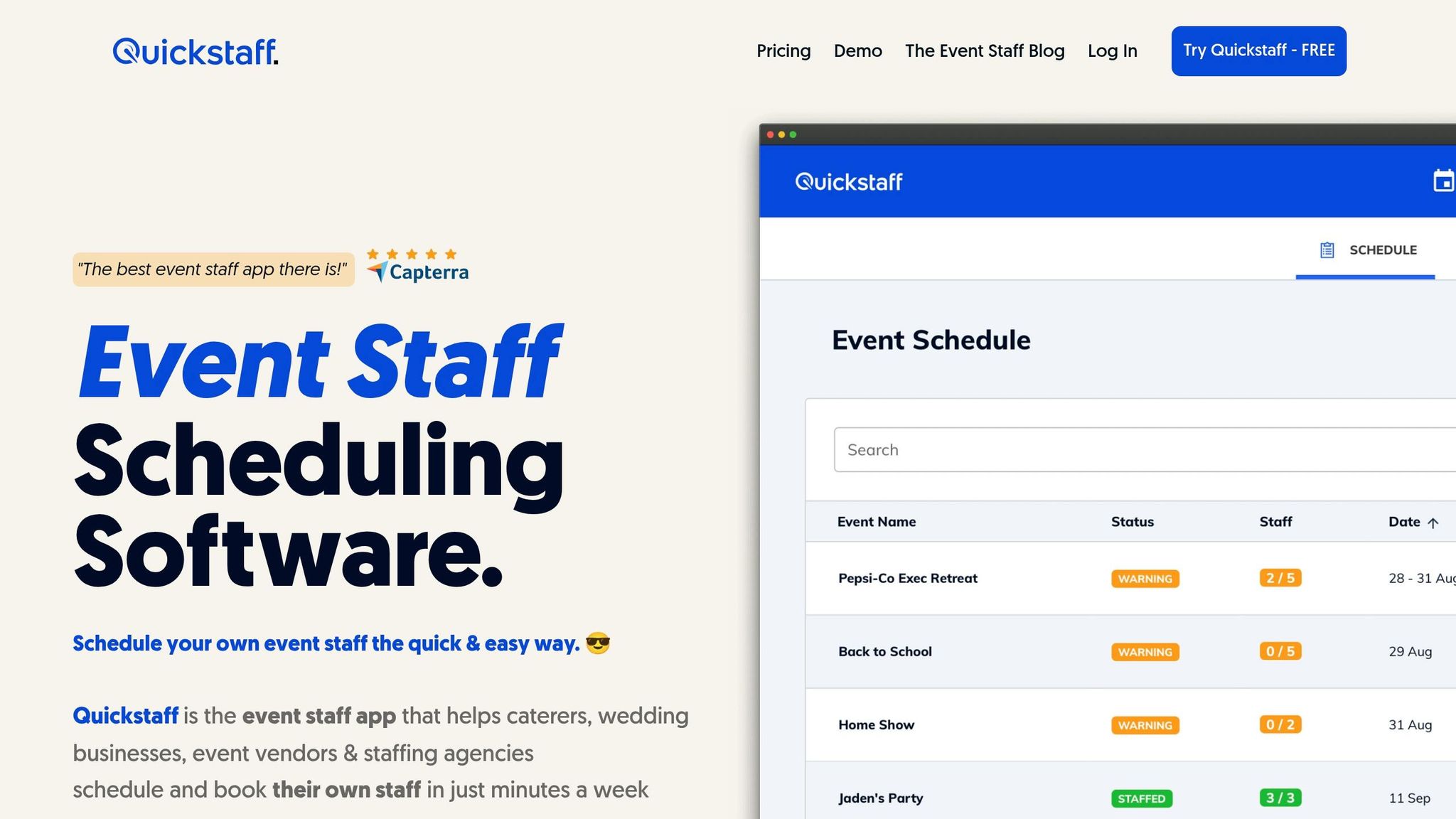
Managing schedules manually can quickly become overwhelming. That’s where digital tools like Quickstaff come in. Built for event-based businesses - such as caterers, staffing agencies, and wedding planners - Quickstaff simplifies the entire scheduling process.
With Quickstaff, you can assign roles and headcounts with precision, track staff availability in real time, and even automate waitlists. This not only saves time but also reduces the stress of last-minute changes. On the day of the event, digital check-in rosters help ensure all areas are properly staffed as planned. The platform’s mobile-friendly design also keeps your team informed with real-time updates and reminders, cutting down on miscommunications during crucial moments.
Managers save an average of 20 hours per month by using integrated scheduling, time tracking, and payroll applications.
That extra time can be used to coach your team, refine your staffing strategies, and elevate the overall success of your events.
To truly improve productivity, training shouldn't be a one-and-done effort. It needs to be an ongoing process, woven into every event cycle. Start by including productivity training in your onboarding process so new hires understand expectations before they even step on-site. Then, keep the momentum going with quick refreshers before each event and structured debriefs afterward.
Coaching should also happen in real time. As Megan Hayward, Founder & CEO of TempGuru, explains:
"The most effective coaching happens during or immediately after the moment it's needed."
Use the SBI (Situation, Behavior, Impact) framework to deliver feedback that's clear and actionable. This method focuses on describing what occurred, the staff member's actions, and the outcome of those actions. By avoiding judgment, it creates a constructive environment where employees can adjust without feeling criticized. Keep coaching sessions focused on development and separate from disciplinary discussions to ensure they remain positive and growth-oriented. This consistent approach helps build a foundation for long-term improvement.
Tracking the results of your training initiatives is just as important as delivering the training itself. After each event, document feedback with details like dates, topics discussed, and agreed-upon improvement areas. Over time, this creates a clear record of each staff member's progress and highlights areas where additional support may be needed.
To measure the impact of your training, monitor metrics like guest satisfaction, task completion rates, and shift acceptance rates. For instance, if trained staff are accepting more shifts and returning for future events, that’s a strong indicator that your program is effective. Tools like Quickstaff can help by providing scheduling software data that reveals patterns in staff availability, repeat bookings, and no-shows. This data-driven approach gives you a clearer view of team engagement and reliability, helping you make informed decisions about future training and adjustments.
Recognition plays a critical role in retaining event staff, especially in an industry where turnover exceeds 70% annually. In fact, recognized employees are 3.7 times more likely to accept future shifts.
There are many ways to show appreciation. Public acknowledgments, personal thank-you notes, or even LinkedIn endorsements can go a long way. Tiered rewards, such as offering $25 after three events or $50 after five, can also motivate staff to stay engaged. For top performers, consider assigning them to higher-profile roles or leadership positions, like crew lead, to further reward their contributions.
Megan Hayward sums it up well:
"Recognizing and appreciating event staff is more than good manners - it's sound business practice. Staff who feel valued perform better, are more likely to return for future events, and create positive word-of-mouth."
To ensure recognition feels genuine and earned, establish clear criteria for bonuses and rewards. When employees know exactly what’s expected, they’re more motivated to meet those goals, and the acknowledgment becomes even more meaningful.
Boosting event staff productivity isn’t about a one-time training session. It’s about creating consistent habits that touch every part of your operation. This includes setting clear goals, tracking performance, offering in-the-moment coaching, and recognizing contributions. The process boils down to a few essential actions: define what productivity looks like, address on-site challenges through targeted training, stick to standardized workflows with real-time feedback, and fine-tune scheduling by addressing common scheduling problems. Research from Gallup shows that highly engaged teams can achieve 21% higher profitability. That level of engagement comes from continuous development, structured feedback, and fostering a workplace where staff feel valued and appreciated.
On top of these steps, scheduling tools can make a big difference. Platforms like Quickstaff simplify the process by centralizing staff availability, role assignments, and event communication. When your team knows exactly where to be and what’s expected before they arrive, they can focus on delivering great results instead of worrying about logistics.
At the end of the day, success isn’t just about systems - it’s about building a culture centered on accountability and growth. The best teams thrive on clear expectations, dependable systems, and ongoing improvement. Start small - perhaps by refining pre-event briefings or tracking shift acceptance rates - and build from there.
Key metrics to keep an eye on for event staff include employee productivity, goal completion rate, engagement levels, time to competency, retention rates, and quality of work. If training is part of their development, it’s also worth tracking learner engagement and how well they perform after completing the training.
For internal events, you can gain deeper insights by measuring factors like participant value, event performance, and the behavioral impact of the event. These metrics can shine a light on staff productivity and the overall success of your events.
Divide training into clear, targeted modules, each zeroing in on a specific event-related skill. For example, you could have separate sessions dedicated to AV setup, logistics coordination, or attendee engagement techniques. Keep the structure consistent across modules and gradually progress from basic principles to more advanced strategies.
To make learning accessible and efficient, offer pre-recorded materials that staff can review anytime. Add interactive elements like quizzes or quick exercises to help reinforce key takeaways and ensure the material sticks.
This modular system keeps training streamlined and ensures team members are well-equipped with the skills they need for a successful event. Plus, it allows for flexibility, letting staff focus on the areas where they need the most improvement.
To keep operations running smoothly and minimize downtime, it's important to plan structured break rotations. Here's how you can do it effectively:
This approach keeps teams focused and ensures no gaps in coverage.