Ultimate Guide to Event Staffing Demand Forecasting
March 7, 2026

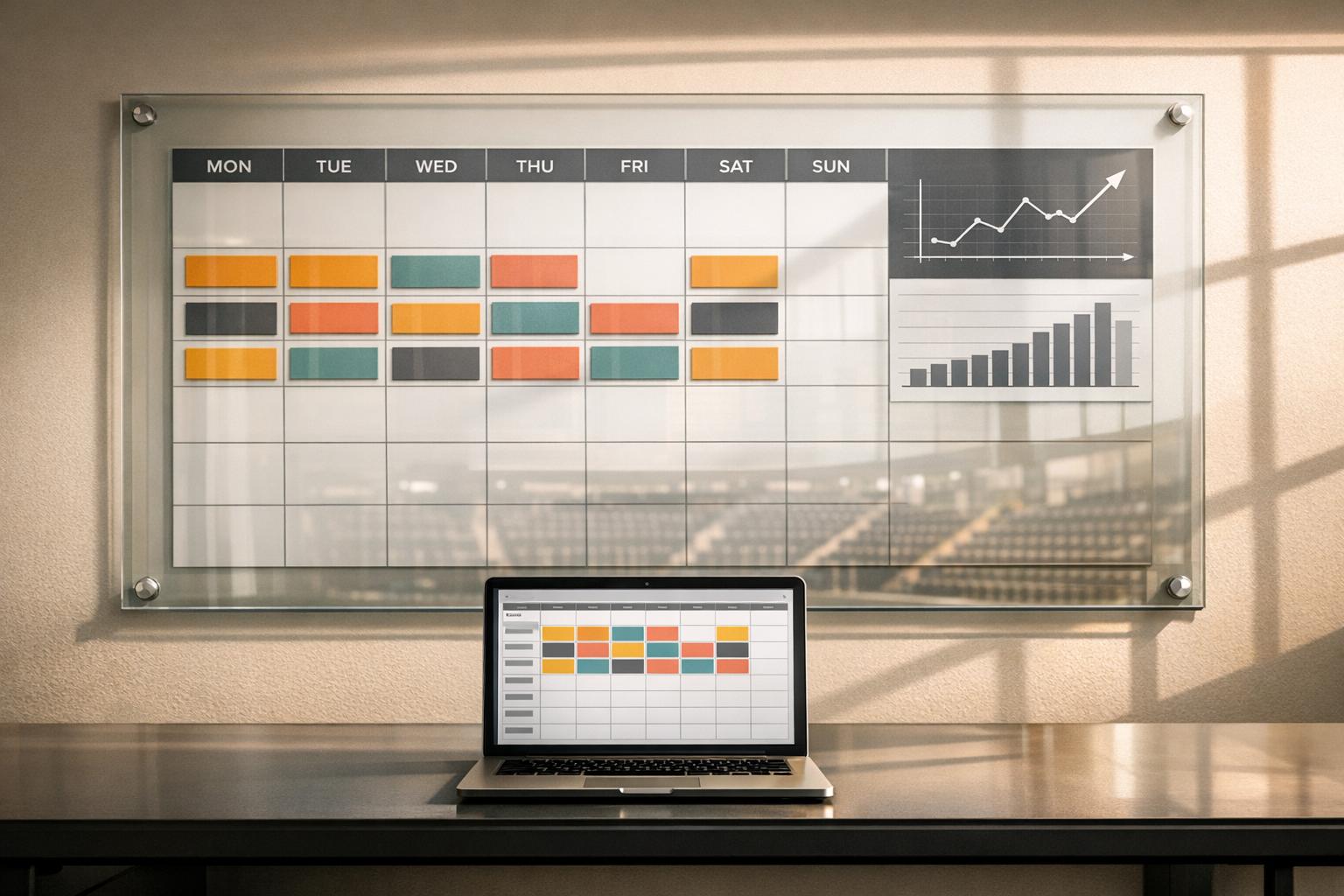
Event staffing demand forecasting helps you plan the right number of staff, their roles, and schedules for smooth event operations. It's not guesswork - it's based on analyzing data like historical trends, staff-to-guest ratios, and peak activity times. This approach reduces costs, prevents service issues, and avoids staff burnout.
By combining past data, demand drivers, and forecasting methods like time-series analysis, regression models, and scenario planning, you can create precise staffing plans. For better efficiency, consider tools like Quickstaff, starting at $49/month, to streamline the process.

Event Staffing Demand Forecasting: Key Statistics and Impact
Getting staffing right is critical for a smooth event day - it safeguards your budget, ensures top-notch service, and keeps your team engaged. When you rely on accurate demand forecasting, you're making decisions based on data, not guesswork. This impacts three key areas: your finances, the quality of your service, and your team's morale.
Overstaffing is a quick way to shrink profit margins in event management. With labor costs accounting for up to 70% of operating expenses, even small missteps in planning can lead to costly consequences. Relying on averages instead of pinpointing specific event needs often results in unnecessary hires.
"Overstaffing inflates costs and erodes margins."
- Edin Pandur, Liveforce
Take recurring events as an example - 85% of them switch cities or dates each year. Using last year’s staffing numbers without adjustments could leave you overstaffed. Instead of scheduling 50 people for 10 hours, demand forecasting allows you to calculate needs more precisely, such as 1.25 shifts per role. This could reduce the headcount to 45, even with a 15% contingency for unexpected changes.
By applying data-driven ratios - like one staff member per 50 guests for certain roles - and considering shift overlaps and breaks, you can avoid hiring too many people while still accounting for last-minute changes or no-shows.
While overstaffing drains your budget, understaffing can hurt your reputation. Not having enough staff leads to delayed setups, long lines, and stressed workers who can't maintain the service standards your clients expect. For example, in retail, understaffing can cause a 6% drop in sales, and 86% of customers abandon a brand after just two bad experiences.
The financial risks don’t stop there. Emergency staffing often comes at a premium, and overworked employees may file workers' compensation claims for injuries caused by fatigue. There’s also the risk of legal trouble - excessive hours for exempt staff could lead to wage-hour law violations, and last-minute scheduling changes might conflict with predictive scheduling laws in some areas.
"These people [overworked exempt staff] will be far more willing to challenge their exempt status, and there will be no shortage of attorneys ready to convert their case to a class action."
- Gary Pearce, Chief Risk Architect, Aclaimant
By analyzing historical trends, seasonal changes, and real-time variables, demand forecasting helps you predict staffing needs more accurately. Instead of scrambling to fill gaps on event day, you can prepare a backup pool of cross-trained workers and use multi-channel confirmations to minimize no-shows.
Good forecasting doesn’t just help with budgets and service - it also affects whether your staff will want to work with you again. A staggering 83% of frontline workers say understaffing makes their jobs far more stressful. Chronic understaffing can create a vicious cycle: burned-out employees quit, leaving the remaining team even more overwhelmed.
Strategic forecasting ensures fair schedules and proper coverage during both peak and slow periods. By planning for high-demand moments - like guest arrivals or meal service - you can avoid overburdening your team during quieter times. This balance keeps stress levels down and morale high.
The results of effective forecasting are clear. In August 2025, Legion Technologies integrated verified event data into their workforce platform, achieving 98% accuracy in labor forecasts while cutting data processing time by 20%. This not only improved operational efficiency but also gave employees more predictable schedules, boosting engagement.
"Customer service leaders that integrate advanced analytics into workforce planning consistently outperform peers in both satisfaction and revenue growth."
Next, learn how to put these forecasting strategies into action. For larger operations, building a scalable event scheduling system is the next logical step.
Forecasting event staffing demand boils down to three key steps: reviewing past data, pinpointing key drivers, and using forecasting tools. With 66.1% of event planners focusing on data-driven decisions, this structured approach can help you make smarter, more accurate predictions. Here's how to get it right.
Start by analyzing historical event data. The best forecasts are rooted in a solid understanding of past trends. Look at metrics like attendance by event type, staff-to-guest ratios, and no-show rates from previous events. Pay attention to peak traffic times to determine when staffing levels need to be highest. Post-event debriefs are invaluable here - they highlight situations where you were overstaffed or understaffed. These insights create a reliable baseline for future planning.
Understand the key factors influencing staffing needs. It’s not just about how many people attend; event complexity plays a huge role. For example, a 500-person plated dinner requires significantly more servers (1 per 10-12 guests) than a 500-person buffet (1 per 20-25 guests). Consider the venue layout, operating hours, and specialized roles - technical positions, for instance, don’t scale proportionally with guest numbers. External factors like seasonal trends, weather for outdoor events, and shifts in the local economy can also impact staffing demands.
Translate those insights into specific staffing numbers. Break operating hours into manageable shifts. For instance, a 10-hour event with 8-hour shifts means you’ll need 1.25 shifts per role. To account for no-shows and last-minute changes, add a contingency buffer of 10-20%. For larger or more complex events, move away from manual spreadsheets and invest in centralized software to track staffing needs in real time. This approach reduces uncertainty and boosts confidence in your decisions.
Once you've gathered historical data and identified demand drivers, it's time to choose a forecasting method to guide your staffing decisions. The most effective methods include time-series analysis for spotting patterns, regression models for understanding relationships, and scenario planning (or "what-if" modeling) to address uncertainties. Each method offers distinct advantages, and together they form a solid foundation for staffing strategies.
Time-series analysis dives into historical data to uncover recurring trends and seasonal cycles. For example, you might discover that event volumes increase by 15% on Mondays or that wedding season drives a 30% spike in staffing needs. This method is ideal for organizations with consistent operations and a wealth of historical data.
It works best for predictable, recurring events like annual galas, corporate conferences, or seasonal festivals. However, it does have a downside: it assumes the future will closely resemble the past. If event formats evolve, client expectations shift, or new regulations emerge, time-series forecasts may fall short.
Regression analysis helps map out how staffing needs relate to specific business drivers. For instance, you might find that every 1,000 new customer acquisitions lead to 150 additional support interactions. Similarly, a plated dinner could require one server for every 10–12 guests, while a buffet might need only one server for every 20–25 guests. These models are especially useful for translating growth projections - like a new marketing campaign or product launch - into actionable hiring plans.
The accuracy of regression models hinges on the quality of your data and the identification of relevant variables. Missteps here can distort your forecasts. This method shines during periods of growth or when rolling out new services, as it links broader business trends directly to staffing requirements.
Scenario planning takes forecasting a step further by preparing for a range of possible outcomes. For example, you might plan for three scenarios: steady growth at 5% annually, rapid expansion at 20%, or a sudden setback like losing a major client. This approach allows you to pinpoint shared staffing needs across scenarios and maintain flexibility in your plans.
"I don't build staffing plans for the easy hours. I build them for the 15 minutes where check-in backs up, the client's asking questions, and everyone's looking at us to fix it." - CEO, Event Staff
The downside? Scenario planning can be speculative and time-intensive, requiring deep operational expertise to set realistic parameters. But when paired with time-series insights and regression adjustments, it becomes a powerful tool for connecting short-term scheduling with long-term goals. In unpredictable environments or during major business shifts, preparing for worst-case scenarios can make all the difference. Tools like Quickstaff further enhance these methods, enabling real-time staffing adjustments with ease.

Forecasting works best when you have the right tools in place. Quickstaff simplifies the process by centralizing event data, tracking real-time staff availability, and automating staffing workflows. Instead of juggling spreadsheets and endless communication, managers can easily see labor supply and demand across their entire calendar.
Quickstaff's centralized dashboard provides a clear view of upcoming events and staffing levels, offering instant insights into labor demand. The event duplication feature lets managers reuse past event details, making it easier to plan and schedule future events based on historical trends.
With role-specific scheduling, managers can ensure the right mix of staff - whether servers, bartenders, or photographers - is accounted for in forecasts. Before confirming any client bookings, pre-booking verification helps managers check staff availability for specific dates. Quickstaff sums it up perfectly:
"Your client wants to know if you can staff their event in 3 months. You can now answer them with confidence, in just 2 minutes."
Real-time availability tracking helps managers stay on top of staff schedules by showing block-out dates and potential conflicts. Staff can update their availability directly using mobile-friendly tools, keeping schedules current. Additionally, automated waitlists act as a safety net by inviting extra staff and managing a waitlist in case someone cancels or declines.
Jaime S., VP at Lisa's Catering, shared her experience:
"Prior to Quickstaff, I was using Excel spreadsheets to track my employees and their shift availability. My life changed the day I started using Quickstaff!"
Kelly from The Abbot KC added:
"The time that we have been able to save by using this staff scheduling software has allowed us to tackle the other issues that we face thereby improving our overall events!"
These features are available across all plans, designed to suit teams of any size.
Quickstaff offers three pricing options to fit different team sizes and event needs:
Each plan includes unlimited events, assisted onboarding, and dedicated customer support. No matter the size of your team, all features - like forecasting tools - are included. Managers can also take advantage of a 14-day free trial (no credit card required) to explore Quickstaff’s capabilities before committing.
Quickstaff’s mobile tools ensure managers can make real-time updates from any device. Whether a client changes their requirements or staff availability shifts unexpectedly, managers can quickly check staffing levels and address gaps across all events.
Steven Townsend, an Event Manager, shared how Quickstaff improved his workflow:
"I used to be on the phone all the time to schedule staff. Now, within a few minutes, I can schedule all the staffing I need for my events."
Jennifer Manley, a Staffing Coordinator, echoed this sentiment:
"My time spent scheduling has shrunk majorly, leaving me more time to focus on recruiting, on-boarding and training."
The mobile interface also allows managers to check availability for future dates instantly, making it easier to respond to client inquiries in minutes rather than hours. Events can sync with major calendar providers to prevent double-booking, and the unlimited messaging feature lets managers quickly contact specific staff groups - like only servers or bartenders - when needed.
No single forecasting method can address every situation perfectly. To improve accuracy, combine approaches. Start with quantitative models like time-series analysis to create a baseline, then add qualitative insights from experienced event managers. These professionals can adjust forecasts based on variables like upcoming marketing campaigns or competing local events. This combination allows for more precise planning and sets the stage for running comparative forecasts.
Running comparative forecasts side-by-side helps you prepare for best-case, worst-case, and expected scenarios. For instance, historical data might suggest you’ll need 25 servers for a corporate gala in June. However, if your sales team mentions the client is launching a new product that week and expects higher attendance, you can adjust staffing levels accordingly. Other factors like weather conditions, local festivals, or broader economic trends (e.g., inflation) should also influence your final numbers. As John Galt Solutions notes:
"Forecast accuracy only comes from blending the two techniques [qualitative and quantitative]".
Blended forecasting approaches are the key to accuracy. While historical data provides a solid foundation, it’s essential to incorporate real-world insights. Involve stakeholders across departments - operations, finance, and frontline staff - to ensure your forecasts align with both budget constraints and practical needs. Often, bartenders and servers notice trends that raw data might miss.
To improve precision, segment your forecasts by factors like role type, region, or event category. For example, a spring wedding might require a different server-to-guest ratio than a fall corporate conference. Only 40% of companies currently excel at workforce forecasting, so refining your methods can give you a competitive advantage. Also, consider lead times when adjusting forecasts to ensure you can schedule staff effectively.
In addition to combining methods, automating forecasting processes can make them even more efficient.
Manual forecasting is time-consuming and often inefficient. Automation can handle repetitive tasks like seasonal adjustments and moving averages, freeing managers to focus on unique or unpredictable situations. Forecasting software processes large, complex datasets - such as historical sales trends, weather impacts, and event staff availability tracking apps - faster and more accurately than manual methods.
The benefits of automation are clear. In 2025, Typeform introduced automated forecasting tools, achieving over 90% accuracy and eliminating daily manual adjustments. Companies that excel at demand forecasting report 60% higher profit margins and can cut labor costs by 10% to 15%. As Manhattan Associates advises:
"Rely on the software forecast as a starting point, but update forecasts closer to the point of decision to improve accuracy".
Tools like Quickstaff streamline these processes, allowing forecasts to adapt quickly to new information without requiring a complete restart each time.
Getting forecasting right is crucial for balancing costs while maintaining quality service. Demand forecasting not only safeguards profit margins but also ensures smooth operations and keeps staff morale high. Companies that excel in this area often enjoy profit margins up to 60% higher than their competitors. The difference between thriving and struggling often hinges on planning for peak demand rather than just average needs.
The best strategies combine hard data - like time-series analysis - with the intuition of experienced managers who understand factors like upcoming promotions, local trends, and competitor moves. Start by clearly defining coverage needs for each role and zone. From there, calculate shifts based on realistic working hours, and don’t forget to include a contingency buffer for unexpected challenges. Pay attention to details like shift handovers and high-traffic periods (e.g., doors opening or meal services), as these can expose gaps that might look fine on paper but fail in practice.
As your operation scales, consider moving beyond manual spreadsheets to tools like Quickstaff. This software centralizes event management, tracks real-time staff availability, and even sets role-specific rates. Starting at $49/month for teams of up to 35, it eliminates the headaches of version control and delayed communication, making scheduling far more efficient.
To make accurate staffing forecasts and improve event planning, focus on tracking essential data points. These include historical attendance patterns, event size and type, and seasonal trends. Be sure to factor in details like guest counts, task coverage requirements, and internal HR data such as timesheets and absentee rates. Don't overlook operational performance metrics or external influences like location-specific factors and market trends. By analyzing these elements, you can align staffing needs with demand and create a smoother planning process.
When determining the right staffing buffer, it's important to factor in your event's usual no-show rate. On average, about 40% of attendees may not show up, though this number can climb for outdoor events or those with more intricate schedules.
To make this process smoother, tools like Quickstaff can be incredibly useful. They allow you to review historical data and simplify scheduling. Additionally, having contingency plans in place and conducting regular check-ins with your team can help minimize no-shows and ensure you're adequately staffed.
Managing staff with spreadsheets can quickly spiral into a headache when things get too complicated. If you're noticing frequent scheduling mistakes, struggling to keep track of availability, or spending way too much time on admin tasks, it might be time to consider a better solution. Issues like poor staff coverage, growing team sizes, or handling complex event requirements are clear signs that spreadsheets just aren't cutting it anymore.
This is where Quickstaff steps in. Its automation features and real-time tools are designed to save you time and reduce errors. Whether you're dealing with understaffing or scrambling to manage last-minute changes, Quickstaff helps you stay organized and on top of your scheduling game.