7 State Laws Event Employers Need to Track
September 3, 2026

If you staff events in more than one state, the rule that usually matters most is the law where the event takes place. That affects how I post jobs, give shift notice, track sick leave, reimburse costs, classify workers, and issue pay statements.
Here’s the short version: 18 states plus D.C. had paid sick leave laws by December 2024, Oregon is the only state with a statewide predictive scheduling law, and at least 13 states plus D.C. require pay ranges in job postings by 2026. Add temp-worker notice rules in states like Illinois and New Jersey, and it’s easy to miss a step.
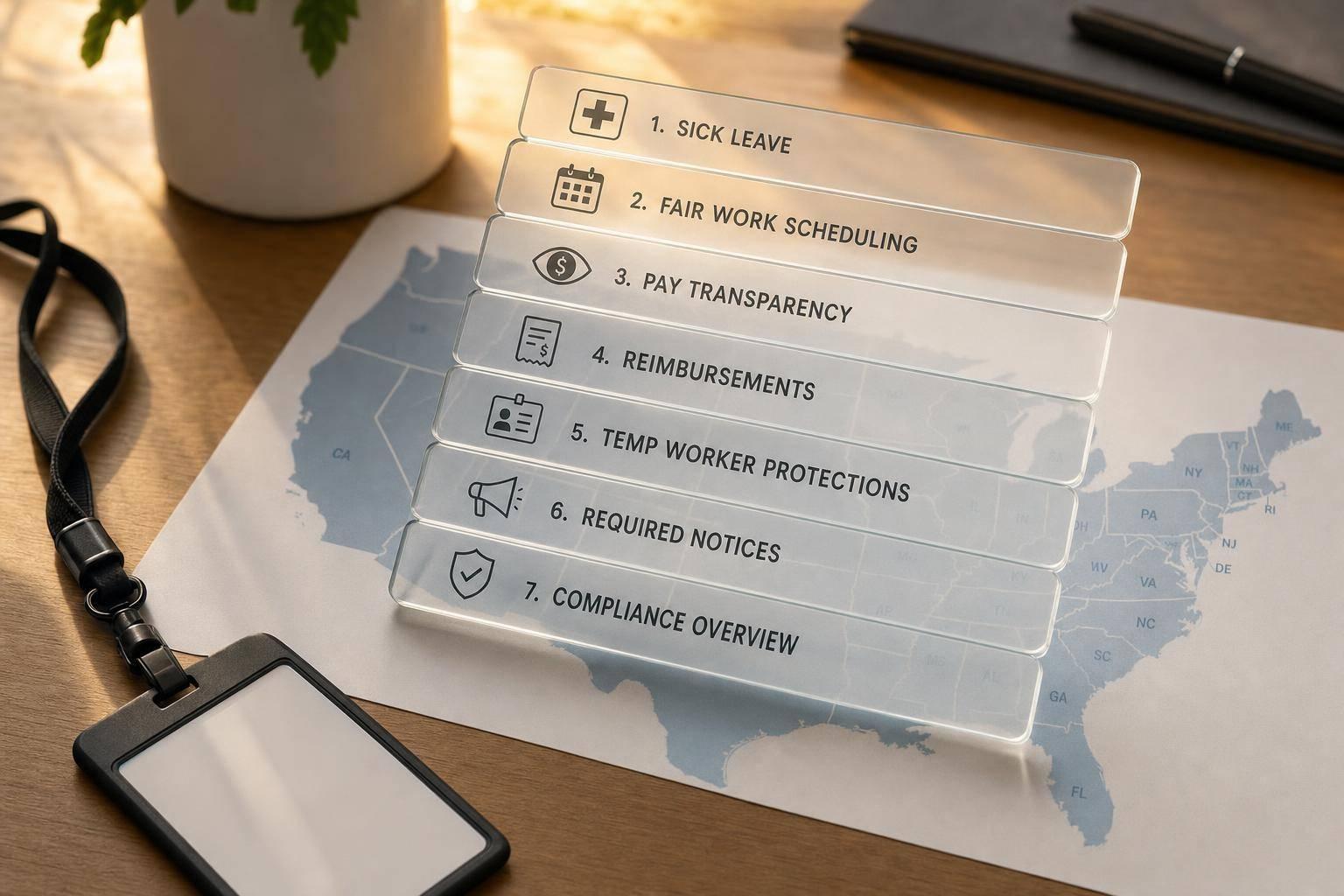
If I run event staff across state lines, I need to track these 7 areas:
Bottom line: I need to match each shift to the right state and local rules, keep clean records, and make sure staffing agency duties are clear before the first shift starts.
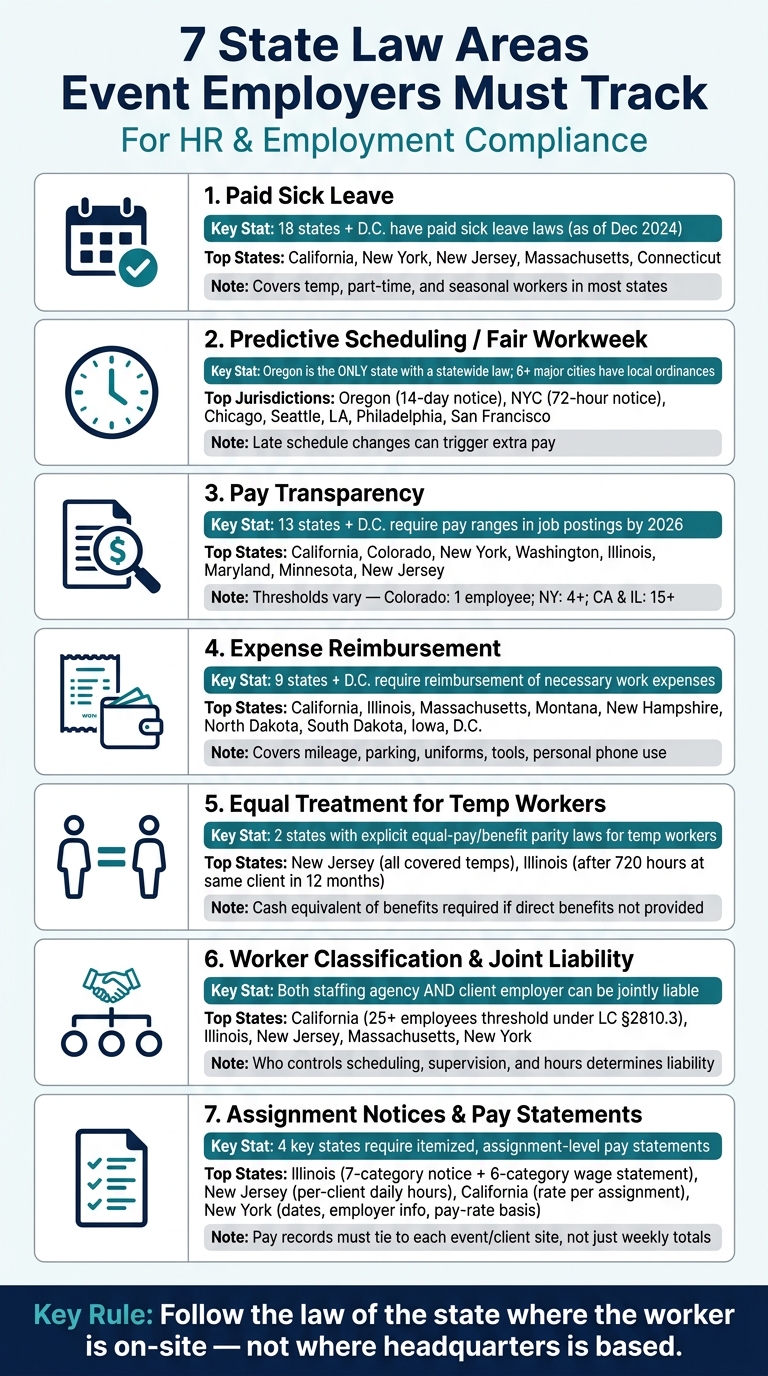
7 State Laws Event Employers Must Track (2024–2026)
| Law area | What I need to watch | States/cities that stand out |
|---|---|---|
| Paid sick leave | Who qualifies, accrual, notice, record retention | California, New York, New Jersey, Massachusetts, Connecticut |
| Predictive scheduling | Common scheduling problems and solutions, advance notice, late-change pay, no on-call limits | Oregon, New York City, Los Angeles, Chicago, Seattle, Philadelphia, San Francisco |
| Pay transparency | Pay range in postings, benefits details, employer-size thresholds | California, Colorado, New York, Washington, Illinois, Maryland, Minnesota, New Jersey |
| Expense reimbursement | Mileage, parking, uniforms, tools, phone use | California, Illinois, Massachusetts, Montana, New Hampshire, North Dakota, South Dakota, Iowa, D.C. |
| Equal treatment | Temp-worker pay/benefit parity with direct hires | New Jersey, Illinois |
| Classification/joint liability | Who controls the work, shared liability with agencies | California, Illinois, New Jersey, Massachusetts, New York |
| Notices/pay statements | Assignment notices, itemized wage details by client or site | Illinois, New Jersey, California, New York |
This article boils down where event employers tend to get hit hardest and what I’d track first. For long-term success, follow our guide to scalable event scheduling to maintain compliance as you grow.
These seven areas shape how event employers hire, schedule, pay, and protect temporary staff.
In hospitality, temporary staffing plays a huge role. At the same time, many states and cities require paid sick leave or fair workweek coverage for temp workers. Those rules apply to temp workers too. The catch is that coverage changes by jurisdiction. Some rules apply statewide, while major cities layer on their own fair workweek ordinances. Oregon has a statewide predictive scheduling law, while cities like Chicago, New York City, Philadelphia, Seattle, Los Angeles, and San Francisco have local fair workweek ordinances that add requirements on top of state law. That patchwork means local compliance tracking isn't optional.
These rules also overlap in ways that can trip employers up. A last-minute schedule change can trigger notice duties and predictability pay. And when a staffing agency is involved, both sides can face joint liability if sick leave or pay statements are handled the wrong way. Each rule matters on its own, but the job gets harder when they stack on top of each other.
The seven topics below show where these rules most often affect event staffing.
As of December 2024, 18 states and Washington, D.C. had enacted paid sick leave laws for private employers. For temp event staff, the details can shift a lot from one state to the next. If you hire banquet servers, bartenders, setup crews, or brand ambassadors, coverage often comes down to state rules and how many hours or days the worker has logged.
A lot of these laws cover temporary, part-time, and seasonal workers, but there’s usually a minimum work threshold with the same employer. California, for example, covers employees who work at least 30 days for the same employer within a year, and that includes temporary workers. New Jersey requires employers of all sizes to provide up to 40 hours of earned sick leave each year to full-time, part-time, seasonal, and temporary employees. Michigan’s 2025 law accrues at 1 hour per 30 hours worked, up to 72 hours for large businesses. Connecticut expanded coverage to include day and temporary workers that had been left out before, though seasonal employees are still excluded under that law’s definition.
The table below shows where the biggest temp-worker differences show up.
| State | Temp/Seasonal Coverage | Key Compliance Point |
|---|---|---|
| California | Covered after 30 days with same employer | Staffing agency employees are covered; "whoever is the employer or joint employer" must provide leave. |
| New York | Seasonal workers can accrue leave | Six years of payroll records required, with weekly accrual data. |
| New Jersey | Full-time, part-time, seasonal, and temp employees covered | Up to 40 hours per year; applies to all employer sizes. |
| Massachusetts | Temporary and seasonal employees included | Posting and written notice required at hire. |
| Connecticut | Day and temporary workers now covered | Seasonal employees are still excluded under the law's definition. |
Notice and recordkeeping rules also change by state. Many laws require workplace postings, written notice at hire, and sick-leave balance details on each pay stub or in a separate pay-period notice. California requires employers to keep records of hours worked and sick leave accrued and used for three years. New York requires payroll records for six years. Those same recordkeeping habits also help with the scheduling rules covered next.
Things get more complicated when staffing agencies are part of the setup. In those cases, the agency and the host employer may both carry part of the duty. That can get messy fast, especially when event workers move from one venue to another and work under different managers. California’s labor agency puts it plainly: "whoever is the employer or joint employer" must provide paid sick leave to workers who qualify.
That means agency contracts should spell out who tracks hours, who handles accruals, and who gives notices and postings at the actual event site. If that part is fuzzy, shared liability can sneak up on both sides.
Quickstaff can centralize schedules and attendance records to support sick-leave tracking across events and venues. Sick leave is only one layer; next come rules that govern when shifts are posted and changed.
Predictive scheduling laws require covered employers to give workers written schedules ahead of time. In some cases, they also require extra pay when shifts change after the notice window closes. For event employers, that matters a lot. A last-minute shift swap or cancellation can set off both notice and pay duties.
Oregon sets the statewide baseline, while most other fair workweek rules come from city ordinances. Oregon is the only state with a statewide predictive scheduling law. It applies to certain large employers in retail, hospitality, and food services with 500 or more employees worldwide, and it requires a written schedule at least 14 calendar days in advance. Oregon guidance also says temporary or leased workers are not covered under the state rule.
Many fair workweek rules are city-based, including in New York City, Chicago, Seattle, Philadelphia, Los Angeles, and San Francisco. New York City’s retail rule is stricter in a different way: employers must provide written schedules 72 hours before the first shift, cannot use on-call shifts, and cannot cancel a shift with less than 72 hours' notice. Los Angeles requires 14 days' advance notice, written responses to some schedule requests, and retention of related records - including good-faith estimates and change correspondence - for at least 3 years.
The biggest differences usually come down to notice timing and who the rule covers.
| Jurisdiction | Notice Required | Key Notes |
|---|---|---|
| Oregon (statewide) | 14 calendar days | Certain large retail, hospitality, and food service employers only; temp/leased workers not covered |
| New York City | 72 hours | No on-call shifts; no cancellation inside the 72-hour window |
| Los Angeles | 14 calendar days | Written responses to some schedule requests; 3-year record retention |
Temp staff often move across venues, supervisors, and job roles. That can get messy fast. The rule tied to the shift location may control, so check each venue’s requirements before posting shifts.
On the recordkeeping side, keep copies of posted schedules, any revisions, the date and time each change was shared, and whether employees agreed to those changes on their own. Quickstaff can centralize schedules, staff assignments, and change logs by event and role.
These notice rules are only part of the pay-compliance picture; next come wage disclosure requirements.
Pay compliance starts before anyone clocks in. It starts with the job post.
By 2026, at least 13 states plus Washington, D.C. require employers to include pay ranges in job postings. Key states include California, Colorado, New York, Washington, Illinois, Maryland, Minnesota, and New Jersey.
This applies to temporary event roles too. In many states, a temp event posting has to follow the same disclosure rules as a full-time job when the employer meets the state threshold.
Those thresholds vary quite a bit:
So even if an employer only hires event staff now and then, there's a good chance it falls under at least one state rule. And once a business is covered, the next step is figuring out what has to appear in the post beyond the wage range.
Most state laws call for a good-faith pay range. Some go further and also require a general description of benefits and other compensation, like overtime premiums, travel stipends, or per diem. Colorado, Washington, Maryland, and Minnesota do this. In those states, vague language like competitive pay or DOE is not enough.
For temp shifts, on-call roles, and agency placements, the key moment is still the posting or the point of hire. New Jersey handles temporary staffing agencies a bit differently. There, agencies placing event workers must provide the hourly wage, benefits, and other compensation details at the interview or hire stage for that assignment, instead of putting that information in the posting itself. California, Colorado, and New York do not give agencies that same exception. In those states, agencies must include pay ranges in the posting.
Archive every posting with the pay range, run date, and any later updates. Quickstaff can keep staff assignments, event details, and pay-rate records in one place.
Most event employers focus on wages first. That makes sense. But there's another cost that can trip people up: what a temp server pays out of pocket to do the job.
Picture it. A worker drives 30 miles to a venue, pays for parking, and buys a required uniform before clocking in. In several states, plus Washington, D.C., that can create a compliance issue.
Several states, plus Washington, D.C., including California, Illinois, Massachusetts, Montana, New Hampshire, North Dakota, South Dakota, Iowa, and Washington, D.C., have rules that can require employers to reimburse employees for necessary work-related expenses. California's Labor Code § 2802 is one of the broadest. It can cover mileage, parking, tolls, uniforms, tools, and even part of a worker's cell phone bill when the device is used for shift assignments. Illinois follows a similar approach, but with more structure. Expense requests generally must be submitted within 30 calendar days after the expense is incurred unless a written policy gives workers more time, and employers must keep reimbursement records for at least 3 years. If those costs go unpaid, the next question is simple: did they push the worker's net pay below the wage floor?
For temporary event staff, that risk is real. Unreimbursed job costs can turn a legal wage into a lower net wage. If temporary staff pay unreimbursed mileage, parking, or uniform costs out of pocket, net pay can fall below the state minimum wage floor. At that point, you're not just dealing with an expense issue. You're also looking at a wage-and-hour problem.
For event employers, the costs most likely to trigger reimbursement are:
If workers have to use their own phones to receive shifts in Quickstaff, those costs may qualify in states like California and Illinois.
Illinois does not leave much room here: a written reimbursement policy is required. In other states, a written policy may not be mandatory, but it's still smart to have one. It should spell out covered expenses, how workers submit requests, what documents they need to provide, and when payment will be made. Giving that policy to workers during onboarding new event staff, or adding it to assignment confirmations, helps temp staff know the rules before they accept a shift.
| State | Reimbursement Scope | Submission Deadline | Recordkeeping |
|---|---|---|---|
| California | Broad - necessary expenditures or losses incurred in direct consequence of job duties | No specific deadline identified | No specific rule identified |
| Illinois | Necessary expenditures directly related to work duties | 30 days unless a written policy extends it | 3 years |
Track reimbursement rules based on where the event happens, not where your company is based. These rules often sit right next to equal-treatment standards for temporary workers.
Equal treatment laws require some employers to give temporary workers pay and benefits that line up with similar direct hires.
Two states have the clearest rules here. In New Jersey, covered temp workers must receive the average pay and benefits of comparable client employees, or a cash equivalent. In Illinois, a temp worker must receive the straight-time rate paid to the lowest-paid directly hired comparable employee after working more than 720 hours for the same client during a 12-month period. Illinois also requires equivalent benefits, or a cash equivalent, once that hour mark is reached. For a worker picking up recurring shifts through a full catering season, 720 hours can arrive faster than it sounds. New Jersey also applies this rule to benefits, not only wages.
These laws come with notice duties too. New Jersey's Temporary Workers' Bill of Rights requires staffing agencies to post a notice that sums up the law and to give written placement notices for each assignment. Those notices must include job and wage details, schedule, clothing requirements, and sick leave information. Illinois has similar notice and safety-training duties under its Day and Temporary Labor Services Act. Put those details into assignment confirmations so nothing gets lost in the shuffle.
Recordkeeping matters just as much. Keep assignment, hour, pay, deduction, contract, and notice records for at least three years. A simple way to handle this is to match scheduling records with payroll or HR data. That makes comparator information easier to find when you need it. Those same records also help with the next compliance step: worker notices and pay statements.
| State | Equal Pay Trigger | Benchmark | Benefits Required? |
|---|---|---|---|
| New Jersey | Covered temp workers | Average pay and benefits of comparable client employees | Yes, or cash equivalent |
| Illinois | More than 720 hours in a 12-month period at the same client | Lowest-paid directly hired comparable employee | Yes, or cash equivalent |
Getting classification wrong is more than a payroll mess. It can lead to back wages, overtime, leave, unemployment, and workers' comp liability. And when a staffing agency and a client employer both control the work, the risk goes up.
For event employers, this usually comes down to control. Who sets the schedule? Who manages the worker on-site? Who approves hours? Who can end the assignment? If the client handles scheduling, supervision, hours, or removal from the shift, states are more likely to treat that worker as an employee. That can put both the client and the staffing agency on the hook.
California is a big example. Under Labor Code Section 2810.3, client employers can be jointly liable with staffing agencies for wage and workers' compensation duties in covered labor-contractor setups, including certain employers with 25 or more employees. Illinois and New Jersey also have temp-worker rules that can increase exposure for pay and benefit violations.
Some states go a step further and require pre-assignment notices. That means the staffing agency and client need to line up on what the worker gets before the first shift even starts.
The day-to-day fix is simple: write it down. Before the first shift, spell out which party controls hiring, scheduling, supervision, discipline, and timekeeping. Then keep records of:
Hold on to those records after the assignment ends too. They also help with the notice and pay-statement rules covered in the next section.
| State / Rule | What It Does | Why It Matters |
|---|---|---|
| California Labor Code § 2810.3 | Joint liability for wages and workers' compensation in certain labor-contractor arrangements | Client employers can share liability even when a staffing agency issues the paycheck |
| New Jersey Temp Workers' Bill of Rights | Joint and several liability for wages, benefits, and retaliation | Both the agency and client can be held responsible for violations |
| Massachusetts Temp Workers Right to Know | Written notices and workplace-rights postings required | Agencies and clients must coordinate on pre-assignment documentation |
| New York temp-help notice rules | Written pay-rate and payday notice required | Wage notice obligations apply at hiring and during assignments |
Once liability is sorted out, event employers still have another layer to handle: state-specific assignment notices and itemized pay statements.
Illinois shows how detailed these rules can get. Under the Day and Temporary Labor Services Act (DTLSA), staffing agencies must give workers a written assignment notice when they are dispatched. That notice has to cover at least 7 categories: the worker's name, a description of the work, wages offered, the worksite destination, transportation terms, meal and equipment provisions, and any worksite codes used on the pay stub. If the pay stub uses a code instead of a client name, that code must match back to the actual worksite information. Then, when wages are paid, the agency must issue an itemized wage statement with at least 6 categories of detail: client identity, hours worked by client per day, hourly rate, total earnings, deductions, and any other required information.
New Jersey's Temporary Workers' Bill of Rights uses a similar two-step setup. First, the staffing firm gives a written assignment notice at dispatch with the worksite information and job details. Then, when wages are paid, it must provide an itemized pay statement that lists each client, hours worked for each client per day, pay rates, any premium or bonus, and the amount and purpose of every deduction.
California connects the notice and pay statement duties even more directly. The pre-hire notice must state pay rates and the basis of pay, and the wage statement must show the rate of pay for each temporary services assignment and total hours worked for each client or legal entity. New York Labor Law § 195 also sets clear wage statement rules. Statements must list the dates of work covered, employer information, and the rate or rates of pay and the basis for the pay rate.
For temporary event staff, this usually comes down to one plain question: can the employer match each shift to the right notice and the right pay statement? That's where things often get messy. Event pay records need to tie hours and pay to each event or client site, not just show a single weekly total.
| State | Notice at Assignment | Pay Statement Requirement | Distinctive Feature |
|---|---|---|---|
| Illinois | Yes, at dispatch | Itemized at payment | Worksite codes allowed if cross-referenced to worksite |
| New Jersey | Yes, at dispatch | Itemized when wages are paid | Hours broken out per client per day |
| California | Pre-hire written notice | Rate and hours per assignment | Links notice and wage statement obligations |
| New York | - | Dates of work, employer information, and basis for the pay rate | Wage statements must include dates of work and pay-rate basis |
Mid-event changes can make this harder. A reception runs late, setup starts earlier than planned, or bad weather shifts staff to another venue. In stricter states, the safer move is to treat meaningful changes - like a new location, a longer shift, or added overtime - as a reason to issue an updated written notice. Timekeeping also needs to reflect the hours actually worked so pay statements show the right rates and the right number of hours at each rate.
Quickstaff can tie each worker's shift to a specific event, venue, and client, which helps notices and pay statements line up with the assignment. Keeping records at the assignment level also makes it easier to spot state-by-state compliance patterns.
Across the seven law areas in this article, a few states keep coming up. That’s useful, because they show how these rules play out on the ground.
Oregon is the only state with a statewide predictive scheduling law, so it’s the clearest point of reference for advance schedule notice. That same assignment-by-assignment model also shows up in temp-worker rules and reimbursement rules.
New Jersey links equal-pay rules with detailed assignment notices, bilingual disclosures, and change-notice duties. Miss a required notice, and civil penalties can run $500–$1,000 per violation.
California and Illinois both treat required job costs as employer expenses. That can include mileage, parking, uniforms, tools, and phone use. And this state-by-state patchwork doesn’t start only after work begins. It shows up before hiring too.
On pay transparency, California, Colorado, New York, Washington, and Illinois require pay ranges in job postings, and Colorado goes a step further by barring vague pay language.
The pattern here is pretty simple: track each shift by assignment, keep each notice in the record, and spell out responsibility in staffing contracts. In practice, that means using event staff scheduling systems that connect notices, schedules, and pay to each assignment.
| State | Law Area | Key Requirement |
|---|---|---|
| Oregon | Predictive Scheduling | 14-day schedule notice; predictability pay for late changes. |
| New Jersey | Temp Worker Rights | Equal pay/benefits; bilingual notices; change notice. |
| California | Expense Reimbursement & Pay Transparency | Reimburse necessary expenses; pay scale in postings. |
| Illinois | Expense Reimbursement & Pay Transparency | Reimburse necessary expenses; pay scale and benefits in postings. |
| Colorado | Pay Transparency | Concrete pay range; no vague pay language. |
| New York | Pay Transparency | Pay range in postings. |
| Washington | Pay Transparency | Pay range plus benefits description. |
The rules in this article only hold up if the records line up with the shift. That’s the part many teams miss. First come the rules. Right after that come the records.
For event employers, one system should track who worked, when, where, in what role, and at what rate. Just knowing the rules won’t cut it. When temp event staff move between venues, shifts, and pay rates, the record system has to move with them.
Recordkeeping is the proof point. Several fair workweek rules require employers to keep original schedules, every change, and delivery records for at least three years. A central system handles this on its own, instead of leaving managers to piece everything back together later.
Quickstaff is built for event staffing workflows for caterers, wedding businesses, event vendors, and staffing agencies, with event creation and staff scheduling tools. Quickstaff keeps event dates, times, locations, staff assignments, and roles in one place. That clean paper trail helps with compliance needs like Illinois's Day and Temporary Labor Services Act, which requires detailed wage-statement information such as:
If a review happens, that data is much easier to pull.
For fair workweek compliance, log the original schedule, every change, the time of the change, who made it, and worker consent. Systems that send schedule updates to workers and log those messages create the kind of audit trail regulators want to see. If a worker moves between venues or shifts, the system should still keep the original notice and each update. That trail makes audits, pay disputes, and notice checks far easier to handle.
Treat your scheduling system as part of compliance. Set it up by location, send every change through the platform, and review last-minute changes and overtime on a regular basis.
When each assignment lines up with the right notice and pay record, the compliance picture gets a lot easier to read. In event staffing, seven state-law areas shape the work: paid sick leave, predictive scheduling, pay transparency, expense reimbursement, equal treatment, classification and joint liability, and required notices and pay statements. They don’t sit in separate boxes. They touch the whole process, from the job post to the final paycheck.
NYC enforcement shows how expensive scheduling violations can get.
For multi-state event teams, one rule should guide the whole operation: follow the law of the state where the worker is on-site, not where headquarters is based.
If your events run across more than one state, review your policies, posting templates, staffing-agency agreements, and scheduling practices at least once a year. Do the same any time a law changes or you start working in a new state. The same assignment records you use for scheduling and pay can also help with that yearly review. That matters because state labor departments often update required forms and notices at the start of a new calendar year or in the middle of the year, and static templates get old fast.
Build compliance into the way you hire, schedule, pay, and document work, so state-law changes lead to system updates instead of last-minute fixes.
Generally, the law that applies is the law of the physical location where the work is performed.
That means employers should follow the rules in the state or city where the event happens. This matters because pay and scheduling rules, such as minimum wage, overtime, meal and rest breaks, and predictive scheduling, are often set at the state or local level.
If state and local rules conflict, use the rule that gives the employee the greater protection.
Yes. City rules can apply on top of state and federal labor laws.
When more than one rule covers the same issue, use the one that gives the employee the most favorable outcome or sets the strictest standard.
For example, some cities require:
Always check wage, break, and leave rules for each event location.
Keep an audit-ready file for each worker and each event. That file should include identity details, hire and separation dates, pay rates, gross pay, deductions, and the original daily or weekly time records.
That means saving records such as:
You should also track paid sick leave accrual, balances, and usage. If they apply, keep assignment notices, written shift updates, worker acknowledgments, and tip or service charge logs in the same record set.
For retention, keep payroll records and time or scheduling records for at least 3 years. In New York, keep them for 6 years. In Texas, keep payroll records for at least 4 years.