Seasonal vs. Year-Round Staff: What Works for Peak Demand?
July 16, 2026

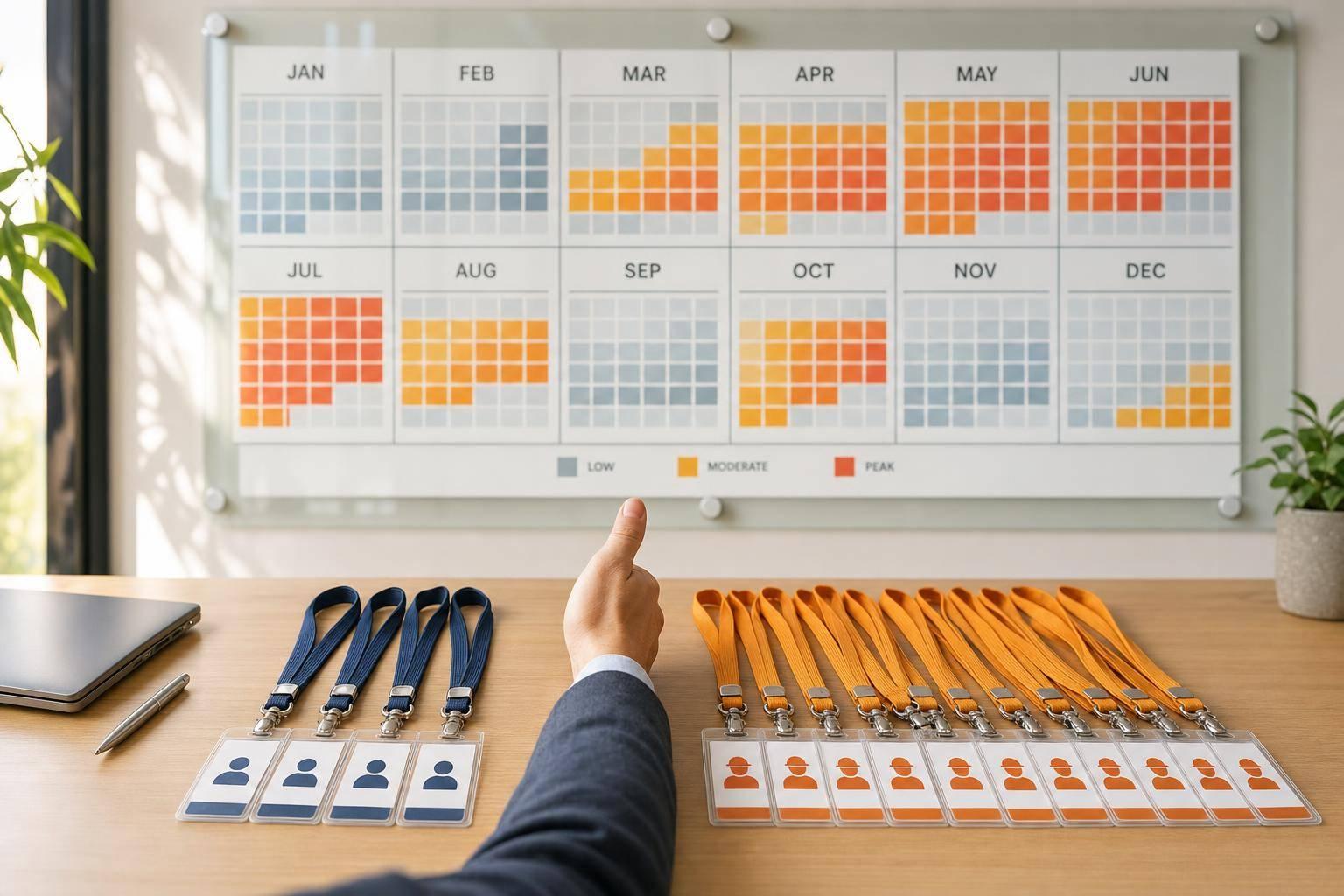
If your busy season comes in short waves, seasonal staff usually cut labor cost. If demand stays steady or service is high-touch, year-round staff usually do the better job. For many event businesses, a mixed model works best.
I’d sum it up like this:
The main trade-off is simple: lower fixed payroll vs. better consistency. Seasonal teams can save money and add headcount fast, but they bring more hiring, training, and no-show risk. Year-round teams cost more across slow months, but they know your clients, venues, and process.
| Model | Best for | Main upside | Main downside |
|---|---|---|---|
| Seasonal staff | Short peak periods, repeatable roles, festival or wedding rushes | Lower fixed labor cost | More training and call-out risk |
| Year-round staff | Steady demand, repeat clients, more complex events | Better service consistency | Higher payroll during slow months |
| Hybrid / core-and-flex | Event businesses with baseline work plus peak spikes | Better balance of cost and coverage | More schedule planning challenges |
If I were making the call, I’d start with one question: Does your demand spike for a few months, or does it stay strong most of the year? That answer points you to the right staffing setup faster than guesswork.
When peak demand hits for a short stretch, shows up on schedule, and comes back every year, seasonal hiring is often the leanest move. Seasonal staff are short-term employees brought in for a set busy window, like wedding season from May through October, holiday parties in November and December, or a city’s annual festival week. Unlike year-round part-time staff, they’re hired for a defined period with a clear start and end date tied to the demand spike.
The big upside is simple: lower fixed labor costs. Seasonal hiring turns labor into more of a variable cost and cuts benefit expense during slower months.
Seasonal hiring works best when demand is high, predictable, and packed into certain months, and when the work is repeatable enough to teach fast. Think wedding caterers in New England with May–October seasons, corporate catering teams pushing through the holiday rush, and festival food vendors staffing back-to-back event weekends. These are strong use cases.
The best roles for this model are usually banquet servers, setup and breakdown crews, and guest registration staff. These jobs can be taught fast and managed well by experienced year-round team members.
There’s a catch. Every season, you have to recruit and onboard a new group. That takes time and management focus right when the calendar starts filling up. Seasonal workers may also see the job as secondary to school, another job, or personal plans, which can lead to more last-minute cancellations. And since they’re new to your venues, clients, and internal process, they’re less likely to adjust smoothly when plans shift in the middle of an event.
You can see that trade-off pretty clearly:
| Factor | Seasonal Staff | Best-Fit Scenarios |
|---|---|---|
| Labor cost | Lower - paid only during busy windows, with fewer benefit costs | Short, predictable peaks (weddings, holiday parties, festivals) |
| Scaling speed | Fast - hire only for defined windows | Labor-intensive roles: servers, setup crews, bar support |
| Training burden | Higher each season - new cohort every year | Repeatable, well-scoped tasks with clear checklists |
| Reliability risk | Higher no-show and call-out rates | Events with tiered rosters and backup coverage built in |
| Institutional knowledge | Low - limited familiarity with venues and clients | Roles supervised by experienced year-round staff |
Once your seasonal roster gets big, scheduling and reconfirming shifts gets messy fast. That’s where scheduling software can take some pressure off. Quickstaff lets managers create events, track staff availability, fill open slots from a waitlist, and send confirmed shift details straight to staff phones. Keeping communication in one place helps cut confusion and reduce no-shows.
When demand shows up often, gets complicated, or puts your team directly in front of clients, a permanent core team usually handles it better than seasonal hires on their own. Year-round staff are the employees who support baseline operations across all 12 months of the year. In event businesses, that usually means managers and senior team members who keep standards steady no matter the season. They help protect service quality during busy stretches while seasonal workers take on the extra volume.
There’s a simple reason this matters: permanent staff already know your venues, your clients, and the way your business runs. That kind of familiarity is hard to swap out in the middle of peak season. Cornell research found that inexperience accounted for 47% to 68% of turnover costs in a hotel sample.
A larger permanent team makes sense when peak periods call for the same group to deliver at a high level again and again. This often fits businesses with recurring corporate contracts, weekly venue events, or complex multi-day jobs. In those cases, repeat clients expect the same quality each time, and a stable core team makes that easier to deliver.
Complexity matters just as much. Multi-course plated dinners, large corporate conferences, and multi-day events all rely on staff who already understand the operation. If a guest count shifts at the last minute during a big gala, you need people who can adjust on the fly without constant direction.
The trade-off is pretty direct: fixed labor costs don’t fall when bookings do. Wages, benefits, and payroll taxes keep going during slower months, even when the calendar looks light. In many U.S. wedding markets, winter revenue can drop hard while permanent staffing costs stay flat, which puts pressure on margins.
Overtime can make that pressure worse. During peak months, if your permanent team is spread across too many events, overtime costs can climb fast. For non-exempt employees, overtime starts after 40 hours in a week. Workforce planning guidance suggests keeping a core staff of 60% to 70% full-time year-round employees, then adding part-time and contingent workers to help keep that balance under control.
| Factor | Year-Round Staff | Best-Fit Scenarios |
|---|---|---|
| Labor cost | Higher - wages, benefits, and paid leave continue year-round | Businesses with steady or frequent demand across 12 months |
| Service consistency | Strong - deep familiarity with workflows, clients, and standards | Premium or repeat-client events |
| Operational complexity | Well-suited - experienced staff handle multi-vendor, complex events | Corporate galas, multi-day conferences, recurring venue events |
| Flexibility during slow periods | Lower - fixed headcount is harder to scale down | Operations with diversified revenue or year-round bookings |
| Overtime exposure | Higher risk during peaks if not supplemented with flexible staff | Any business where peak demand can run far above baseline |
That trade-off gets easier to see when you compare seasonal and year-round staffing side by side.
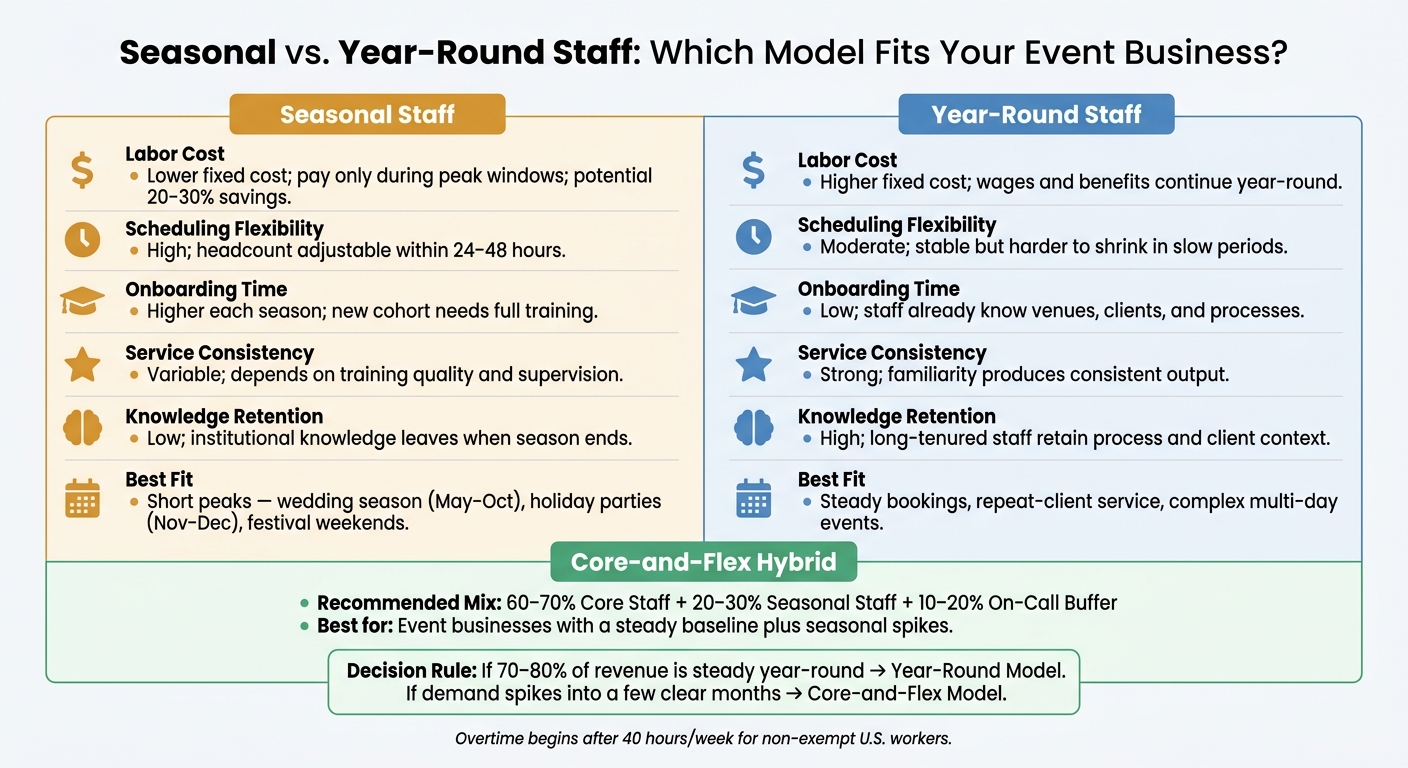
Seasonal vs. Year-Round Staff: Side-by-Side Comparison for Event Businesses
Each model lines up with a different kind of demand. The table below turns those trade-offs into a simpler staffing call. Using a catering staff scheduling checklist can further streamline these decisions.
| Dimension | Seasonal Staff | Year-Round Staff |
|---|---|---|
| Labor cost | Lower fixed cost; pay for hours worked during peak only; fewer benefit costs; potential 20–30% savings | Higher fixed cost; wages and benefits continue even when bookings slow |
| Scheduling flexibility | High; headcount can change within 24–48 hours | Moderate; stable schedules are predictable but harder to shrink during slow periods |
| Onboarding time | Longer per season; each new cohort needs recruiting, training, and alignment to current processes | Less onboarding; staff already know the operation, venues, and client expectations |
| Service consistency | Variable; depends heavily on training quality, supervision, and incoming group experience | Strong; familiarity produces more consistent output |
| Knowledge retention | Low; institutional know-how often leaves when the season ends | High; long-tenured staff retain process knowledge and client context |
| Scalability | Best for short, sharp spikes; easy to add headcount fast for a defined busy stretch | Better for steady, moderate growth; scaling solely with permanent staff is slower and riskier if demand later drops |
| Best fit | Short peak windows such as wedding season, holiday parties, and festival weekends | Steady bookings, repeat-client service, and complex events |
Start with your last 12 months of revenue. That pattern usually tells the story faster than gut instinct.
If 70–80% of revenue comes in at a steady pace across most months, a year-round staffing model is often the better call. Your team stays busy, and service stays more even from one event to the next.
If demand piles up into a few clear months - like May through October for weddings or November through December for corporate holiday events - a core-and-flex model usually works better. Keep a smaller permanent team to handle baseline operations, then add seasonal staff when volume jumps, often requiring tools for last-minute scheduling.
This setup also works well for short bursts of heavy demand. Think festival weekends, major conference weeks, or a packed run of holiday parties. In those cases, leaning more on seasonal staff helps you avoid paying permanent employees through long slow stretches when there just isn’t enough work.
Check the plan once a year against actual bookings. When demand falls somewhere in the middle, a core-and-flex mix is often a better fit than going all-in on either side.
The core-and-flex model gives you steady coverage for your baseline workload, plus extra hands when demand spikes. It tends to work best when you keep a close grip on scheduling.
A solid mix looks like this: 60%–70% core staff, 20%–30% seasonal staff during peak periods, and a 10%–20% on-call buffer for last-minute gaps. Put managers, leads, and coordinators on the core team. Use the flex layer for servers, runners, and setup crews.
Once that mix is in place, the hard part shifts to daily coordination.
The biggest risk with a hybrid model isn't the mix of people. It's coordination. When permanent and temporary workers are spread across multiple events, schedules can unravel fast if there isn't a clear system.
Start with your last 12 months of bookings. Use that data to map peak weeks, spot high-demand event types, and set a staffing baseline for each category. Then build in a 15–20% coverage buffer above your projected peak to handle no-shows and surge weeks. Bring in seasonal staff before the busy season starts, not after the calendar is already packed.
After your team is lined up, assign people by role, not just by total headcount. Knowing exactly who is covering bar lead versus runner makes event-day execution smoother. It also helps you catch coverage gaps before they turn into headaches.
Availability tracking matters just as much. If seasonal staff can mark unavailable dates ahead of time, managers spend less time chasing replies and more time filling shifts.
Each shift invite should include:
Then send a reminder before the event.
To keep everything organized during peak season, use one central scheduling tool. Quickstaff helps by keeping event schedules, availability, role assignments, and reminders in one place, so core and seasonal staff stay aligned during peak weeks.
Use data, not guesswork. Look at 12 to 18 months of performance data to find peak periods, service slowdowns, and staffing gaps.
A balanced staffing mix often looks like this:
On top of that, add a 15% buffer for no-shows or sudden demand spikes.
Keep permanent staff on the more complex roles. Then use flexible workers to cover high-volume work where needs can change fast. Quickstaff can help bring scheduling into one place and track who’s available.
Roles tied to strict compliance rules or risky equipment should remain permanent, year-round jobs. As a rule of thumb, your core full-time team should cover 60% of shifts. That gives you more stability and helps keep quality steady across the board.
Seasonal staff work best when demand spikes. They’re a good fit for tasks like:
Meanwhile, permanent employees should take care of specialized duties.
Plan for a 10% to 15% buffer above your staffing needs to cover sick days, no-shows, and sudden demand spikes. With smaller events, that cushion matters even more. One person calling out can throw the whole shift off.
It also helps to build a roster that's 30% to 50% larger than your peak staffing need. That gives people breathing room, helps cut burnout, and leaves space for proper downtime. A pre-vetted waitlist, paired with automated availability tracking, makes it much easier to fill gaps fast.