OSHA Recordkeeping for Temp Staff
September 26, 2026

If a temp worker gets hurt, the employer with day-to-day supervision usually records the case on the OSHA 300 Log. That means the company directing the worker’s tasks, methods, pace, and site rules at the time of the injury usually owns the log entry.
Here’s the short version:
In most temp staffing setups, the host employer records the injury because the host supervisor is the one running the shift. But not always. If the staffing agency is the one giving daily direction, then the agency may own the log entry instead. The key question is simple: who controlled the work when the injury happened?
I’d treat this as a two-part job:
That is the main point of the article. It separates OSHA log ownership from the other work that still needs to happen after an incident, like fact-sharing, training review, hazard correction, and deadline tracking.
A few facts stand out:
If you want the fastest way to avoid mistakes, I’d do three things before each assignment:
That keeps you from missing a case, logging it twice, or losing time while both sides wait on each other.
Use the day-to-day supervision test to figure out which employer puts the injury on the OSHA log.
OSHA draws a clear line between telling someone what needs to get done and directing how the work is done. Day-to-day supervision is about control over the actual work, not just the end result.
A simple way to work through it is to ask who was handling these things at the time of the injury:
If those answers point to the host employer’s supervisor or manager, the host employer will usually record the case. If the staffing agency’s supervisor was the one running the work at that level, then the staffing agency records it.
| Actual supervision arrangement | Employer responsible for the OSHA log | Key reason |
|---|---|---|
| Host employer assigns tasks, directs methods, controls equipment, and corrects unsafe work | Host employer | The host provides day-to-day supervision. |
| Staffing agency controls daily assignments, methods, pace, and immediate supervision at the host site | Staffing agency | The agency supervises the work in practice, even though the worker is at another employer's site. |
| Supervision is divided, shifts by role, or is genuinely unclear | Review the facts and assign one log owner | The parties should identify which employer controlled the work and ensure the case appears on only one OSHA 300 Log. |
If control was mixed or hard to pin down, document who directed the task that led to the injury. That detail often makes the call much easier.
Some factors sound important, but they do not control the log entry:
After that recordkeeping call is made, the two employers still need to sort out reporting and documentation duties.
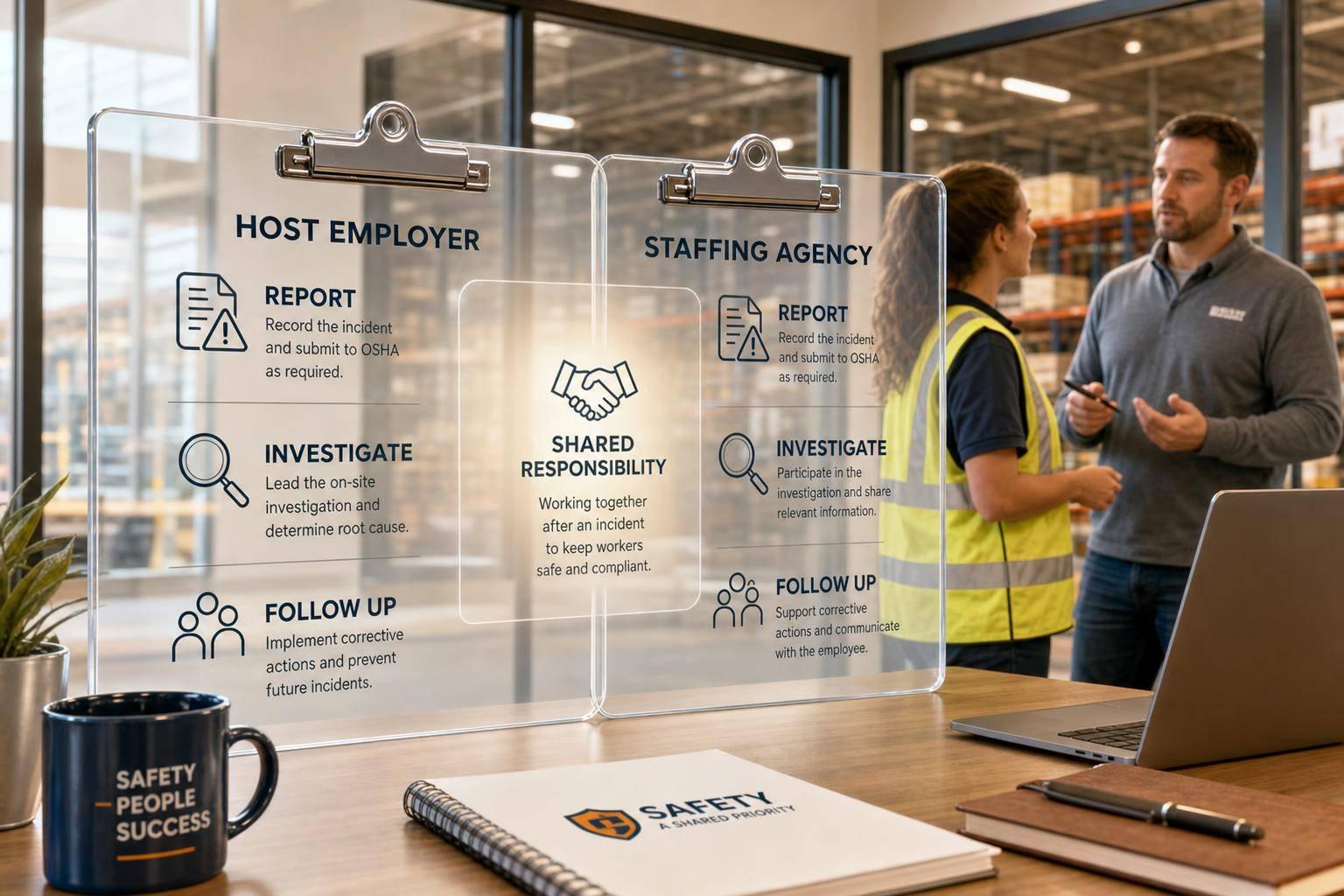
Once one employer owns the log entry, the other still has work to do after the incident. That gap is where reporting and corrective action can stall. Even if one employer puts the case on the OSHA 300 Log, both employers still share post-incident duties. A good way to handle it is simple: use the log owner as the paperwork anchor, then split the incident response between the host and the agency.
In most cases, one recordable case belongs on one employer's OSHA 300 Log, not both. But that rule applies only to the log entry. It does not end the other employer's role.
The other employer may still need to:
So, log ownership and safety follow-up are not the same thing. One party may own the record, but both sides may still need to act.
The record owner also needs incident details from the other employer to complete the log and investigation.
Use these task splits to keep the report, investigation, and corrective action moving without delay.
| Responsibility | Host Employer | Staffing Agency |
|---|---|---|
| Daily hazard control | Controls the worksite, equipment, work methods, and immediate hazard corrections | Confirms that the assignment is suitable and communicates known worker limitations or concerns |
| Worker reporting instructions | Explains how and to whom the worker reports injuries, near misses, and hazards at the worksite | Gives the worker an agency reporting contact and reinforces prompt reporting to both parties |
| Information exchange | Sends incident facts, witness information, treatment details, and corrective-action findings to the agency promptly | Sends assignment, training, medical-claim, and worker-reported information to the host promptly |
| Safety follow-up | Investigates worksite causes, corrects hazards, reviews training and PPE, and monitors the assignment | Participates in the investigation, reviews whether similar placements are affected, and helps communicate corrective actions |
Use the table to divide post-incident tasks, not log ownership. After the immediate response, assign one owner, one due date, and one follow-up check for the corrective action. Then document who completed each action and when.

OSHA Recordkeeping for Temp Workers: Step-by-Step Incident Response
When one employer owns the OSHA log and both parties share facts, the paperwork needs to follow a clear order. Each step builds on the one before it.
Emergency care comes first. Call 911 if needed, give first aid within your training, and stop any equipment or task that could hurt someone else. Once the worker is safe, secure the area and preserve evidence when you can. Don't clean up or move equipment before the basic facts are recorded.
Notify the host supervisor and the staffing agency contact right away. The worker should report the incident to both parties immediately. Write down when each party was told and note any immediate controls that were put in place. Check right away whether the case involved a fatality, inpatient hospitalization, amputation, or loss of an eye. Those events trigger separate OSHA reporting deadlines and should be flagged at once.
After the scene is secure and the right people know about the incident, move straight to recordability.
Record the main facts before memories get fuzzy. That includes the worker's name and staffing agency, the host worksite and department, the date and time, the exact location, the task underway, any equipment or materials involved, witnesses, treatment given, work restrictions, and contributing conditions such as guarding, housekeeping, or training gaps.
The employer that owns the log makes the recordability decision using OSHA's rules. A case is generally recordable if it leads to death, days away from work, restricted work or job transfer, medical treatment beyond first aid, loss of consciousness, or a diagnosed injury or illness that OSHA treats as serious enough to log. Don't wait for the other party to finish its review. Share facts fast, but the recordability call belongs to the employer that owns the log.
If the case is recordable, complete the OSHA forms and meet the deadlines next.
Once you've made the recordability call, finish the OSHA paperwork and keep the required records.
Complete Form 301, or an equivalent, as soon as the facts are available. Then enter the case on Form 300 within 7 calendar days of learning that it is recordable. The case goes on one log only: the log of the employer that provided day-to-day supervision, not both.
Severe incidents follow a separate deadline. A work-related fatality must be reported to OSHA within 8 hours. A work-related inpatient hospitalization, amputation, or loss of an eye must be reported within 24 hours. These incidents must be reported directly to OSHA.
After the calendar year ends, prepare the OSHA Form 300A summary and post it from February 1 through April 30 of the following year. Establishments covered by OSHA's electronic submission rules must submit the required data by March 2. Keep the log, summary, and supporting records for 5 years.
Once the incident response is done, lock down the reporting chain before the next assignment begins.
Set OSHA recordkeeping roles before the worker starts. The staffing agency and the host employer should agree in writing on a few basic points: who handles day-to-day supervision, who decides if a case is recordable, and who keeps the OSHA log.
A simple contact sheet goes a long way. It should list the host’s on-site supervisor and safety contact, the agency’s account and safety contacts, and after-hours emergency numbers. Then spell out the reporting route in plain English: the worker tells the on-site host supervisor right away; the host contacts the agency that same day; both employers alert their safety contacts.
Use that written route to name one log owner. For OSHA recordkeeping, the record follows actual day-to-day supervision. Put the supervision chain and reporting route in writing before each assignment, and update it any time the supervisor, venue, or scope changes. If another incident happens, this should be the first process everyone uses.
Each placement should have its own assignment file. That file should include the worksite and event details, shift dates and times, job duties, supervisor name and contact information, orientation confirmation, training records, hazard information, and the agreed reporting route.
When an incident happens, match it to the assignment file that shows who supervised the work. In other words, don’t build a separate paper trail off to the side. Link the incident record straight to the assignment file.
Keep the incident file together with the report, witness statements, photos, medical notes, OSHA forms, corrective actions, and follow-up dates. Keep the required OSHA forms and supporting records in the assignment file too.
Use the contact sheet and assignment file to confirm each item before dispatching the worker.
| Step | Owner |
|---|---|
| Identify the employer providing day-to-day supervision | Assigned in writing |
| Confirm one log entry exists | Employer responsible for the log entry |
| Confirm severe-incident reporting deadlines were met | Employer responsible for reporting |
| Exchange all relevant incident facts promptly | Both parties |
| Document corrective actions with owners and due dates | Both parties |
| Review training, PPE, and hazard assessment for gaps | Both parties |
When facts are disputed, use current OSHA guidance and qualified counsel.
Document the actual working relationship, not just the label in the contract. OSHA and the courts focus on who controls the work in practice. That includes things like shift start times, floor duties, task changes, and site rules.
Keep records of the daily handoff. For each worker, log the date, start time, worker name, assigned role, and the on-site supervisor. Also include supervisor notes on task directions, safety briefings, and any disciplinary actions.
If both employers aren’t sure who should log an injury, the first place to look is the written service agreement. That document should spell out each party’s role.
In most cases, the host employer records the injury on its OSHA 300 Log if it provides direct day-to-day supervision. To avoid duplicate entries - or worse, a missed report - both parties should communicate right after the incident.
Yes. A temporary worker injury can be reportable to OSHA without being recordable.
Here’s the difference.
Reporting is for severe events, such as fatalities, in-patient hospitalizations, amputations, or the loss of an eye.
Recordkeeping is narrower in a different way. An injury goes on the OSHA 300 Log only if it is work-related and leads to medical treatment beyond first aid, restricted work, days away from work, or loss of consciousness.