NLRB 10(k) Rulings: 5 Takeaways for Event Teams
August 17, 2026

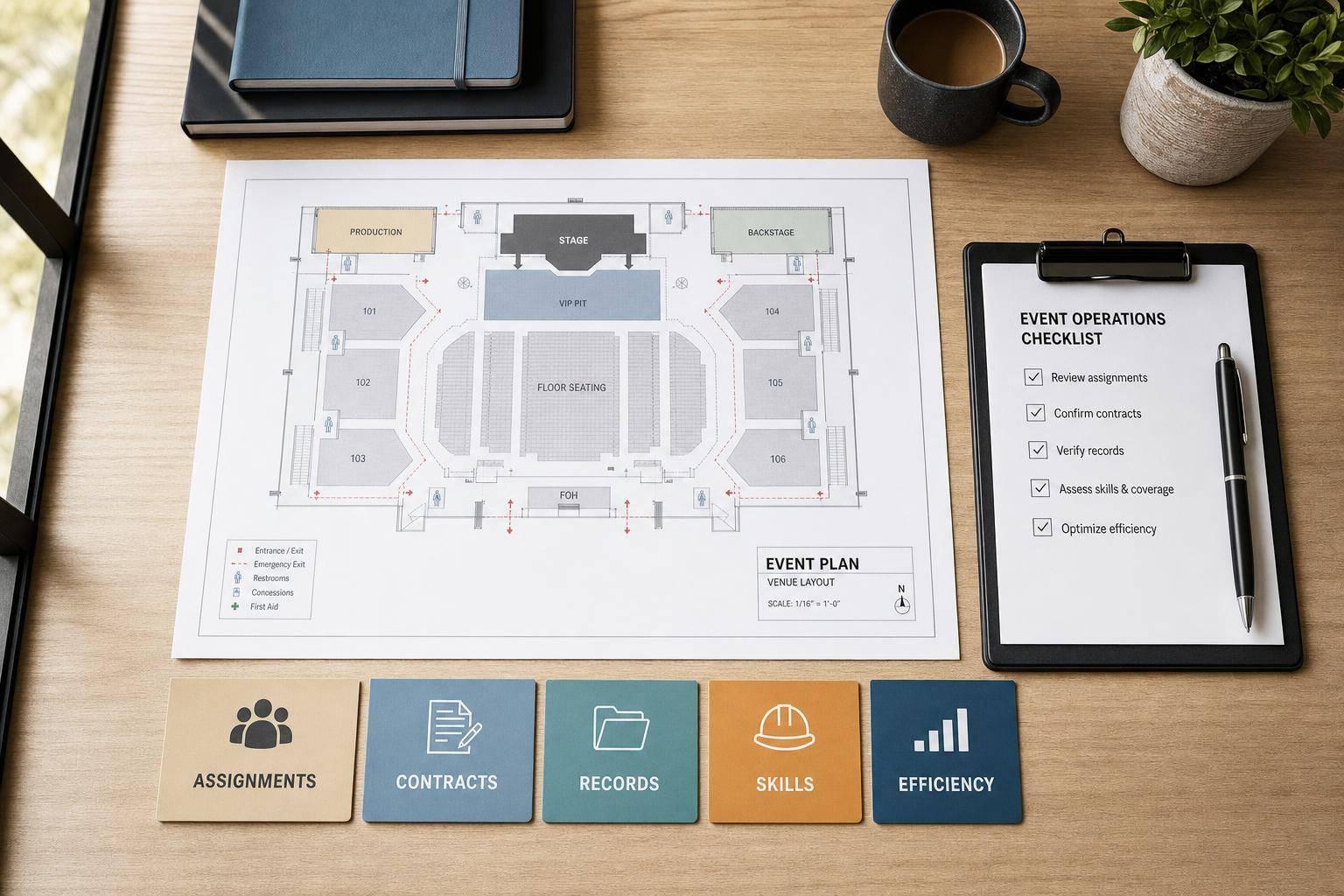
If two crews claim the same job at your event, your staffing notes can end up mattering as much as your crew plan. My main takeaway is simple: I should assign work by checking contracts, current assignment, past practice, employer choice, skills, and efficiency - then write down the reason at the time.
Here’s the short version of the full article:
What the Board tends to weigh most often:
| Factor | What I should check |
|---|---|
| Contracts | CBA language, side letters, venue rules |
| Current assignment | Who is doing the work now |
| Past practice | Who has done it over time |
| Employer choice | My stated reason for the assignment |
| Skills | Training, licenses, certifications |
| Efficiency | Fewer handoffs, less downtime, clearer supervision |
A few facts stand out. The article centers on six main factors, five staffing takeaways, and a staffing example built around a 4:00 PM–11:30 PM ballroom setup. It also notes that split-crew plans may need 15–30 minutes of overlap per handoff, which can add labor time and supervisor load.
So if I want fewer disputes, I don’t wait for a labor issue to start. I treat work assignment like part of event planning and keep a short written reason behind each call.
When two crews both say, “That’s our job,” the task itself becomes the issue. A jurisdictional dispute is about who gets to do a specific task, not whether the task needs to be done in the first place. Put simply, two groups are claiming the same work - not arguing over the work itself.
Section 10(k) relies on a fact-specific balancing test, which means no single factor decides the case on its own. One point alone won’t carry the day. For schedulers, that matters a lot: every assignment should have a clear, written reason behind it. And those same factors should shape event staffing before any dispute starts.
These six factors drive most staffing decisions. Think of them as a pre-show check, not something you scramble to assemble after a conflict begins:
| Factor | What the NLRB Looks At | Event Example |
|---|---|---|
| Contracts and CBAs | Jurisdiction clauses in collective bargaining agreements, venue rules, vendor contracts | A local IATSE CBA covering all rigging and lighting at a unionized arena |
| Current assignment | Who is actually performing the work at the time of the dispute | Which crew is running cameras at a recurring corporate town hall series at a New York hotel |
| Past practice | How the work has been assigned consistently over time at that employer and location | Four seasons of load-in records showing the same house stagehand crew built risers at a stadium |
| Employer preference | Management's stated, reasoned choice - backed by efficiency, safety, or quality goals | An AV company using its own LED techs across multiple U.S. cities for consistent setup |
| Relative skills and training | Certifications, manufacturer training, OSHA credentials, safety records | Assigning high-steel rigging at a stadium concert to ETCP-certified riggers |
| Economy and efficiency | Whether the assignment minimizes handoffs, downtime, and supervisory complexity | One crew handling booth setup, AV hookup, and end-of-day reset at a trade show |
The NLRB usually steps in only when three things are present:
That’s the framework behind the five takeaways below.
The NLRB gives strong weight to collective bargaining agreements and jurisdiction clauses when it decides which crew should get disputed work. That means your CBA, side letters, and MOUs should be your first rulebook for assigning work. If the contract doesn’t settle the issue, go straight to documented past practice.
Jurisdiction clauses are the first place the Board looks. A clause that assigns all load-in and load-out functions, or all operation of sound equipment, can settle a dispute before it gets off the ground. Side letters and MOUs can narrow or expand those clauses for certain venues or event types, and the Board treats those documents as part of the agreement.
Pull the full CBA, side letters, and MOUs for each regular venue. Flag the parts that deal with jurisdiction, subcontracting, temporary staff, and special-event terms. Then add a one-line plain-English note showing who owns each task.
If any wording is fuzzy, document clarifying talks with venue labor relations staff or union stewards and store those notes with the agreement. That small step can save a lot of trouble later.
If the language still doesn’t answer the question, assignment history becomes the next control point.
When the contract is unclear, past practice becomes the fallback. Track who did the work, when they did it, and whether both sides accepted that pattern. A record across many events showing the same crew handled load-in, FOH audio, video wall setup, or similar tasks can matter a lot in a 10(k) hearing.
For each venue and event type, record:
That record becomes your practice map if a dispute ever reaches the NLRB.
The Board also looks at why an employer made a certain assignment. A loose preference won’t do much. You need a clear record of the operating reason behind any unusual assignment, such as safety, efficiency, or contract coverage.
Add a short rationale note to any complex show or any job that departs from normal practice. Tie that note directly to one of the 10(k) factors: contract coverage, past practice, safety, or efficiency. A note written at the time carries far more weight than something pieced together after a grievance lands on your desk.
When safety or system complexity is driving the call, credentials should drive the assignment.
Work involving rigging, aerial lifts, or integrated AV systems may properly go to crews with documented training and certifications, even when another union claims the work, because the employer still has to put safe and efficient operations first.
Build a task-level certification map and keep it current using event staff scheduling software. Tag staff with credentials like ETCP rigger or LED wall tech so schedulers can filter the right labor pool fast.
| Contract Library Element | What to Include | Why It Matters in a 10(k) Case |
|---|---|---|
| Full CBA per venue | Current agreement, appendices, and jurisdiction language | Sets the baseline for each task |
| Side letters and MOUs | Effective dates and task-specific carve-outs | Can modify or limit CBA coverage |
| Assignment history | Crew, task, date, event type, and venue | Shows consistent past practice |
| Business rationale notes | Operating reason for each key assignment | Supports the employer’s stated reason |
| Certification records | ETCP, OSHA 10/30, manufacturer training | Supports skill-based assignments tied to safety grounds |
Good records can be your best defense if a jurisdictional dispute ends up before the NLRB. The Board looks at current assignment and past practice as two separate factors. That means you need more than a rough memory of who usually does what. You need records that show the pattern over time.
Keep multi-year assignment logs. Once that pattern is on paper, the next step is simple: figure out whether a change was a one-off exception or the start of a new practice.
A dated record showing the same crew handling the same task across similar events can carry real weight. Build the log so schedulers can sort it by task, venue, and crew type. That way, if a dispute comes up, you can pull the record fast instead of digging through old notes.
Quickstaff can help here. Use it to tag roles by crew classification and filter shift history by venue or event type. If assignments change on show day, a designated lead should record what changed, why it changed, and who approved it right away. Small details matter when people start arguing over who was supposed to do the work.
Each assignment log should connect to the governing CBA and the related jurisdiction clause. Add a simple CBA alignment tag so the status is clear at a glance:
This makes it much easier to check whether the assignment lines up with the contract or sits in a gray area.
If you deviate from the usual assignment, record it immediately with a short reason and manager sign-off. The goal isn't to write a long memo. It's to show a clear, specific business reason.
Keep rationale notes tight and concrete. Tie each one to an operational reason, such as:
When records are clean, employer-preference calls are easier to justify if assignments shift.
Once contracts and past practice are clear, employer preference can help fill the gaps. But it only carries weight when it reflects documented business judgment and lines up with past practice, crew skills, and efficient operations.
Use clear business language. A preference without a reason behind it doesn't mean much.
State why the work was assigned a certain way. Point to things like:
Add that preference to assignment notes, show-day crew calls, and task-level rules. That way, it shows up as a repeatable decision on paper, not a one-time judgment. The more clearly the reason is written down, the easier it is to connect that preference to crew skills and task needs.
Assignment history helps show that the preferred crew has handled the same task again and again. A steady record makes that preference easier to defend. A one-off explanation usually won't.
If you need to break from the usual pattern, document the reason and tie it to a specific business need. That helps show the change was deliberate, not arbitrary.
Tie preference straight to the qualifications the task calls for, then assign the crew that meets them. Use Quickstaff to tag certifications and keep these assignments consistent. That turns the decision into a documented skills-based call instead of a last-minute choice.
That makes employer preference most useful when it's documented, consistent, and tied to qualifications.
When the contract and past practice don't settle an assignment, skills and safety usually tip the scale. Those are direct 10(k) factors. The Board looks at what the task calls for and compares that with each crew's training and qualifications. The rule is simple: put high-risk work only in the hands of crews you can show are qualified.
High-risk work needs proof. When you're building crews for rigging, lifts, power, or integrated AV, use task-level credentials, not guesswork.
| Task | Common qualification proof |
|---|---|
| Overhead rigging | ETCP-certified rigger or equivalent lead; load chart familiarity; hoist manufacturer training |
| Aerial lift operation | OSHA-compliant documented training in safe operation, fall protection, pre-use inspection, and load/reach limits |
| Temporary electrical setup | Licensed electrician with temporary-power training, lockout/tagout knowledge, and grounding/GFCI training |
| Complex AV integration | AVIXA CTS, Dante, or equivalent; experience with power separation, grounding, and RF coordination |
For high-risk tasks, documented training and a clean safety record matter a lot.
A certification by itself isn't enough. If the assignment breaks from normal practice, write down the reason right away. Note the task, the credential you relied on, and the business reason for the assignment.
Training dates matter too. Keep initial training and refreshers up to date so you can show that the people assigned to lift operation, rigging, or electrical work are still qualified for the procedures and equipment in use. Quickstaff can help here. Tag certifications with expiration or renewal dates so only staff with current qualifications show up as eligible when you're building a crew for OSHA-sensitive tasks.
Keep the written rationale to one sentence, and make it specific. That's the kind of record that helps support your position in a 10(k) dispute.
Once skills and safety are covered, there’s one more test: will this setup run cleanly on show day? If contracts and qualifications don’t settle the call, efficiency often does. The Board tends to back the setup that gets the job done with fewer handoffs, less downtime, and clearer supervision.
In live events, that usually means one crew handling a task from start to finish under one lead from load-in through strike. When main stage AV, rigging, or other critical-path work gets split across multiple crews, things can get messy fast. More crews usually means more handoffs, more coordination, and more chances for miscommunication or idle time.
A simple rule works well here: if one crew can handle the task end-to-end under one supervisor, and there’s no skill or safety gap, that setup is usually the easiest to defend. Keep each function under one lead from load-in through strike.
But that logic shouldn’t live only in the scheduler’s head. Write it down in a short staffing note. Include:
If you looked at splitting the work and decided not to, add that too. Say why the single-crew setup was the better call for operations.
Past assignment logs help here as well. They show which crew structure has already worked on similar jobs. Keep a simple log for each venue or repeat client that tracks the task category, which crew handled it, how the setup performed, and whether handoff issues showed up.
Quickstaff can store assignment history with staff records, which saves you from rebuilding the story later when an assignment is challenged. Over time, those records become the base for a task-by-task staffing rule.
Put the five takeaways to work in your day-to-day scheduling. That means turning them into pre-show rules, checklists, and records your team can use without guessing. The goal is simple: build a system around the five factors - contracts, current assignment, past practice, employer preference, and skills - so your crew decisions hold up under pressure.
In practice, that system usually comes down to four things: a jurisdiction matrix, approval rules, assignment logs, and backup plans.
Start with a simple table. Map rigging, drape, forklift, cable, lighting, and load-out tasks to the assigned crew or union for each venue or client type. For each task, note the applicable CBA or work rule, the historical crew assignment, and any required certifications. Also flag tasks that have drawn competing claims before, so planners know those jobs need extra review.
Store the matrix somewhere the whole team can check before any call sheet goes out. Treat it as the source of truth for approvals and exceptions.
Set the rules before the show day rush kicks in. Decide who has authority to assign work and what they need to review first. In most cases, a production manager or labor coordinator should check the jurisdiction matrix, the relevant CBA, and past assignment records for that venue before staffing is locked in. If someone wants to break from past practice, document it with a one-line business reason.
Spell out the escalation path too. If two unions claim the same task, or a steward objects, move it to operations leadership or labor counsel before show day.
That step may feel like extra work. It isn't. It's a lot easier to sort out a conflict the day before than while a crew is waiting on the floor.
After each event, log the crew, task, objections, and handoffs. Those records matter. They help show what happened, who did the work, and whether a pattern is starting to form. Tag each worker's profile with verified certifications and training dates, and audit those tags on a regular basis. Expired credentials can weaken the reason behind an assignment.
Quickstaff can centralize assignment history, staff records, and event notes. Use those logs to spot tasks that may need a fallback crew.
Some tasks are magnets for competing claims. If the matrix already flags them, build a backup crew plan before show day. Write down the conditions that trigger the backup plan, and confirm that the change still lines up with your contracts and past practice so it doesn't look random.
At union-heavy venues, add extra time around high-risk tasks. That gives you room for any needed talks with stewards or labor counsel without putting show start at risk. And if the CBA lays out a dispute path, map that path before the event begins.
NLRB 10(k) Staffing Models: One-Crew vs. Split-Crew vs. Non-Represented
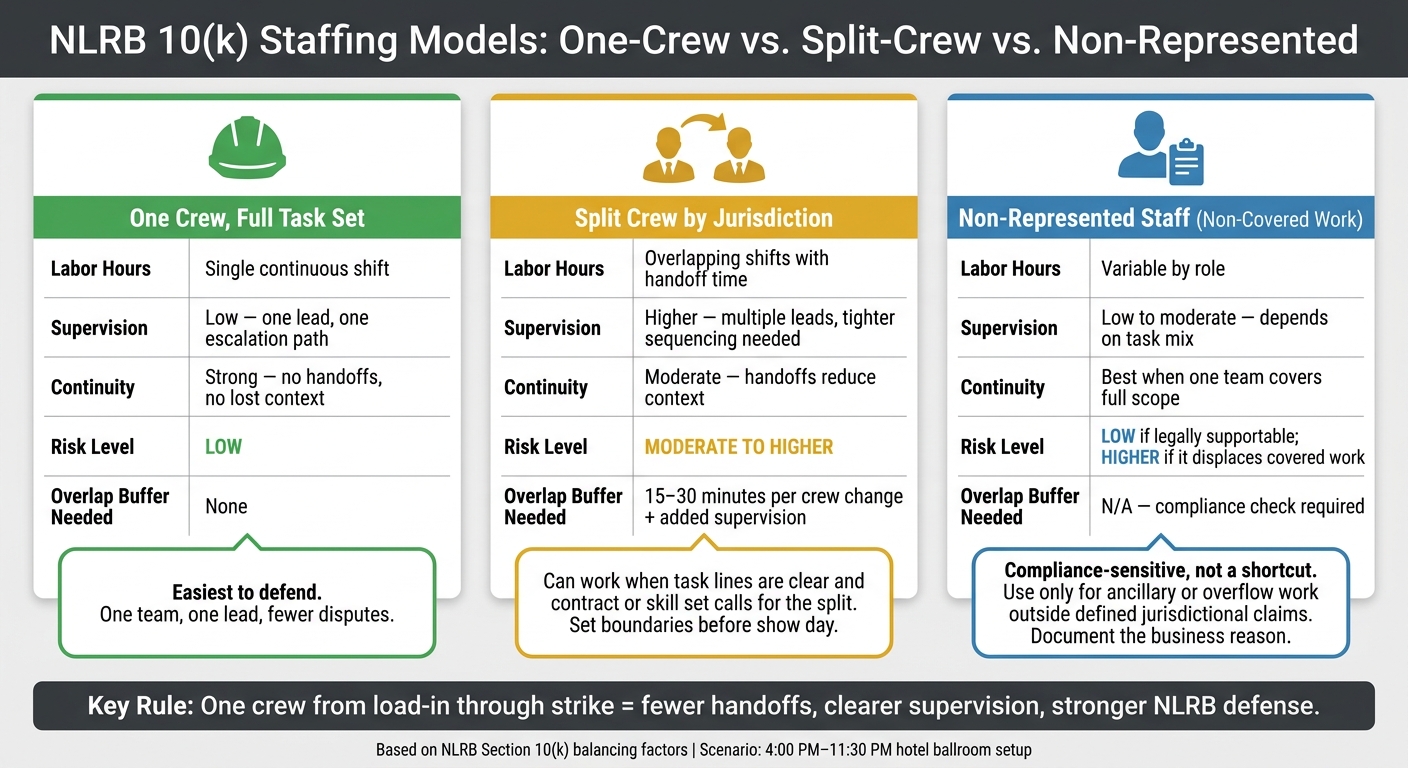
Not all staffing models carry the same level of risk. The best fit comes down to your contract, the order of the work, and what your records can support. This is where the five takeaways turn into an staffing challenges turn into an actual staffing call. In practice, that call often decides whether the plan lines up with the contract, past practice, and the needs of the operation.
Take a 4:00 PM–11:30 PM hotel ballroom setup. Same room. Same event. Same work window. But the staffing model can change the risk picture fast.
| Staffing Approach | Labor Hours | Supervision | Continuity | Risk |
|---|---|---|---|---|
| One crew, full task set | Single continuous shift | Low - one lead, one escalation path | Strong - no handoffs, no lost context | Low |
| Split crew by jurisdiction | Overlapping shifts with handoff time | Higher - multiple leads, tighter sequencing needed | Moderate - handoffs reduce context | Moderate to higher |
| Non-represented staff for non-covered work | Variable by role | Low to moderate - depends on task mix | Best when one team covers the full scope | Low if the assignment is legally supportable; higher if it displaces covered work |
Use the comparison above to choose the cleanest assignment structure before show day.
A one-crew plan is usually the easiest to defend. One team handles the full task set, one lead manages the shift, and there’s less room for confusion. Fewer handoffs also mean less lost context.
Split crews can work, but only when the task lines are clear and the contract or skill set calls for that split. You need the boundaries set ahead of time, not figured out on the fly. And there’s a cost to that setup. Split crews add coordination time, so budget 15–30 minutes of overlap for each crew change, plus added supervision.
Non-represented staffing needs a separate check. This is not a shortcut around crew rules. Non-represented staffing is compliance-sensitive, not a shortcut. Use it only for ancillary or overflow work that falls outside defined jurisdictional claims, and document the business reason for the assignment.
These five 10(k) themes turn into plain scheduling rules event teams can use every day: start with contracts, back decisions with records, show employer preference the same way each time, match work to actual skills, and plan for day-to-day efficiency. That matters because those same factors come up in hearing evidence and in routine staffing calls. So the process you use during a dispute should look a lot like the one you use on a normal show day. Put contracts first, records second, and keep your reasoning clear from start to finish.
That approach can cut down on disputes and make execution smoother. Documented assignments help prevent last-minute conflicts. Crews matched to the right skills tend to move faster and reduce the chance of accidents or delays. Continuity can also lower coordination costs, overtime, and rework.
The next step is turning those ideas into a workflow your team can repeat without guesswork. Tools like Quickstaff can keep assignment records and communication in one place, so each decision is easier to track after show day.
When your process lines up with the factors the Board looks at, each assignment becomes easier to defend.
A 10(k) ruling is an NLRB decision used to settle jurisdictional disputes when two or more employee groups claim the same work.
In plain terms, it decides who gets the assignment. To do that, the NLRB looks at things like contracts, employer preference, past practice, business needs, and the skills the job calls for.
For event teams, this matters because it can shape workforce planning and day-to-day staffing choices.
Keep full records for each worker, and tie every assignment back to payroll and timekeeping.
That means keeping track of:
For record retention, keep payroll records for 3 years. Keep timecards, work schedules, and wage calculation records for at least 2 years.
You can assign work based on safety or efficiency as long as all temporary workers get proper site-specific safety training and daily oversight, no matter who employs them.
And because the host employer has to maintain a safe workplace and record injuries on OSHA logs, those duties should be spelled out clearly in a written agreement.