ICS Scalability: Small vs. Large Events
July 12, 2026


One system can handle both a 50-person banquet and a 50,000-person stadium crowd. The difference is how much of ICS you turn on.
If I had to sum up the article in one line, it would be this: small events use a lean ICS setup, while large events need more roles, written plans, tighter tracking, and multi-agency coordination. The structure changes with incident size, risk, duration, and the number of people involved.
Here’s the short version:

Small vs. Large Event ICS: Key Differences at a Glance
| Criteria | Small Event ICS | Large Event ICS |
|---|---|---|
| Structure | Lean, few roles | Full ICS structure |
| Command | Single IC | IC or Unified Command |
| Staffing | Combined roles | Separate section chiefs, supervisors, unit leads |
| Span of control | IC may supervise directly | More layers added to keep ratio in range |
| Communication | Verbal updates, one main channel | Written comms plan, multiple channels/talk groups |
| Documentation | Basic time-stamped log | IAP, ICS forms, unit logs, maps |
| Resource tracking | Simple verbal or manual tracking | Check-in, staging, status tracking |
| Best fit | Low complexity, short incidents | High attendance, more hazards, more agencies |
Bottom line: I’d match the ICS structure to the incident, not the event label. A small event can turn serious fast, and a large public gathering usually needs more structure from the start.
ICS scales up or down based on what the event calls for. The core idea is modular organization: you add structure only as the incident gets more complex. That’s what keeps a small event from feeling overbuilt and a large event from slipping into chaos.
The system still relies on the same five main functions: Command, Operations, Planning, Logistics, and Finance/Administration. At smaller events, one person may handle more than one function. At larger events, those roles are usually split out so each area gets proper attention.
Span of control matters at every level. The target is 1:5, with an accepted range of about 1:3 to 1:7. If one supervisor has too many or too few direct reports, the structure should change. That may mean adding another layer of supervision or combining roles so communication stays clear and accountability doesn’t get fuzzy.
ICS is also built top-down. You start with Incident Command, then add Sections, Branches, Divisions, or Units only when the situation calls for them. In plain terms, you don’t build the whole machine on day one. You add parts as the workload grows.
At small incidents, ICS may include only Incident Command and Operations. In that setup, the Incident Commander sets direction, while an Operations lead manages what’s happening on the ground. Planning, Logistics, and Finance/Administration may still be handled, just less formally, by one or two people.
Sections should be added when the incident grows beyond one person’s span of control. Once that happens, keeping everything under a single set of hands starts to break down. At larger events, the better move is to activate all five sections early so Command can stay focused on strategy and outside coordination instead of getting pulled into every supply, staffing, or paperwork issue. Using event staff scheduling software can help automate these logistics as the team grows.
Activation timing can also depend on regulations, venue rules, public-safety needs, and how long the incident lasts. Many event teams use pre-set triggers to make that call, such as:
Those triggers help mark the line between a lean setup and a fully staffed response.
At a small, single-site event, ICS usually stays lean. One Incident Commander can cover all five functions until the situation starts to grow. That's the low-complexity side of ICS scalability.
The upside is simple: faster decisions. The IC can work directly with a small group of responders and only add layers when the workload gets too heavy.
A common tipping point is span of control. If the IC is managing more than 3 to 5 responders at the same time - while also dealing with crowd control, guest relocation, and EMS coordination - things start to slip. That's the practical signal to assign an Operations lead so the IC can step back and focus on the bigger picture. It's also the moment when a small-event setup begins to look more like a larger response.
Once that structure is in place, the next job is keeping communication clear and maintaining a simple record of what happened.
At small events, direct verbal communication usually works best. A short huddle often does the job. The IC can pull together key people - like a security lead, venue manager, and event coordinator - and quickly cover three things:
If people are spread across the venue, radios or phones can bridge the gap. In that case, it helps to keep one main channel set aside for emergency coordination.
Documentation can stay light at the start. A short, time-stamped log is often enough: when the incident began, what actions were taken, and which staff were involved. Formal ICS forms matter more if the situation grows, outside agencies ask for records, or the event team needs documentation for liability or reimbursement.
That kind of clarity is a lot easier when staffing details and message flow are already sorted out.
For event businesses that depend on temporary staff - such as caterers, bartenders, and setup crews - Quickstaff helps both before an incident and during the response by keeping staffing details in one place and easy to access.
Before the event, coordinators can use Quickstaff's role assignment features to give staff emergency jobs like "evacuation guide" or "crowd control" alongside their regular event duties. Availability is confirmed ahead of time, so the IC knows which team leads and first-aid-trained staff will be on-site. If assignments shift, updates can be sent without a scramble.
During a minor incident, Quickstaff's mobile-friendly messaging lets the IC or coordinator send targeted instructions to specific staff groups. Security can get one message, while catering gets another, each with clear direction tied to that team's role. Staff can confirm receipt on their phones, which gives the IC a live view of who has acknowledged the assignment and who hasn't. That supports accountability and situational awareness.
When an incident gets too big for one supervisor to manage well, large-event ICS takes over. Small events can run with a lean setup. Stadium concerts, marathons, and county fairs usually can't. Once the scale grows, that lighter structure starts to crack.
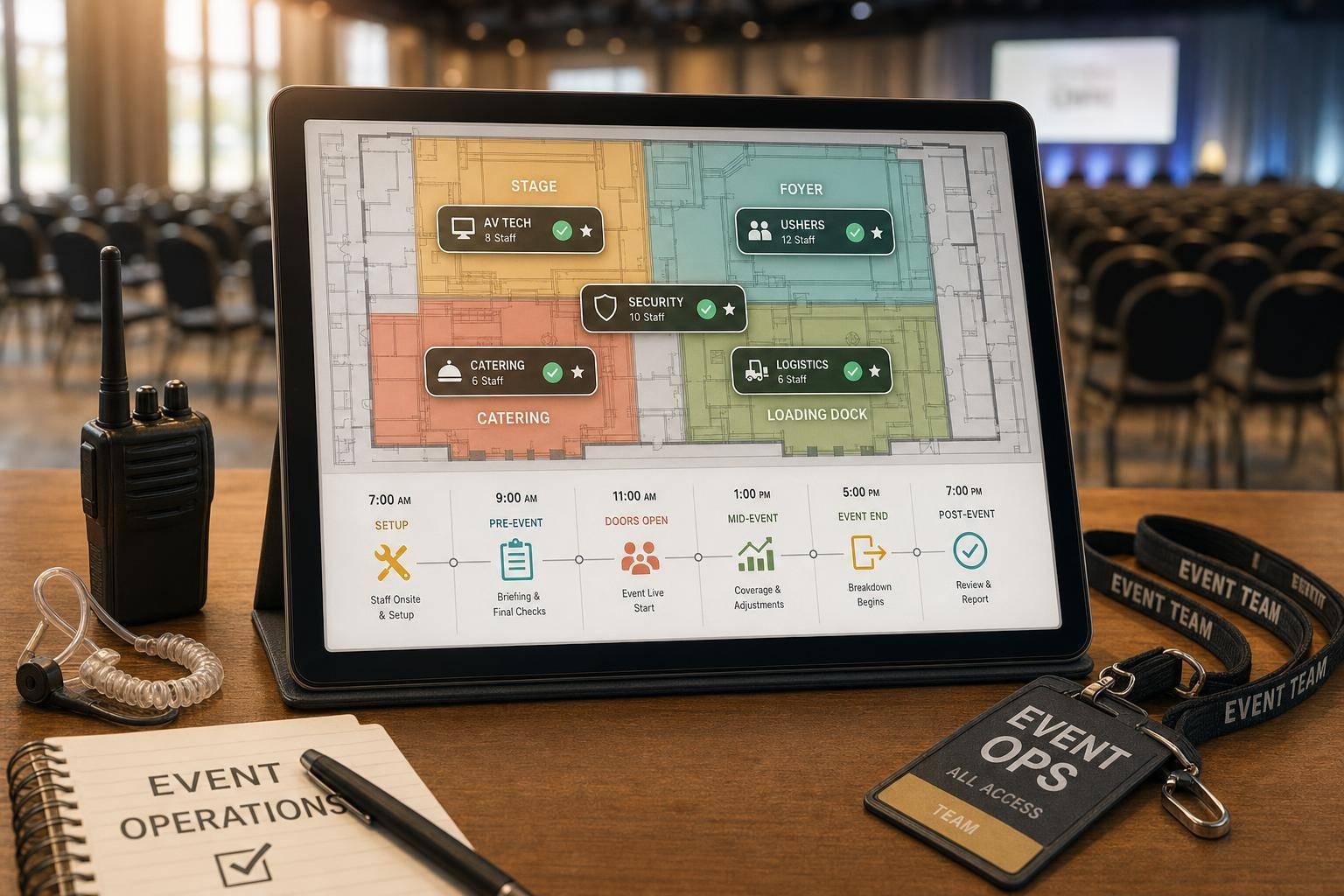
At large events, the four General Staff sections are usually staffed on their own: Operations, Planning, Logistics, and Finance/Administration, with a dedicated Section Chief for each. That setup lets the Incident Commander focus on command, priorities, and coordination instead of getting pulled into every detail.
As the structure grows, command roles become just as important as field operations. A few positions do a lot of the heavy lifting when the incident reaches public, operational, and interagency scale:
Branches, Divisions, and Groups help keep span of control in check. Geographic Divisions cover set areas, like a West Concourse Division or Finish Line Division. Groups handle functions that cut across the venue, such as a Medical Group or Traffic Group. Large planned events often use both at once, with Divisions spread along the route and Groups working across all of them.
When many agencies are involved, the structure shifts to Unified Command instead of a single Incident Commander. Each agency keeps its own chain of command, but they work from one set of objectives and one coordinated ICS structure.
That structure only holds together if resources, communications, and assignments are written down.
Large event emergencies need formal resource tracking. Incoming units check in at assigned staging areas, get documented, and wait for assignment to a Division or Group instead of showing up and picking their own task. Planning tracks resource status, Logistics orders what is needed, and Finance/Admin tracks costs.
Communications follow a plan too. A formal communications plan assigns radio channels or talk groups to each Branch, Division, and Group, with a separate command channel for Section Chiefs and Command Staff. At recurring large venues, pre-event interoperability testing between police, fire, EMS, and venue security is standard practice. That can include shared radio caches or gateway devices.
Each operational period, usually 8–12 hours, has its own written Incident Action Plan (IAP). For a large event, the IAP includes incident objectives, an org chart, Division and Group assignment lists, a communications plan with radio channels and call signs, a safety message, and venue maps. In plain terms, it gives supervisors and partner agencies one shared reference point from shift to shift.
The ICS structure runs the incident. Staffing software helps keep the workforce lined up with that structure. Those are two different jobs, but they need to work together. Quickstaff helps event organizers manage the staffing side without losing sight of where people are and what they are assigned to do.
Planners can sort staff by role and match those roles to ICS Groups or Divisions. A shift named "West Concourse Division – Guest Services" or "Medical Group – Finish Line Aid Station" mirrors the field structure, which makes coverage gaps easier to spot before the event begins. Quickstaff's availability tracking and waitlist features are useful when an incident grows and extra staffing is needed fast. Coordinators can see who is available and move them into needed roles while keeping a record of who was deployed and when. That record supports the accountability that large ICS operations depend on. Quickstaff's mobile tools also help with reminders and shift updates, so staff communication stays in one place instead of getting scattered across texts and phone calls.
Small and large event ICS differ mostly in structure, staffing, and coordination. The table below pulls the earlier sections into one quick reference:
| Attribute | Small Event Emergency ICS | Large Event Emergency ICS |
|---|---|---|
| Organizational structure | Single IC handles most or all functions | Full Command and General Staff |
| Positions filled | Minimal; combined roles | More specialized roles, including Branch Directors, Division/Group Supervisors, and Unit Leaders |
| Span of control | IC may manage all resources directly | Formally maintained at 3–7 per supervisor, with 5 as the target |
| Resource management | Verbal tracking | Dedicated Resource Unit and staging areas |
| Communications | Limited channels and brief updates | Multi-channel communications plan and interoperable radio systems |
| Documentation | Basic incident log | Written IAPs, ICS forms, and unit logs |
| Activation thresholds | Single agency, short duration, low complexity | Multi-agency, multi-operational-period, or high-impact |
That table shows the setup at a glance. The harder part, of course, is using the right setup at the right time.
Use ICS at every event. That way, roles, terms, and escalation steps feel normal before a serious incident hits.
Core staff should complete ICS-100 at a minimum. Supervisors, safety managers, and anyone who may serve as an Incident Commander or Section Chief at a larger event should also complete ICS-300, which covers expanding incidents. If your venue or agency deals with large, complex events on a regular basis, ICS-400 helps prepare key leaders for area command and multi-agency coordination systems.
Your Emergency Operations Plans (EOPs) and event contingency plans should also spell out clear activation triggers. Put it in writing when a Logistics Section gets stood up, when Planning is activated because the incident lasts more than one operational period, and when Unified Command applies because more than one agency shares jurisdiction. It also helps to pre-design org charts for both routine operations and worst-case scenarios, so teams aren't making structure calls in the heat of the moment.
Staffing tools should line up with the ICS structure instead of sitting off to the side. Quickstaff mirrors ICS roles, availability, and emergency assignments, which helps coordinators fill supervisory gaps fast.
Scalability only works when the response structure fits the incident. Small events need a clear IC, defined roles, and simple communication. Large events need the full structure because no one person can keep track of everything across multiple divisions, agencies, and operational periods. Strong teams plan that structure before the incident starts.
Switch based on your event’s risk, complexity, and span of control, not just after something goes wrong. A full ICS is often needed once attendance goes above 500 or when shared roles no longer cover the work.
Common signs include:
Unified Command comes into play when an incident is too complex for a single agency to handle on its own, or when more than one group is responsible for the response.
It brings police, fire, EMS, venue staff, and other partners together under one leadership team, while each agency keeps its own authority. In plain terms, everyone works from the same game plan instead of operating in separate lanes. That makes it easier to line up goals, settle conflicts, and avoid siloed responses.
Keep span of control manageable by limiting each lead to 3 to 7 direct reports. That makes accountability easier to track and helps prevent communication bottlenecks.
If the event becomes more complex or grows past 500 attendees, add zone leads to keep that same ratio in place. When needed, move to a full sectioned ICS model with dedicated leads for logistics, finance, and interagency coordination.