How to File a Wage Claim for Event Staff
September 21, 2026

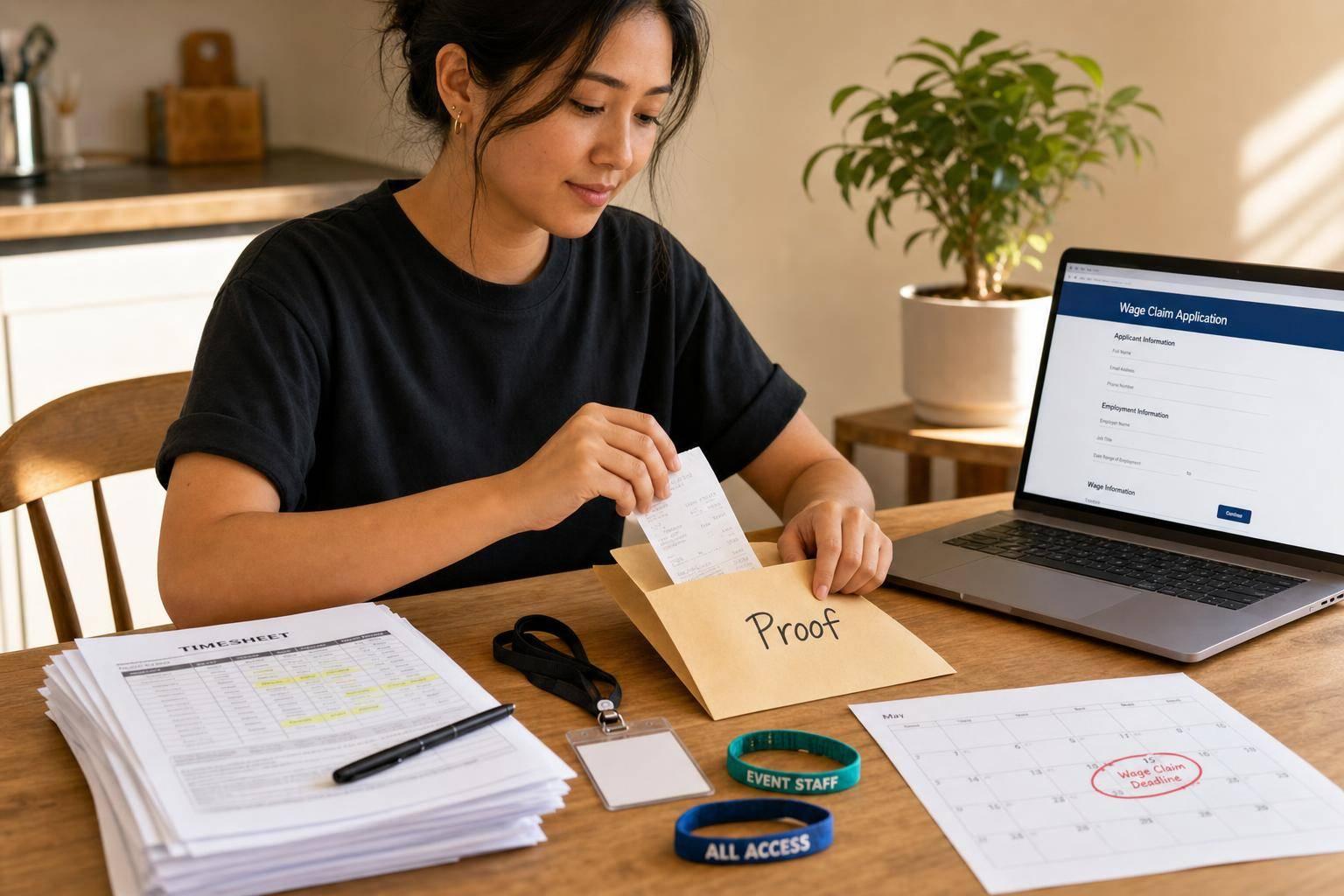
If your pay is missing, short, or late, I’d file fast, save every record, and send the claim to the agency for the state where the work happened. For many workers, the first check is simple: compare shifts worked to pay received, total the gap, and watch the deadline. Under federal law, wage claims often tie to a 2-year limit - or 3 years for willful violations.
Here’s the short version:
A few points matter most for event staff: shifts are often split across venues, hours can be missed during setup or cleanup, and overtime may show up when multiple events fall in the same week. That’s why shift-by-shift records do so much of the work in a claim.
Quick comparison
| Filing path | Best for | Time limit |
|---|---|---|
| State labor agency | Unpaid wages, final pay, deductions, state pay rules | Varies by state |
| U.S. Department of Labor (WHD) | Federal minimum wage and overtime | Usually 2 years; 3 years if willful |
If I had to sum it up in one line: document the work, total what’s owed, file in the right place, and do it before the clock runs out.
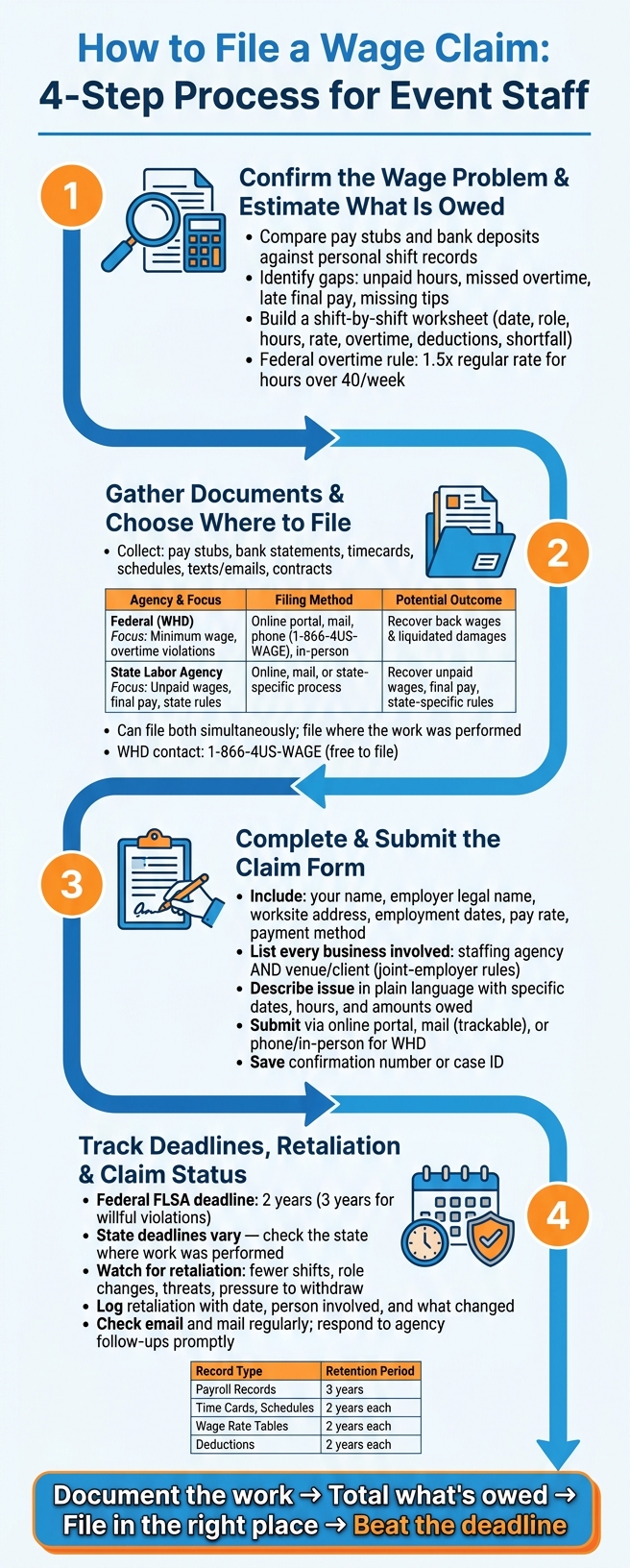
How to File a Wage Claim: 4-Step Process for Event Staff
Before you file, pin down each missing payment and come up with a rough total. A shift-by-shift breakdown gives the agency a clear place to start.
Gather your pay stubs, bank deposit records, event schedules, event staff scheduling software records, and any time logs you kept. Then compare each pay stub with your own records. Also check that the bank deposit matches the net pay listed on the stub.
If you're paid per event, match every event you worked to a pay record and deposit. You're looking for gaps like unpaid hours, a lower rate than promised, missing overtime, or unpaid training, setup or cleanup, or briefing time. If the employer's records are missing pieces, rebuild each shift using calendars, notes, texts, emails, receipts, and timekeeping screenshots.
Overtime is a common problem for event workers who take multiple shifts in the same workweek. Under federal law, covered nonexempt employees generally must be paid 1.5 times their regular rate for hours worked over 40 in a workweek. If your weekly total went past that mark, check whether the pay stub shows any overtime line at all.
For final pay, write down your last day worked and when the final check or direct deposit showed up. Many states require final wages by a set deadline or by the next payday, so late final pay can become a separate claim issue. Make sure final pay includes last-event hours, overtime, training, setup or cleanup time, and any tips or service charges you're still owed.
A simple worksheet can make the claim much easier to file and review. For each event date, list:
For each pay period, compare the total you expected with what you were actually paid on the pay stub or in the bank deposit.
That difference is your estimated unpaid amount for that period. Add each shortfall to get your total claim. It doesn't need to be a formal audit. The main thing is that your worksheet lines up with schedules, pay stubs, and time logs, so it's easier for the agency to review. Use that worksheet when you decide where to file and when you fill out the claim form.
Use your shift-by-shift worksheet to pull together proof and pick the right agency before you file.
Start by matching each missing payment on your worksheet to the records that back it up.
Most workers should gather pay stubs, bank statements or direct deposit confirmations, timecards or timekeeping screenshots, event schedules and staff rosters, and any texts or emails that confirm shift times, locations, and pay rates. If you have them, include your offer letter, staffing contract, or employee handbook too. Those papers can help show what pay you were supposed to get.
It also helps to add personal notes from any talks you had with a supervisor or coordinator about missing pay. Write down the date, who was there, and what was said. Small details can matter more than people think.
Send copies, not originals. Agencies may keep documents while they look into a claim, and you should keep your own full set at home. Scan or photograph paper records and save them in clearly named digital folders so you can find things fast later. If official time records are missing, even a handwritten shift log reconstruction may still work as evidence.
These records also help show where your claim belongs.
Match the pay problem to the agency before you submit anything.
State labor agencies are often the first place to file for unpaid wages, underpaid wages, and late or missing final pay. That's because state rules often have specific deadlines and penalties that federal law doesn't include. Final-pay deadlines differ by state, so file where the work was done.
File with the U.S. Department of Labor's Wage and Hour Division if the issue involves federal minimum wage or overtime violations. Filing with WHD is free. You can do it online, by phone at 1-866-4US-WAGE, or through a local office.
Some cases involve both state wage-payment rules and federal wage law. In that case, you can go down both paths at the same time.
If you worked events in more than one state, file based on where each shift happened. That may mean separate claims for different states.
| Federal (WHD / FLSA) | State Labor Agency | |
|---|---|---|
| What it covers | Federal minimum wage and overtime | State wage-payment rules, minimum wage, and overtime |
| Where to file | U.S. Department of Labor, Wage and Hour Division | State labor agency or labor commissioner where the work occurred |
| How to submit | Online, phone (1-866-4US-WAGE), or local WHD office | Online portal, mail, in person, or phone, depending on the state |
| Possible results | Back wages, additional amounts under federal law, and compliance orders | Back pay, state penalties or interest, waiting-time penalties, and corrective payroll orders |
| Filing cost | Free | Free |
List both the staffing agency and the client venue in your claim, since either one may owe back wages.
Once you've pulled together your records and picked the right agency, fill out the claim form and send it in with your proof. Use the worksheet from Step 1 so your dates, hours, and unpaid wages match what you already documented.
Most wage claim forms ask for the same basic information: who you are, who the employer is, where you worked, when you worked, your rate of pay, and how much you're owed.
Start with your full legal name, mailing address, phone number, and email. Use an address where you can receive mail without issues for the next several months. A lot of agencies still send notices and decisions by mail.
For the employer, list the legal business name, DBA names, mailing address, and a contact person. Stick with the legal business name shown in your records.
You'll also need the worksite address, your employment dates, job title, pay rate, and how you were paid - hourly, per event, cash, direct deposit, or another method. For event work, it helps to lead with the details that matter most:
Then add a short, plain-language description of the issue, how you figured out the amount owed, and what you've already done to try to fix it with the employer.
Example: worked four July events at $18 an hour, paid for only 8 hours per shift, with no overtime for the week of 07/17, and no final paycheck after 08/15.
That level of detail makes it easier for the agency to review the claim.
For federal claims with the Wage and Hour Division, you may also see the WH-3 Employment Information Form. It's optional, but investigators sometimes use it when pay arrangements get messy - like day rates, service charges, or tip pooling - or when several workers at the same venue or staffing agency are involved.
When the form is done, submit it and keep proof that you filed.
How you file depends on the agency. Many states use online portals that let you upload records directly. If you file that way, save the confirmation number. If you mail a paper claim, use a trackable mailing service. For federal WHD complaints, intake often starts by phone or in person, and the forms may be completed during or after that conversation.
After you file, answer follow-up requests as soon as you can. Agencies often ask for the same records you gathered in Steps 1 and 2: time logs, pay records, payment app screenshots, or messages about shift times and rates.
Some claims move fast. A missing final paycheck, for example, may get resolved fairly soon if the employer cooperates. Others take longer. Cases with many events, disputed hours, or more than one business involved can stretch from weeks into months.
While the claim is under review, keep updating your records.
Event staffing claims can get tricky because more than one business may be tied to the job. In many cases, there's both a staffing agency and a venue or client. Either one - or both - may be legally responsible for unpaid wages under joint-employer rules.
When you fill out the claim, name every business connected to the work. That includes the staffing agency's legal name and coordinator, the venue or client name and address, and anyone who supervised you on-site.
It also helps to spell out who handled scheduling, timekeeping, and pay. Those details give investigators a clearer picture of which business may be responsible.
Once you file, the job isn't over. You still need to watch deadlines, pay attention to any pushback from the employer, and stay on top of agency updates.
Check the filing deadline before you wait for the employer to fix the issue. Under federal law, FLSA claims usually have a 2-year limit, or 3 years for willful violations. State deadlines depend on where the work was performed.
That detail matters a lot for event work. These jobs are often short, irregular, and spread across different venues or staffing agencies. Because of that, each shift may have its own deadline. If you wait to see whether the employer fixes the problem on the next paycheck, you could lose the right to recover wages from earlier shifts.
Check the deadline with the labor agency in the state where the work was performed, not the state where you live. Those states may follow different rules.
A missed deadline can kill the wage claim. And if the employer pushes back after you speak up, that may open a second case.
Federal law and many state laws ban retaliation against workers who file wage claims or ask about unpaid wages in good faith.
For event workers, retaliation doesn't always look dramatic. Sometimes it's quiet and calculated, like:
If this happens after you file or ask about unpaid wages, write down the date, who was involved, what changed, and what was said. Do it right away while the details are still clear. Those notes can support a separate retaliation complaint with the same agency handling the wage claim.
In California, for example, a retaliation complaint with the Labor Commissioner generally must be filed within 180 days of the retaliatory act.
Use your case number to track the matter until the agency closes it.
Hold on to the confirmation number, case number, or claim ID the agency gives you. You'll need it to check status and respond to follow-up requests.
Keep a simple log with:
Also check your email, spam folder, and physical mail on a regular basis. Agencies may send official notices through either channel. If they ask for more information, answer fast. A missed follow-up can delay the claim or hurt it.
If you later find more unpaid shifts, or if the employer sends a partial payment, update your wage worksheet right away and tell the agency. A partial payment lowers the amount still owed.
When a wage claim comes in, agencies compare the worker’s pay worksheet against the employer’s records. If those records are clean, the dispute is usually a lot easier to sort out. Under the FLSA, employers must keep payroll records for at least 3 years and time cards, work and time schedules, and wage rate tables for at least 2 years.
For each worker, keep a file with their full legal name, address, Social Security number, job role, and basis of pay, such as hourly, salary, piece-rate, day rate, or tipped position. For each pay period, track daily and weekly hours, regular rate, overtime, deductions, pay dates, and total wages paid. For event staff, it also helps to keep shift assignment sheets, event dates and locations, and, when needed, tip pool distribution records that show amounts collected and paid for each event.
| Record type | Federal minimum retention |
|---|---|
| Payroll records | 3 years |
| Time cards / time sheets | 2 years |
| Work and time schedules | 2 years |
| Wage rate tables | 2 years |
| Deductions / additions records | 2 years |
The DOL does not require a specific form. What matters is that the records include the required information and are stored in a way that’s easy to search and pull up later.
Centralized scheduling helps connect assigned shifts to hours worked and wages paid. When details live across scattered texts, separate sign-in sheets, and last-minute messages, it gets messy fast. That’s when payroll errors can slip through.
A platform like Quickstaff keeps assignments, availability, shift changes, and team communication in one place. That makes payroll checks easier before pay runs and helps catch problems early, like missed overtime or a role mismatch, before they turn into a formal claim.
Filing a wage claim gets a lot simpler when schedules, timecards, and payroll records line up. Good documentation gives both workers and coordinators a clear way to check the facts and deal with disputes before they drag into longer investigations.
Yes. You can file a wage claim even if you were paid in cash.
Your employer still has to keep accurate payroll records, including the hours you worked and the wages you were paid. Getting paid in cash doesn't erase that duty.
If your pay doesn't match your hours, or your overtime is missing, start keeping your own records. That can include:
Those records can help support your claim with the Department of Labor or the state agency that handles wage complaints.
Wage and hour laws usually depend on where the work was performed.
So if you worked events in more than one state, you need to check the rules for each location. Minimum wage, overtime, and meal or rest break rules can change from state to state.
To lower risk, the safest move is often to follow the strictest standards across all event locations.
Yes. You can still file a wage claim even if you don't have all of your time records.
Clear records of your hours and wages can make your case stronger, but you do not need them to start a complaint. If your paycheck looks off, compare your hours and pay rate with your own notes and bring any documents you do have.