Union Contracts vs State Law On Hours Limits
October 8, 2026

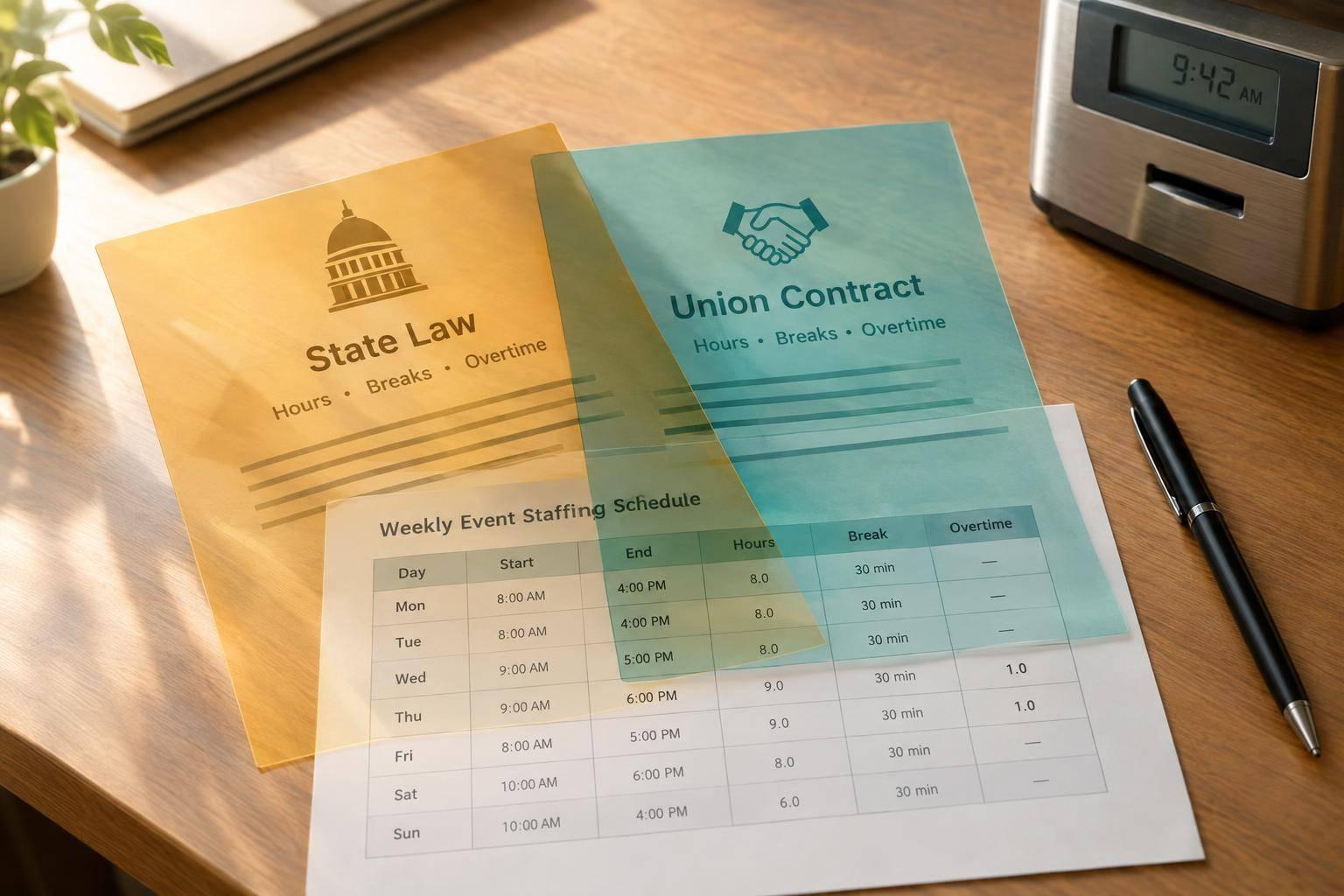
I check two things before approving a long shift: whether the hours are allowed and what pay is owed. Paying overtime does not make a shift lawful. Follow the applicable law and any stricter union-contract terms unless a lawful exception applies.
Federal law generally requires 1.5× pay after 40 hours in a workweek for covered, nonexempt employees, but it generally sets no hours cap for workers age 16 or older. State rules and union contracts may add shift limits, breaks, rest between shifts, and extra pay.
Here’s what I check before assigning event staff:
My rule: <u>resolve scheduling conflicts before assigning the shift</u>. Software can organize schedules, but it does not decide whether a shift complies with the law or the contract.
Federal overtime uses the employer’s fixed seven-day workweek. Holidays, Saturdays, and back-to-back shifts do not, by themselves, trigger a federal overtime premium. Next, check the rules in the state where the shift takes place. They may be stricter than federal overtime rules.
| Issue | Federal baseline | State-law variations | Union-contract provisions to check |
|---|---|---|---|
| Hours caps | Generally no daily or weekly cap for workers age 16 or older. | Industry, safety, and youth-employment rules may limit hours. An overtime trigger does not necessarily cap shift length. | Maximum consecutive hours; minimum time between shifts; approval for extensions |
| Overtime | Covered, nonexempt employees generally receive 1.5× their regular rate after 40 hours in a workweek. | Daily or consecutive-hours overtime may apply. | Daily overtime, double time, and sixth- or seventh-day premiums |
| Meals | Generally not required. A fully off-duty meal break, usually 30 minutes, may be unpaid. | Required length and timing vary. | Paid meals, earlier meal deadlines, and missed-meal penalties |
| Rest breaks | Short rest breaks are usually paid work time. | Some states require paid rest periods. | Longer breaks or additional break requirements |
Do not stack premiums unless the collective bargaining agreement (CBA) allows it. Check for a higher rate, separate penalty, no-pyramiding rule, legally permitted CBA exception, or occupation-specific or age-based rule that changes the baseline. An overtime exemption does not cancel applicable safety or break rules.
Before making scheduling decisions, use the official sources below to verify current coverage, effective dates, industry rules, and exceptions. These examples show where states add meal, rest, or daily-hour rules to the federal baseline. Compare those rules with the CBA: it may set tighter shift caps or rest requirements, but it cannot replace stricter law without a legally permitted exception.
| State | Hours limits and overtime | Meals and paid rest breaks | CBA exceptions and enforcement |
|---|---|---|---|
| Colorado | COMPS materials describe 1.5× pay after 40 weekly hours, 12 daily hours, or 12 consecutive hours. Use the method that yields higher pay; this is not a blanket ban on shifts longer than 12 hours. | Shifts over five hours require a 30-minute uninterrupted, duty-free meal. Paid 10-minute rest periods apply per four hours or major fraction, subject to coverage and exceptions. | Confirm COMPS coverage and any claimed exception. Union coverage alone does not remove these duties. Check the Colorado Division of Labor Standards and Statistics. |
| Illinois | Generally uses a 40-hour weekly overtime threshold. The One Day Rest in Seven Act addresses rest days, with statutory exceptions. | Shifts of at least 7.5 continuous hours require a meal of at least 20 minutes, no later than five hours after starting, subject to exceptions. | Confirm statutory and collective bargaining exceptions through the Illinois Department of Labor. |
| Washington | Generally requires overtime after 40 weekly hours, rather than universal daily overtime. Check occupation-specific limits. | Qualifying shifts require meals. Paid rest periods are commonly 10 minutes per four hours worked. Check coverage exceptions. | Confirm whether a CBA exception applies to the workers and the break rule with Washington Labor & Industries. |
| Minnesota | Break requirements do not set general adult shift caps. Check state overtime coverage separately from the federal threshold. | Rules effective January 1, 2026, generally require a meal of at least 30 minutes for six or more consecutive hours and a paid rest break of at least 15 minutes within each four consecutive hours, subject to exceptions. | Check statutory exceptions and permitted CBA treatment with the Minnesota Department of Labor and Industry. |
State rules follow where work is physically performed, not the employer’s headquarters. That includes each site on a cross-state assignment. Check local rules, worker classification, age, industry limits, employer-size thresholds, and actual meal duties. Monitoring guests or answering radios can turn an unpaid meal into paid work time.
For agency staff, identify who controls schedules, breaks, pay, and records to determine who must correct violations. The agency and event client may share joint-employer duties. Assign scheduling, break, wage, and record duties explicitly instead of leaving them implied.

Union Contracts vs State Law: 6 Shift Approval Checks
A CBA can set stricter scheduling limits, but it cannot override state law.
Start with the state’s minimum requirements. Then check the CBA for tighter caps, longer rest intervals, or extra pay.
The provisions below are common in CBAs, but they aren’t in every agreement. Read the actual clauses to determine whether you can assign a shift - or whether it will cost more.
| Issue | Statutory baseline to check | CBA term and scheduling action |
|---|---|---|
| Maximum consecutive hours | No general federal daily cap for adults; state, local, and industry limits may apply. | Daily cap, maximum tour, or ban on back-to-back shifts; reject, shorten, or get required approval |
| Turnaround time | No universal federal rest interval for adults | Required 8-, 10-, or 12-hour interval; delay, shorten, or reassign conflicting work |
| Overtime | Federal weekly and state triggers | Daily overtime, double time, or holiday and seventh-day premiums; calculate pay owed and allowed credits |
| Other pay guarantees | Split-shift and reporting-time rules | Call-in, split-shift, or minimum-shift pay; check guarantees before shortening or canceling |
| Meals | Timing, duration, and duty-free requirements | Paid meals, relief, or interruption penalties; arrange coverage and record compensable interruptions |
| Rest periods | Paid-break requirements | Extra breaks or recovery time; include them in the event plan |
| Scheduling notice | State and local scheduling rules | Posting deadlines, seniority bidding, and cancellation or call-in rules; check assignments and changes |
| Exceptions and overtime assignments | Whether the law allows an exception | Voluntary or mandatory overtime and emergency clauses; check eligibility, consent, and approvals |
| Disputes | Complaint deadlines | Grievance and arbitration deadlines; keep assignment and approval records |
Check each proposed shift against these terms before assigning it.
Count only premiums or credits allowed by law. A rule requiring advance approval does not erase pay owed for compensable overtime already worked.
Consult labor and employment counsel before using proposed exceptions for hours limits, breaks, turnaround, or mandatory overtime. Check that the law allows the exception, the CBA permits it, and the worker qualifies. Union approval alone may not be enough.
These examples assume specific CBA terms to show how contract rules can affect scheduling.
Hypothetical assignment Statutory issue Assumed contract term Scheduling response Guest service ends at 1:00 a.m., followed by a 7:00 a.m. load-in Federal law has no universal adult turnaround rule, but the hours still count toward overtime. 10 hours between shifts unless the worker volunteers and the CBA allows an emergency exception Assign the load-in only if both the CBA exception and legal basis apply. Otherwise, reassign it or delay the call time. A four-hour reception extends into guest service, teardown, or call-in coverage Added hours may trigger overtime, but not necessarily a shift cap Double time after 12 hours and minimum-shift pay for call-in coverage Approve the extension only within hours limits, with required overtime pay and call-in guarantees. Guest requests repeatedly interrupt a scheduled meal Work interruptions may make the meal compensable. 30-minute uninterrupted paid meal, or an interruption penalty Assign meal relief so the worker gets an uninterrupted paid meal. Apply the contract penalty if the meal is interrupted.
If the shift is worked, keep its hours, approvals, and premiums together in the record.
After a shift is approved, the records help show whether the employer followed the rules if a dispute comes up later.
Statutory claims and CBA grievances follow separate paths. A single shift can trigger both, and resolving one does not automatically resolve the other. The U.S. Department of Labor’s Wage and Hour Division (WHD) enforces the FLSA, while state labor agencies may enforce additional state requirements. CBA grievances follow contract deadlines and may move to arbitration. A complete record trail helps employers respond to disputes.
| Claim | Where it goes | Key records | Remedies |
|---|---|---|---|
| Federal minimum wage or overtime | WHD complaint, state agency claim where state law also applies, or eligible private lawsuit | Actual hours, payroll, pay rates, workweek definition, edits, and approvals | Back wages, an equal amount in liquidated damages, attorney’s fees and costs in qualifying private actions, injunctions, and possible civil penalties for certain willful or repeated violations |
| State break, meal, rest-period, or daily-hours rule | State labor agency or private claim, where allowed | Worksite, actual hours, break records, missed-break explanations, notices, payroll, and signed waiver records where legally valid | Back wages, statutory damages or penalties where authorized, interest, fees, citations, or other state remedies |
| CBA shift-length, overtime-premium, scheduling-notice, or rest-period term | Union grievance and possible arbitration | CBA, side letters, schedules, time records, union notices, and grievance communications | Back pay, premiums, schedule correction, or make-whole relief; arbitration costs or other CBA remedies |
| Inaccurate or incomplete time records | DOL or state investigation, private wage claim, and possibly a contract grievance | Timekeeping policy, audit trail, actual-work confirmations, payroll, schedules, and corrections | Weaker defense of the employer’s hours records, back wages, recordkeeping penalties where authorized, and added litigation or investigation costs |
Check deadlines immediately. FLSA recovery periods are generally two years, or three years for willful violations. State claims and contract grievances have different deadlines. Rights, procedures, and remedies also vary by coverage and claim. Paying a contractual premium does not automatically settle unpaid statutory wages.
If someone challenges a shift, the schedule alone will not suffice. The records must reflect the hours actually worked.
Keep the schedule separate from the actual-work record. Record actual start and finish times, including any compensable setup, teardown, travel, or closing work. Document interruptions to meal and rest periods and whether the worker was relieved of duties. Reconcile hours across events using the applicable statutory and CBA measurement periods - not just one event at a time.
Keep original and revised assignments, reasons for changes, supporting approvals, premiums, legally valid waivers, employee correction requests, and related grievance communications. These records may support both a state-law claim and a CBA grievance. Log who changed each entry and when.
Federal rules generally require employers to keep payroll records, CBAs, and related records for at least three years, and wage-calculation records for two years. Follow any longer retention requirements that apply, and preserve records tied to an active dispute.
Scheduling software can organize assignments, but compliance still depends on the rules and the records behind each shift.
Quickstaff helps track assignments, availability, reminders, and schedule changes. It does not determine compliance or calculate overtime.
Overtime pay does not make a longer shift lawful. If the CBA and state law conflict, follow the stricter rule unless a lawful exception applies.
Recheck the assignment after late shift endings, call-offs, or cross-state travel. Recalculate hours, breaks, premiums, and rest before the next shift. Take unresolved conflicts to labor counsel, the union representative, or the staffing contact.
Before approving an assignment, check the issues that could make it invalid:
Generally, no. Employees can’t waive shift limits or overtime requirements set by law or union contracts. Under the Fair Labor Standards Act, employers and employees can’t agree to waive overtime requirements.
Union contracts often set rest periods, minimum time between shifts, and maximum hours. When managing event staff, you must follow your collective bargaining agreement and applicable state labor laws - even if an employee wants to work beyond those limits.
Follow your collective bargaining agreement (CBA) and applicable labor laws, applying whichever rule is stricter. Check whether your CBA uses weighted credits in its equalization log: time-and-a-half counts as 1.5 hours, and double time counts as 2.0 hours.
When daily, weekly, or standby overtime triggers overlap, track all compensable hours, including setup, teardown, and waiting time, to determine which premium applies. Record every hour worked to the nearest tenth of an hour.
The right path depends on the dispute, your union contract, and the labor laws that apply.
A grievance addresses violations of your collective bargaining agreement, such as seniority errors or mistakes in overtime equalization. A wage complaint addresses violations of state or federal labor laws, such as unpaid wages or overtime.
You may need to file both if the same incident violates your contract and the law. Talk to your union representative about which path fits your situation.