How Temp Staff Earn Paid Sick Leave
September 18, 2026

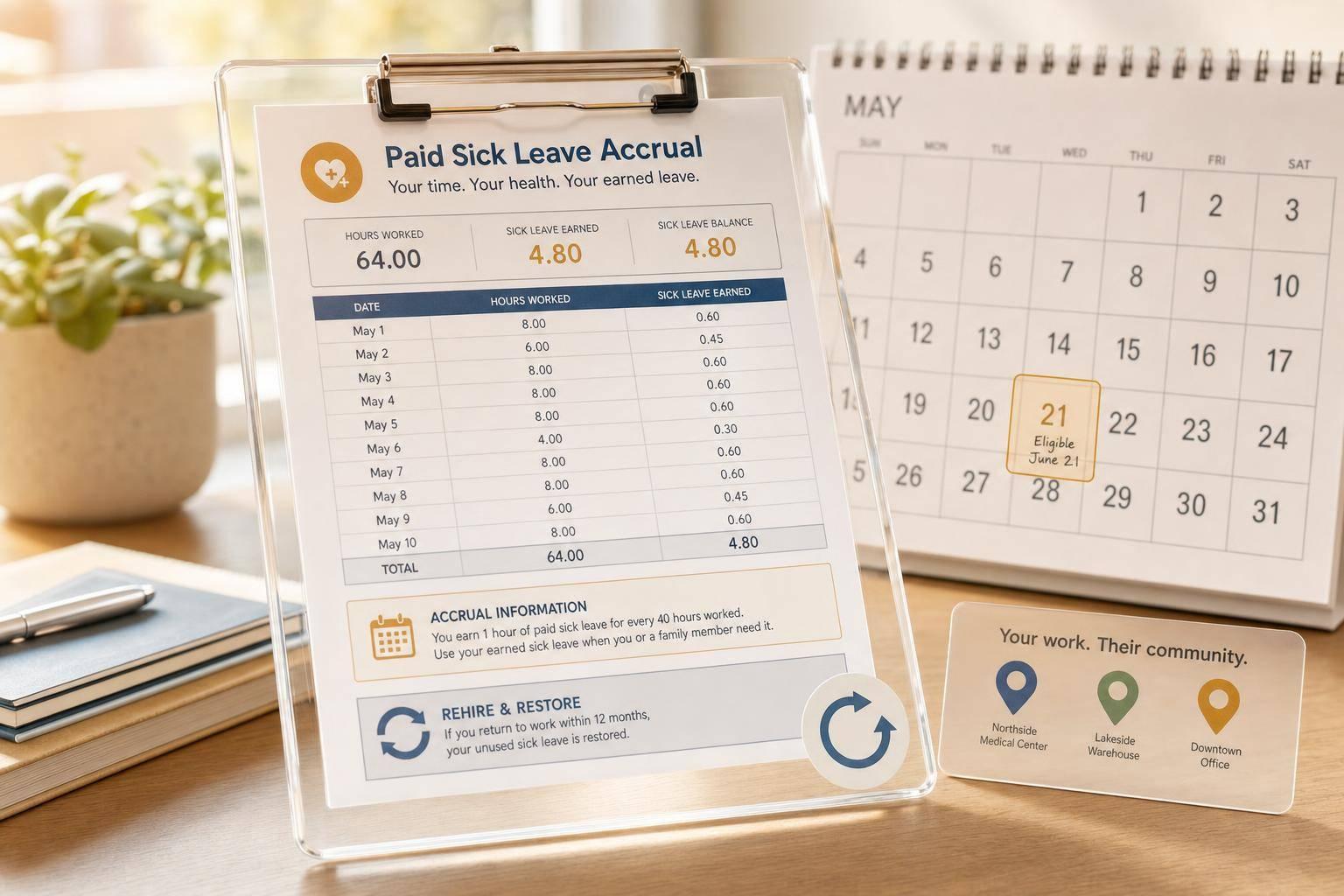
Most temp staff can earn paid sick leave, but the rule usually depends on where they work, not where the company is based. I’d check four things first: when accrual starts, which hours count, when leave can be used, and what happens if the worker leaves and comes back.
Here’s the short version:
A simple example: if a temp worker puts in 200 hours under a 1:30 rule, they earn about 6.67 hours of sick leave. Under a 1:40 rule, they earn 5 hours.
| Topic | What I’d check |
|---|---|
| Coverage | Is the worker covered under the state or city rule? |
| Accrual | Does leave start on the first day, and at what rate? |
| Use | Is there a 90-day, 120-day, or other wait before use? |
| Rehire | Does unused leave have to be restored after a return? |
| Records | Are hours, balances, and notices being tracked the right way? |
Bottom line: calling someone a “temp” does not by itself take away paid sick leave rights. I’d match each worker to the law for the job site, then track hours worked, waiting periods, use limits, and rehire dates with care.
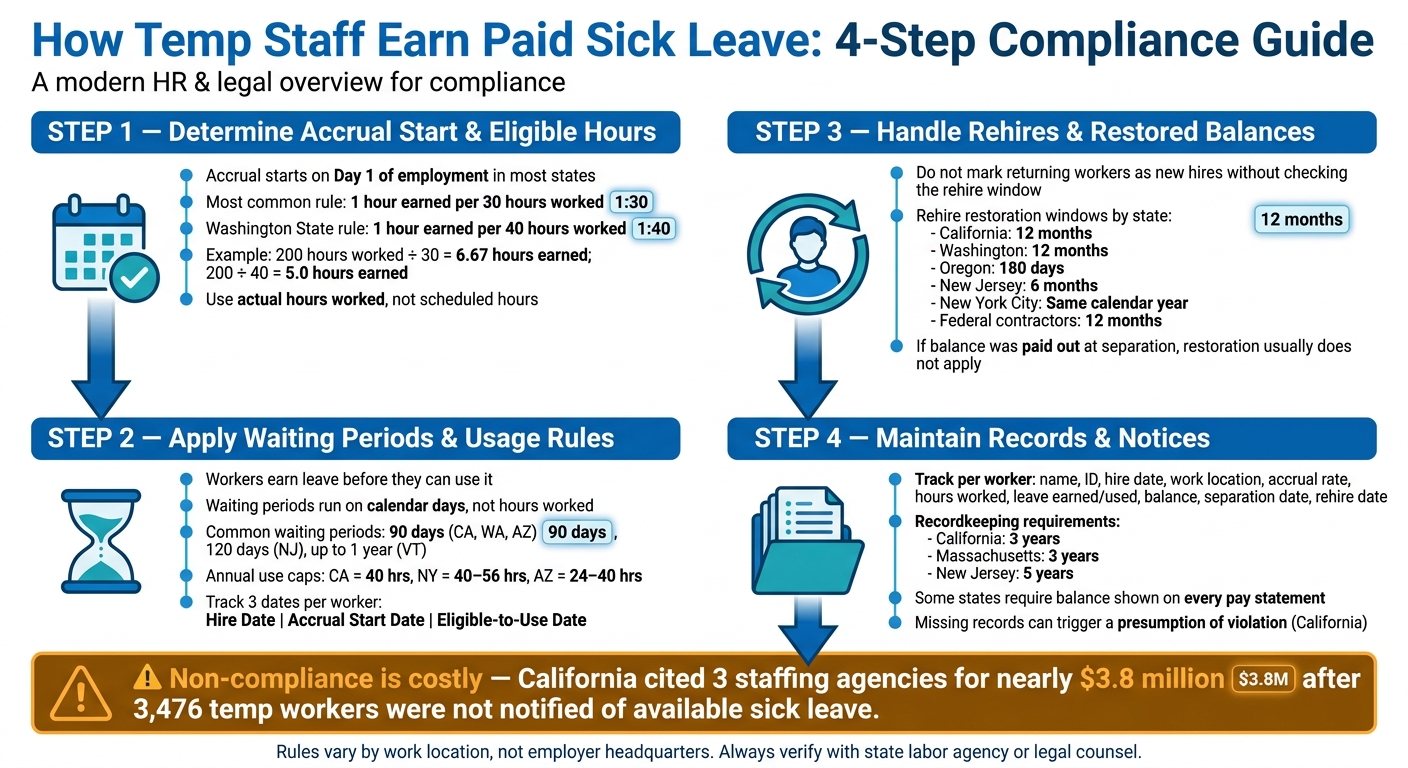
How Temp Staff Earn Paid Sick Leave: 4-Step Compliance Guide
Under most state and local paid sick leave laws, accrual starts on the first day of employment, not after a probation period. California's Healthy Workplace Healthy Family Act, for example, says employees accrue paid sick leave beginning at the commencement of employment. Washington state follows the same basic rule: accrual starts from the first hour worked.
It helps to keep two dates separate: when accrual starts and when use starts. They are not the same thing. A temp worker may begin earning leave on day one but still need to wait before using it, often 90 days or another set period under the law. Step 2 covers when workers can use earned leave.
The formula you’ll see most often is 1 hour of sick leave for every 30 hours worked. Washington state uses 1 hour for every 40 hours worked. Apply the right formula for each work location.
The math is pretty simple once you line it up with hours worked. If an event server works 200 hours under a 1:30 rule, they earn about 6.67 hours of paid sick leave (200 ÷ 30). Under a 1:40 rule, that same worker earns 5 hours (200 ÷ 40). That gap may look small at first, but over a busy season, it can add up.
Example: 6 hours worked under a 1:30 rule earns 0.2 hours of sick leave.
Use actual hours worked for the calculation, including overtime, and base the math on verified time records, not scheduled shifts. Don’t include paid time off when no work is performed or sick time already used. In plain terms, if someone was scheduled for 8 hours but only worked 6, accrual should be based on the 6 hours worked. That’s why it makes sense to centralize hours by assignment so payroll credits accrual from verified time, not the schedule.
After accrual begins, you can then apply any waiting period before use is allowed. From there, the next step is to line up earned hours with the rules on use, caps, and carryover.
Accrual can begin on day one. But workers often can't use that time until later.
That's where waiting periods come in. And here's the part that trips people up: waiting periods run on calendar days, not hours worked. Many jurisdictions use a 90-day window. Others use 120 days or more.
For staffing managers, this means one thing: keep the dates separate. For each worker, record these three dates:
It may sound basic, but mixing up those dates can cause a mess fast.
Once the waiting period ends, that doesn't mean a worker can use leave without limits. Many jurisdictions set a separate annual cap on how many hours a worker can use. They may also set rules for the smallest increment of leave a worker can take at one time.
For temp staff with short or uneven shifts, a 1-hour increment is often the easiest way to handle this on a steady basis, as long as it fits the law.
Common approved reasons for use include the worker's illness, preventive care, family care, and safe-time leave. Being a temporary worker does not, by itself, remove eligibility once the worker is covered and allowed to use leave.
Use this quick reference to compare common limits by location.
| Jurisdiction | Annual Use Cap | Minimum Usage Increment | Waiting Period |
|---|---|---|---|
| California | 40 hours | Not specified by state | 90 days |
| Washington | Not specified | 1 hour | 90 days |
| New York | 40–56 hours (by employer size) | Up to 4 hours max | Not specified |
| Arizona | 24–40 hours (by employer size) | Not specified | 90 days |
| New Jersey | Not specified | Not specified | 120 days |
| Vermont | Not specified | Not specified | Up to 1 year |
Next, handle breaks in service and rehires the same way every time.
After waiting periods, the next issue is what happens when a temp worker leaves one assignment and comes back later. Don't mark them as a new hire until you check the rehire window.
Many U.S. paid sick leave laws say you must restore previously earned, unused sick leave when a worker is rehired within a set window. In staffing, where people often move in and out of assignments fast, this matters a lot. A worker who looks "new" in the system may actually be a rehire.
If the worker returns within the reinstatement window, restore the unused balance. If that balance was paid out at separation, restoration usually doesn't apply.
If the worker had already finished the waiting period before the break, restored leave is available when they come back.
The reinstatement window changes by jurisdiction, so there isn't one rule for every assignment. Here are some common examples:
| Jurisdiction | Rehire Window for Restoration |
|---|---|
| California | 12 months |
| Washington State | 12 months |
| Oregon | 180 days |
| New York City | Within the same calendar year |
| Federal contractors | 12 months |
For each returning worker, document:
That written record can help if anyone later reviews the decision. Keep the process tied to assignment history and attendance data so your team has one clear reference point for each returning temp.
A short rehire checklist can also help. Recruiters or schedulers should confirm the jurisdiction, check the window, pull the prior balance, and note whether the balance was restored or reset. Quickstaff can help keep assignment histories and attendance records in one place. When rehire dates and restored balances are documented clearly, payroll reconciliation gets easier in the next step.
Once rehire decisions are made, recordkeeping becomes the main checkpoint for every leave balance. At a minimum, track each worker's name, employee ID, hire date, work location, accrual rate, hours worked, sick leave earned and used, current balance, separation date, and rehire date.
Keep separation and rehire dates tied to the balance record so restoration checks can happen automatically.
Those same records should also feed each worker's balance notice. Some states require balance notices on every pay statement or in a separate notice. California allows employers to show this on the wage statement or in a separate notice. Minnesota clearly allows employers to show balances through an electronic portal or timekeeping software, as long as workers can access and print the information during work hours. The simplest setup is to have your system generate that notice automatically each pay period, so staff doesn't have to handle it by hand.
Missing records can trigger a rebuttable presumption of a violation in California, which shifts the burden to the employer to prove compliance. Complete, dated records do more than keep things tidy. They help defend your process if questions come up.
Use the same records to check payroll before accrual is posted. Reconcile scheduled shifts against actual attendance each pay period, then apply the state's accrual rate to approved hours.
Quickstaff keeps assignments, schedules, and shift communication in one place. That makes it easier to match event records to payroll totals. If a balance looks wrong, coordinators can review the worker's recent assignment history, compare it with approved payroll hours, spot where hours were missed or entered wrong, and then rerun the accrual calculation to fix the balance.
New Jersey requires employers to keep records of hours worked and sick leave accrued, used, paid out, and carried over for 5 years. California and Massachusetts require 3 years. If your team works in more than one state, set your system to meet the strictest rule that applies.
When workers move across state lines, retention and notice rules need to follow the work location. Use this table to apply the right state rule for each location.
| State | Rehire Restoration Window | Recordkeeping / Notice Requirement |
|---|---|---|
| California | 12 months | 3 years; balance on wage statement or separate notice |
| Washington | 12 months (including rehire at a different location) | Monthly accruals, unused balance, start date, use, donated leave, and amounts not carried over at year-end |
| New Jersey | 6 months (prior service counts toward waiting period) | 5 years; hours worked, accrued, used, paid out, and carried over |
| Massachusetts | - | 3 years; separate record not required if compliant PTO policy is in place |
| Minnesota | - | Balance may be shown on earnings statement or electronic portal |
Verify current rules with counsel or the state labor agency, and apply any stricter local ordinance.
Paid sick leave for temp staff comes down to four controls: accrual dates, eligible hours, waiting periods, and rehire restoration.
If any one of those slips, the cost can get ugly fast. California's Labor Commissioner cited three staffing agencies and joint employer Foster Farms for nearly $3.8 million after 3,476 temporary workers were not told about available COVID-19 supplemental paid sick leave.
For staffing teams working across many job sites, uneven coding often leads to balance mistakes and underpayments. That's why centralized scheduling records matter.
Quickstaff keeps shift assignments, availability, and event records in one place. That makes it easier to line up actual hours worked with payroll totals. With one shared record, coordinators can spot problems before they hit pay.
Good tracking helps workers use leave the right way and helps staffing teams fill shifts faster.
The sick leave law for a temporary worker depends on where the work is performed.
For example, in Washington, temporary staff are covered by the state’s paid sick leave law. In New York City, temp workers are covered by ESSTA, and the staffing firm is typically responsible for compliance.
That’s why location matters so much. A worker doing the same job in two different places can end up under two different sets of rules.
Because requirements vary by state and city, verify the wage and hour rules for each location where your event staff works.
Yes. Temp workers usually earn paid sick leave based on the hours they work, starting on day one.
That sick leave often keeps building between assignments too, including back-to-back jobs or recurring shifts. In plain English: if they stay employed under the law, the time doesn't reset every time one assignment ends.
They can usually start using that accrued leave by their 90th calendar day of employment, depending on the jurisdiction.
After a rehire, unused paid sick leave usually stays on the books under the required carryover and balance rules instead of being reset.
If leave carries over up to a cap, that carried balance becomes the employee’s starting balance after rehire. From there, new hours worked keep adding to accrual. That means employers need clean records on hours worked, hire and separation dates, and sick leave balances.