5 Event Staff Training Tips for Brand Consistency
July 21, 2026


If your event staff look, sound, and act differently, guests notice fast. And that can weaken the brand experience, hurt lead quality, and make event results harder to track.
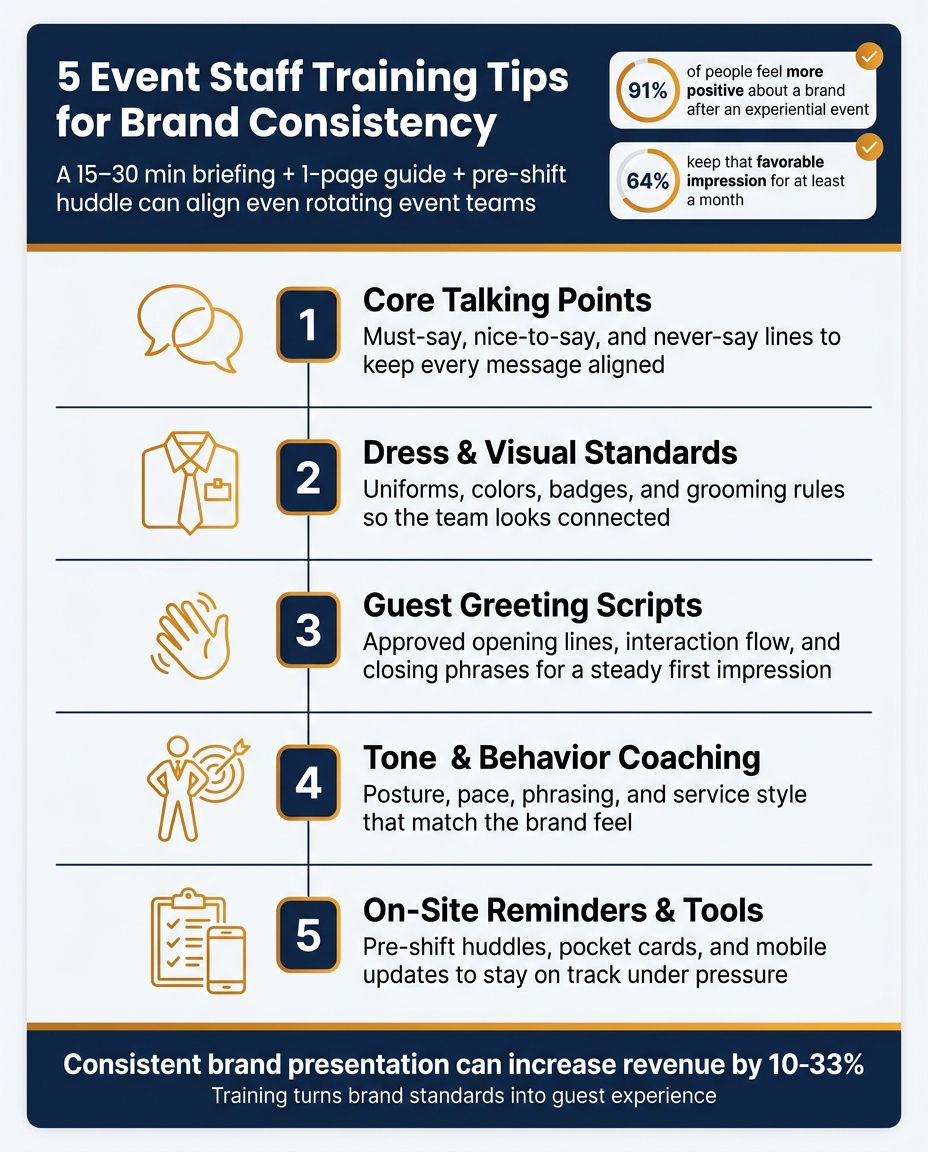
I’d sum up the article like this: if I want brand consistency at a live event, I need to train staff on five things before doors open:
The article also makes one big point clear: short training works. A 15–30 minute briefing, a one-page guide, and a pre-shift huddle can be enough to align even rotating event teams. That matters because event guests judge brands in seconds, and one dataset cited says 91% of people feel more positive about a brand after an event, while 64% keep that feeling for at least a month.
5 Event Staff Training Tips for Brand Consistency
| Tip | What I’d train | Why it matters |
|---|---|---|
| 1. Talking points | Must-say, nice-to-say, never-say lines | Keeps the message the same |
| 2. Dress standards | Uniform, colors, badges, grooming | Makes the team look connected |
| 3. Greetings | Opening line, guest flow, closing line | Sets a steady first impression |
| 4. Tone and behavior | Posture, pace, phrasing, service style | Shapes how the brand feels |
| 5. On-site tools | Huddles, pocket cards, mobile updates | Helps staff stay aligned during service |
If I were running a conference, wedding, trade show, or fundraiser in the U.S., I’d treat staff training as the point where the brand becomes real for guests.
When guests walk into a trade show, festival, or corporate event, they make up their minds fast. And when things feel uneven, they read that as part of the brand experience. That’s why training needs to line up every guest touchpoint.
One experiential marketing dataset found that 91% of people report more positive feelings about a brand after an experiential event, and 64% keep that favorable impression for at least a month. But those gains only stick when staff deliver the same message each time.
If staff wing it instead of working from a shared script, small things start to drift. Badge scans, QR sign-ups, and demo invites stop following the same pattern. That can cut lead volume, weaken data quality, and make ROI tougher to show. Consistency helps turn booth activity into results you can use.
This problem hits hardest with temporary, seasonal, or rotating teams. They often meet just days before an event, so there’s not much room to get everyone on the same page. Without a short, repeatable briefing, each person falls back on personal habits, and the brand starts to feel uneven.
Use a short standardized briefing before the event. Cover:
Start with the brand story and core talking points.
Before staff memorize lines, they need the bigger picture: why the brand exists, who it's for, and what the event is meant to do. That context matters because live conversations rarely follow a script. People ask odd questions, jump topics, and go off on tangents. When staff know the purpose behind the words, they can stay on message from the first hello to the follow-up.
One simple fix is a short briefing built around fixed talking points.
Consistent brand presentation across all touchpoints, including live events, can increase revenue by 10–33%. And that consistency starts with what staff actually say. When the team shares the same view of the mission, audience, and event goal, guest conversations sound aligned instead of scattered.
Use a short staff briefing with three message tiers:
After staff know what to say, define how they should look and sound while saying it.
Run a 15–30 minute pre-event briefing. Cover the mission, the day's goal, the three message tiers, and a short role-play where pairs practice covering all three must-say points in a 60–90 second conversation. That gives you a starting point for dress, greetings, tone, and on-site reminders.
Attach the briefing to each event in Quickstaff so staff review it before confirming their shift.
Once the message is clear, train the team to show it through dress and appearance.
After the message comes the look. Staff should match the brand in how they present themselves, not just in how they speak. That way, the brand feels consistent before anyone even says a word. In many cases, uniforms, badges, and grooming are the first signals guests pick up on.
A dress standard should spell out the full look. Be specific about clothing items, approved colors, fit, and footwear. For guest-facing roles, that might mean a branded polo, black slacks, closed-toe shoes, and a clean name badge. Grooming rules should be clear too: hair neat or tied back, facial hair trimmed, neutral nails, minimal jewelry, and no heavy fragrance. Research summarized by Boston University notes that customers take in brand information through employees' appearance and mannerisms, not just what they say.
Front- and back-of-house teams don't need to wear the exact same thing. But they should still look like they belong to one team. The roles may differ, yet the visual standard should still feel unified.
| Element | Front-of-House | Back-of-House |
|---|---|---|
| Clothing | Branded shirts, polished uniforms, badges | Practical dark attire or branded basics |
| Identification | Highly visible badges and lanyards | Clear but less guest-facing identification |
| Brand emphasis | Strong alignment with event colors and signage | Coordination matters, but function comes first |
It also helps to tie staff attire to the event palette through lanyards, shirt accents, or badges so the space feels pulled together. Use clear badges with large role labels so guests can spot the right person fast, especially in crowded spaces. Once the visual standard is in place, the next step is to script how staff greet guests.
Send dress expectations in writing before the event. Temp staff often jump between jobs, so a written reference cuts down on confusion. With Quickstaff, managers can attach role-specific appearance instructions and uniform requirements directly to each event.
Once the visual standard is in place, guests start judging the experience by how staff speak to them. A rushed or clumsy greeting can undo all that work in seconds. Customer service guidance notes that just a few seconds of poor interaction can be enough to lose a customer. At a busy event, that risk is even higher because guests may talk to several staff members in a short span.
Give staff two or three approved greeting lines that fit your brand voice. A casual brand might use, "Hi, welcome in. I'm here if you need anything." A premium brand might say, "Good evening, welcome. Please let me know how I can assist you." Hospitality training often uses clear rules, like greeting guests within 1 minute of arrival and within about 6 to 8 feet of comfortable speaking range. Add time-of-day versions and a closing line that confirms the guest is set. The goal is simple: the first words a guest hears should match the same talking points staff use all event long.
Staff also need to know what happens after hello. That middle part matters just as much. A clear interaction flow cuts out guesswork and keeps the greeting, response, and close in sync.
Once that flow is set, coach staff on the tone behind the words. The script matters, but the delivery is what guests remember.
Role-play is one of the best ways to make this stick. Run short practice rounds before the event with situations staff are likely to face: a busy check-in line, a confused attendee, a VIP arrival, or a guest with a complaint. Pair newer staff with experienced leads so they can hear the right tone in action. Then give feedback right away after each round. That gives people time to fix wording, posture, and pacing before doors open.
It also helps to give staff a short "say this / avoid this" sheet. Phrases like "I can help with that" and "Here's what happens next" keep the interaction clear and on-brand. Avoid "I don't know" and "That's not my job." Staff should also avoid interrupting guests, using jargon they may not understand, or making promises they can't keep. With Quickstaff, managers can keep greetings, reminders, and event details in one place so staff show up prepared.
Once greetings are scripted, the next step is coaching how staff say them. Word choice matters, but so do posture, pace, and the way someone stays engaged. Guests notice all of it, and that’s often how they size up the brand.
Choose 3–5 brand traits like friendly, professional, warm, confident, energetic, or consultative. Then turn each trait into actions people can see and practice. Saying “be warm” doesn’t give staff much to work with. This does: nod while the guest is speaking, paraphrase their concern, and say, "I understand how that could be frustrating - let's fix this for you." That kind of behavior is clear, repeatable, and easy to coach.
Body language carries just as much weight as the script. For luxury or corporate brands, coach staff to stand upright, keep shoulders relaxed, show their hands, and move in a calm way. For high-energy events, you can allow more animation, but gestures should still stay open and under control.
One of the fastest ways to make tone training click is to show on-brand vs. off-brand phrasing. Same moment, very different effect.
| Situation | On-Brand | Off-Brand |
|---|---|---|
| Handling a delay | "Thank you for your patience. We're running about 10 minutes behind, but we're working to get you seated as quickly as possible." | "Yeah, we're behind. You'll have to wait." |
| Complaint response | "I'm sorry this has been inconvenient. Let me see what we can do to fix it right away." | "That's not my fault. There's nothing I can do." |
| Giving directions | "The bar is just past the main stage on your right. If you'd like, I can walk you there." | "It's over there somewhere, just keep going." |
Shadowing also helps. Pair new staff with an experienced lead for one shift. After that, let the trainee take a few guest interactions while the lead gives immediate feedback. It’s simple, and it works because people learn fastest when they can watch, try, and adjust on the spot.
Tone guides should work like coaching tools, not a stack of rigid rules. Call out strong examples in front of the team, fix misses right away, and use on-site reminders during the event so those habits stick.
Once staff know the message, look, and tone, the next step is simple: give them tools that help them stick to it on the floor. Training sets the direction. On-site reminders help people stay on track when the room gets busy.
Start with a pre-shift huddle. Keep it short - about 10–15 minutes - right before doors open. Go over the core brand message, review approved and off-limits phrases, and confirm role assignments, key time periods, and venue hot spots. Then end with a quick read-back of the main message so it stays top of mind. Keep the agenda in one shared digital template so every shift starts from the same place.
Give each staff member a pocket card or lanyard insert. This should be short and easy to scan, not packed with extra copy. Include the core brand promise, a few approved talking points, the standard greeting and closing phrase, dress and appearance reminders, and a couple of behavior cues. When someone needs a fast reset, this kind of reference helps.
A venue walk-through right after the huddle makes those reminders feel concrete. Walk the guest path from start to finish: entrance, check-in, main activation, food and beverage, restrooms, and exit. At each stop, point out the expected greeting, body language, tone of voice, and visual standards. Also flag the pressure points where the message or behavior may drift. From there, turn the notes into a simple visual checklist staff can glance at during service.
Once service starts, short updates help keep everyone saying and doing the same thing. Mobile updates cover last-minute changes that training alone can't. Leads can send quick, targeted reminders about guest greetings, staffing changes, or key product terms. A platform like Quickstaff lets managers keep event details, role assignments, shift info, and brand notes in one shared reference, then send reminders straight to staff phones before doors open and during service. For multi-day U.S. events or large conferences where different staff rotate through the same roles, that shared reference helps avoid mixed messages when lines get long and the pace picks up.
Use the tables below to show staff what on-brand and off-brand look like at a glance. The goal is simple: give people fast examples they can use on the floor without having to guess. Group them into three quick-reference areas: dress, guest flow, and behavior.
| Aspect | On-Brand | Off-Brand |
|---|---|---|
| Color, Fit & Uniform | Coordinated brand colors; well-fitting, clean, pressed clothing | Clashing colors; poor fit; wrinkled or stained clothing |
| Logo & Branding | Branded polo or blazer, visible name badge, branded lanyard | No visible branding, outdated logo, missing name badge |
| Footwear | Closed-toe, polished shoes appropriate for long standing | Worn-out sneakers, flip-flops, overly casual shoes |
| Grooming | Neat hair, minimal accessories, clean and ironed clothing | Messy hair, distracting jewelry, oversized accessories |
| Step | On-Brand Phrase | Off-Brand Phrase |
|---|---|---|
| Initial Greeting | "Good afternoon, welcome to the event. I'm Maya, and I'll be helping with seating today." | Silence or a vague nod |
| Needs Discovery | "What brings you to our event today? I'm happy to help." | "You can look around. I'll be over here." |
| Answering Event Questions | "We're here to help with the event. Let me point you in the right direction." | "It's all in the brochure." |
| Handling a Question | "Great question - let me check that for you." | "I don't know. You'll have to ask someone else." |
| Farewell | "Thanks for coming. Enjoy the rest of the event!" | Walking away without acknowledging the guest |
| Dimension | On-Brand | Off-Brand |
|---|---|---|
| Voice & Pace | Warm, clear, and steady | Cold, rushed, casual, or stiff |
| Sample Phrase | "I'm happy to help. Let me check that for you." | "That's not my job." |
| Body Language | Open posture, eye contact, relaxed smile | Arms crossed, looking at a phone, minimal engagement |
| Issue Handling | Calm, courteous, concise, and proactive | Defensive, dismissive, or visibly impatient |
Add these to the pre-shift packet and huddle so staff can see the standard fast and use the same cues in live guest moments.
For U.S. event managers dealing with tight timelines and rotating staff, consistency usually comes down to one thing: turn training into a system you can run again and again. A one-time briefing sounds fine on paper, but on a busy event day, people need something simpler. The aim is to make the brand easy to follow on the floor. Use the tables above as the quick-reference version of these standards.
"Great communication is critical for effective temporary staff management." - Quickstaff
A one-page event brief does a lot of heavy lifting. Include the brand story, approved talking points, greeting script, dress standards, and the escalation path. Then share it in both formats: digitally for easy access and printed in the pre-shift packet.
Keep the pre-shift huddle short, about 3 minutes. Right before doors open, review the greeting script, walk through one or two common guest scenarios, and confirm appearance standards. That gives staff a fast reset without eating into setup time.
It also helps to document role-specific appearance standards on their own. Spell out uniforms, grooming, color palette, and what not to wear. Photos or simple visuals can clear things up much faster than a long paragraph.
During the event, mobile reminders can keep talking points, details, and updates in one place. A tool like Quickstaff lets staff check key info fast during service. That helps keep the message consistent from the first briefing to the last guest interaction.
Brand consistency at live events shows up where guests meet your team: on the floor, in each interaction, and in how staff carry themselves. Marketing makes the promise. Staff training brings that promise to life.
When those standards line up, guests get one clear brand experience from beginning to end. Whether you're running a 150-guest wedding or a 2,000-person corporate conference, that match leads to a smoother guest experience and makes the brand easier to recognize.
For U.S. event managers working with rotating or temporary staff, consistency usually comes down to clarity and repetition. A focused pre-event briefing, a one-page standards sheet, and a quick on-site check-in can get even a new crew on the same page about the message, look, and tone. Use Quickstaff to share standards and on-site reminders so every staff member shows up prepared.
That final huddle is where training turns into action. Before the next event, use one staff huddle to practice the brand story, greeting script, and dress standards. That one move turns these five tips from ideas into habits, and those habits shape the guest experience.
Train event staff fast by keeping things clear, organized, and in one place. Before the event, spell out each role and set expectations with short, role-based instructions and simple one-page checklists.
Use short training modules for specific tasks. Practice real guest interactions instead of relying only on theory. Then send focused pre-event briefings that cover timelines, escalation protocols, and brand standards.
Quickstaff can help keep scheduling, shift assignments, and reminders centralized.
A one-page event brief should be clear, direct, and easy to scan.
Include the event name, date, purpose, location, staff roles, schedule, and key logistics like site maps, parking, and equipment checklists.
It should also include manager and emergency contacts, communication protocols, and simple visual aids such as labeled maps, color-coded task lists, and a short glossary if needed.
Keep temporary staff on-brand by making expectations clear and consistent. A master checklist can spell out brand standards, dress codes, and guest interaction rules without leaving room for guesswork. And instead of handing people a long manual they probably won’t read, give them a one-page quick-reference guide they can scan in seconds.
Use Quickstaff to send event-specific notes, dress codes, and role expectations straight to staff on their phones. Then, during pre-event briefings, focus on 2–3 brand talking points so the message stays simple and easy to remember. It also helps to pair new hires with experienced buddies, giving them in-the-moment support while the event is live.