Crowd Management Training: 7 Skills for Event Staff
October 16, 2026

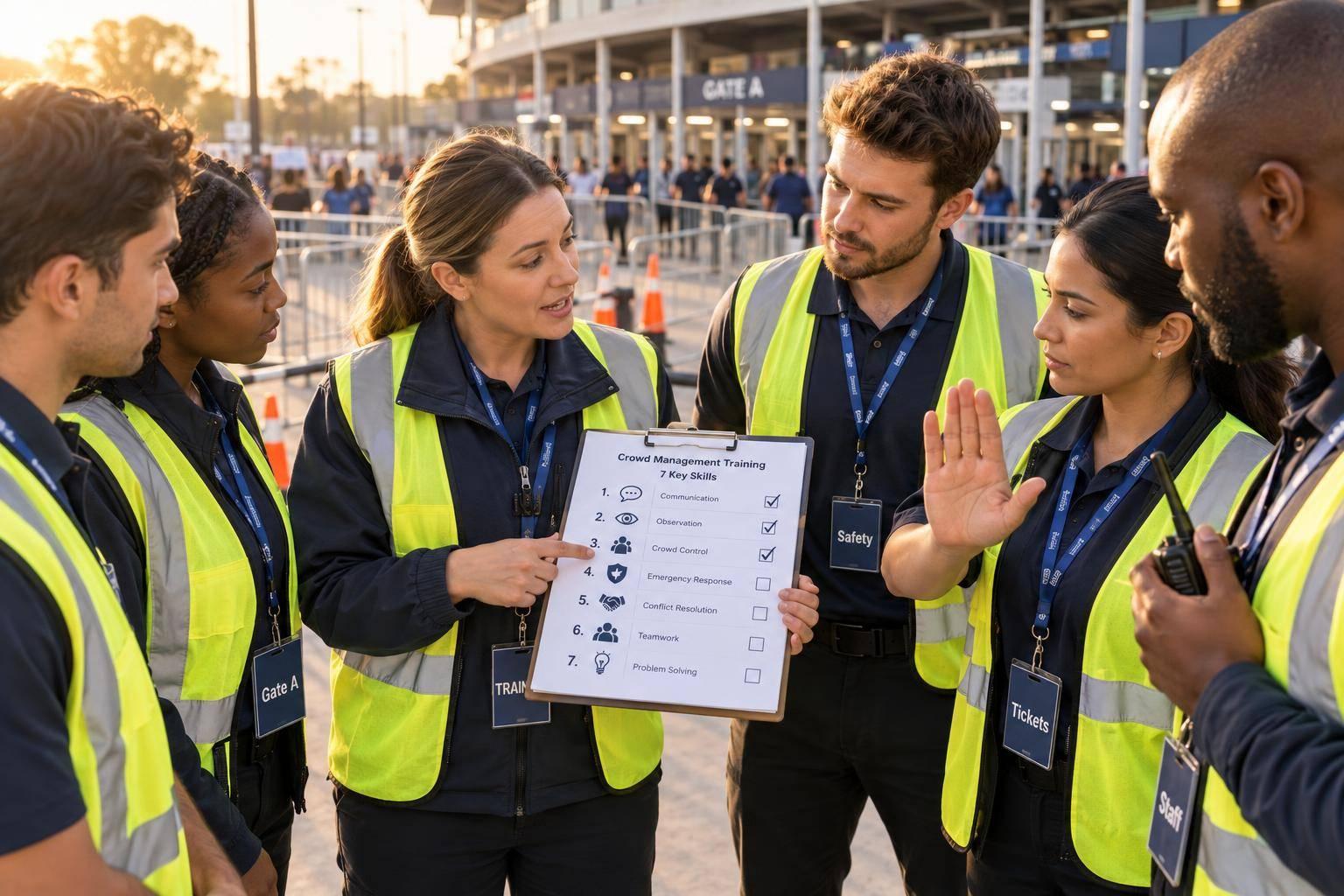
I check what event staff can do - not just whether they attended training. Before doors open, I use short drills to check seven crowd-management skills:
My rule: <u>attendance alone does not clear someone for a post.</u> I record skill checks, address gaps, utilize budget-friendly staff scheduling tools to track progress, and match assignments to passed assessments using scalable event scheduling rules. Each shift also needs a venue briefing, tested contacts, and clear role limits. Staff guide and report - they do not replace security or medical responders.
Before each assignment, give staff a written briefing that covers their post, duties, authority limits, supervisor, radio channel, and handoff steps. General staff guide guests and report concerns. Crowd managers direct flow, while security handles threats and removals.
Walk through the current layout with staff. Review primary and alternate exits, accessible routes, first-aid points, and assembly areas. Cover elevator restrictions, assistance points, and how employees are accounted for after an evacuation. Keep exits and accessible paths clear of queues and equipment.
Confirm contacts for the supervisor, security, medical team, and venue control by name or role. Test radios, review call signs and urgent radio traffic procedures, and agree on a backup method if a radio fails. Explain which emergencies require calling 911, notifying internal contacts, or both. Each report must include the location, visible hazard, number of people affected, and help needed.
Before doors open, check that each person can identify their exit routes, assembly point, supervisor, and reporting method. Have them explain their role in observation, guidance, reporting, de-escalation, and escalation. Record the venue, assignment, date, supervisor, checks passed, and coaching needed. Retrain staff whenever duties or procedures change. These roles and procedures set the context for the seven skills below.
Follow observe, assess, act, report. Scan for crowding, stalled movement, blocked paths, and unusual activity. Check conditions against the venue’s crowd-flow plan, act only within your authority, and report facts - not assumptions about intent.
Recheck your area when doors open, a performance ends, or the weather changes. Spotting issues early helps prevent line-control problems.
Observe; don’t investigate. Report attempts to enter restricted areas and unattended bags or packages without assuming criminal intent.
Don’t touch suspicious items, confront aggressive guests, or move barriers without permission. Call for help immediately if crowd pressure builds, a threat appears, or the situation goes beyond your role.
Hypothetical exercise: 75 guests are leaving a ballroom, a rideshare line crosses the hallway, two guests are arguing near a stairwell, and an unattended backpack sits beside an exit. Ask the trainee to identify hazards, prioritize concerns, choose an authorized first action, and name the contact. A strong response avoids touching the bag or confronting the guests and reports from a safe location.
Score the trainee on accurate observation, priorities, role limits, clear reporting, and timely escalation. Discuss missed hazards and unsupported assumptions before reassessing.
Record the topic, exercise date, assessment result, evaluator comments, supervisor approval, and review date. Use clear statuses such as “completed,” “needs coaching,” or “not yet assessed.”
Approval should confirm demonstrated skill - not attendance alone. When the layout, crowd conditions, or assignment changes, provide refresher training and update the review date afterward.
When you see pressure building, guide the queue to keep movement controlled before the line jams.
Before opening, review the approved queue layout. Check the entry point, barrier positions, merge points, and overflow trigger. Use event staff scheduling to assign one staff member to watch the back of the line and another to control the merge point. As the line grows, keep overflow areas, merge points, and side exits clear. Use only approved overflow space.
Keep an accessible route clear. Identify a safe side opening where guests can leave without crossing vehicle traffic or walking against heavy foot traffic. If needed, pause movement and request support to make space.
Guide the line, not the layout. Don’t move barriers, restrain guests, or make evacuation decisions unless assigned. Call the supervisor when the queue reaches its limit, blocks an accessible or emergency route, reaches stairs or traffic, or becomes too crowded for safe movement. Report threats, violence, or a medical emergency immediately through the venue’s designated contact.
Hypothetical exercise: Set up one entrance, two merging lanes, a nearby staircase, and an accessible route. Assign primary-guide, overflow-guide, guest, and supervisor roles. Have the queue reach its marked overflow trigger while a guest asks to leave. Assess whether the trainee explains the merge, protects access routes, provides a safe way out, and contacts the supervisor promptly - without moving barriers or redirecting guests into traffic.
Record the assigned queue role, training date, trainer, practical result, and notes on overflow triggers, accessible-route protection, and escalation. Mark unresolved gaps as “needs coaching” and require reassessment before assigning independent queue duty. Document whether the trainee can protect exits while managing the line; this skill also supports exit awareness.
Exit awareness helps staff move people out safely before congestion turns into an incident. Before doors open, check the primary and alternate exits from your assigned area. Check signs, lighting, doors, stairs, and accessible routes, and keep the entire route clear throughout the event. Report crowd pressure, but do not calculate or change occupancy limits.
Know who can order an evacuation and how to reach the venue contact. Report blocked exits, smoke, fire, or surging crowds immediately. Call 911 when the plan requires it.
During an evacuation, give calm directions and help guests only within your training. Do not enter hazardous areas, force doors, or attempt unassigned rescues. Follow posted elevator restrictions.
Use these same routes and landmarks to give clear directions under pressure.
Hypothetical exit-route exercise: Declare the ballroom’s primary exit unavailable because of a simulated obstruction. Have the trainee identify the alternate route, guide a small group to the assembly area, and report the hazard to the designated contact. Assess route choice, clear directions, and whether the trainee asks for help when guest needs go beyond their training.
Practice route control so staff can give clear directions during fast-moving incidents.
Record the venue, date, trainer, exits reviewed, emergency contact method, drill result, and missed items. Require correct answers on critical items - routes, reporting, evacuation authority, and role limits. Reassess missed items before staff work independently, and recheck these items whenever the layout or plan changes.
Guide guests using the routes and landmarks from the last briefing. Don’t guess. Keep directions short and calm: explain where to go, which landmark to look for, and what to do next. Give one or two steps at a time. Use the venue terms shown on signs and maps, rather than vague phrases such as “over there.”
Cover entrances, seating sections, restrooms, exits, restricted areas, and emergency assembly locations. Point out approved accessible alternatives, and offer written directions or approved translation support when needed.
Share only confirmed information. Contact the supervisor if a route changes, instructions conflict, or a guest needs support you can’t provide. Don’t promise access without approval or make unapproved accessibility arrangements.
During emergency movement, repeat only the venue’s approved instructions. Use the assigned radio channel and supervisor contact. If a route issue creates a hazard, report it through incident reporting immediately.
Hypothetical role-play: During an arena event, a guest needs an accessible route to Section 112, but the usual elevator is closed. A second guest asks where to go after a fire alarm; a third requests a staff-only route. Assess three checks: approved landmark use, a confirmed alternative route, and immediate escalation when instructions are uncertain or a hazard exists. Require every critical step with no unsafe improvisation; an invented route means retraining.
Record the staff member, date, trainer, zone, terms reviewed, result, coaching needed, reassessment date, and relevant language support. Recheck the current venue wording before each assignment.
Report problems as soon as crowd observation, queue guidance, or exit checks reveal them. Use the venue’s assigned reporting channel, including for near misses. Record what happened, the exact location, date and time, people involved by role or description, visible hazards, actions taken, witnesses, and who was notified.
Keep direct observations separate from witness accounts. Don’t guess about fault, motives, or medical conditions, and leave out personal details that aren’t needed.
Never delay an urgent call to finish a form. Report serious injuries, fire, violence, weapons, missing children, blocked exits, or a crowd surge immediately. Call 911 as required by the emergency plan. Warn nearby guests only when safe, keep access clear for responders, and don’t investigate or question witnesses.
Hypothetical drill: Several guests are pushed against a barricade while a vendor cart partly blocks an exit. The employee must move to safety, immediately radio the control point with the location and both hazards, and request security or operations support. Only after the situation is stabilized should the employee complete the written report. Assess urgency, correct channel use, factual wording, and a complete report - not form completion alone.
Record the employee ID, date, venue, trainer, score, sample report result, and acknowledgment. After an incident, compare the report with control-point logs and mark the outcome as completed, needs coaching, or refresher required. Assign a trainer and due date for follow-up.
If a guest conflict can still be handled safely, use calm words to lower tension. The goal is to reduce tension, not win the argument. Speak at a moderate volume and steady pace. Listen without interrupting and acknowledge the guest’s frustration, but don’t accept blame or promise anything beyond your authority.
Keep your distance, leave your hands open, and move slowly. Stay relaxed but alert. State the boundary and the next step you’re authorized to take. Don’t argue, interrupt, challenge the guest, or tell them to calm down. Focus on lowering risk and handing the guest off to the right authority.
Request a supervisor or security early if a guest continues to escalate, ignores boundaries, blocks movement, threatens someone, follows staff, damages property, or appears impaired. Keep an escape route open. If violence is about to occur or has already started, move to a safe, populated location.
Contact security early through the venue channel, and call 9-1-1 when needed. General staff should observe, create space, report, and redirect. Do not investigate, restrain, search, remove, or physically intervene without training and authorization. If the guest continues to escalate, hand off to security immediately.
Hypothetical drill: A guest angry about a long entry line shouts that staff are treating people unfairly. The trainee must listen, acknowledge the frustration, explain the available option, maintain distance, and set a respectful boundary. If the role-player makes a credible threat, attempts physical contact, blocks the trainee’s exit, or shows a weapon, stop the drill, require immediate withdrawal, and call for security. Score calm speech, listening, empathy, posture, distance, boundaries, timely escalation, and safe withdrawal. Safe withdrawal counts as success - not failure to satisfy the guest.
Record the employee’s name, date, instructor, scenario score, observed behaviors, feedback, and status: completed, needs coaching, or not authorized. Document any corrective training, such as another boundary-setting role-play or a radio refresher. Include its completion date and supervisor approval before the employee returns to guest-facing duty.
When de-escalation fails or a hazard exceeds staff authority, escalate immediately. Staff report the hazard, then hand control to the right responder.
Before doors open, confirm the contacts for supervisor, security, venue control, and medical issues. Check that a backup communication method is available.
Contact the supervisor for minor operational issues, security for threats or aggression, and venue control for building problems. Report the location, hazard, number of people affected, and help needed. Confirm that the responder received the message.
If the situation becomes urgent, skip internal routing and call emergency services first.
Call 911 immediately when a delay could endanger lives. This includes active violence, a credible or immediate threat, a weapon sighting, fire, serious injury, unconsciousness, severe breathing difficulty, suspected explosive material, or a fast-developing crowd surge.
Give the venue name and address, exact location, safest access point, type of emergency, number of people injured or threatened, and known hazards. Do not delay urgent help while trying to reach a supervisor first. Afterward, notify the appropriate venue contact.
For medical emergencies, alert the medical team. Do not touch or investigate suspicious items. Report blocked routes immediately. Move guests to the nearest approved alternative only if it is safe.
Hypothetical drill: A fight starts at a crowded west-gate queue, one person reports an injury, the crowd begins pushing toward an emergency exit, and an unattended backpack is nearby.
Use a timed radio or phone drill to check how promptly staff make the first notification, choose the correct contact, and report the location accurately. Also assess safe stance and distance, along with the handoff to responders. Staff must avoid hazards and step back once they complete the handoff.
Never use real weapons, unannounced panic tactics, or unsafe crowd compression.
Record the employee’s name, role, date, trainer, venue, and status: “demonstrated,” “needs coaching,” or “not demonstrated.”
Assess chain-of-command knowledge, the decision to call 911, contact accuracy, handoff quality, and missed hazards. Document corrective action, a recheck date, and supervisor sign-off.
Update records after incidents, venue changes, plan revisions, or failed drills.
Log each skill-check result in one central record for each employee and assignment. Include the employee’s name, role, event, venue, date, trainer, approver, skill status, corrective action, and review date. Save earlier results in the change history - don’t overwrite them.
Use four statuses: Not started, Trained, Assessed, Review training required. Assessed means the employee passed a practical or scenario-based assessment. Attendance alone doesn’t show they can perform the skill.
Follow the same record structure for every staff member and assignment, and track all seven crowd-management skills.
Hypothetical sample: Jordan Lee, Guest Services Staff; Fall Food Festival, Riverfront Pavilion; training date: 10/17/2026.
| Skill | Status and evidence |
|---|---|
| Crowd observation | Assessed - scenario drill, 9/10, approved |
| Queue guidance | Assessed - floor-map exercise, 8/10, approved |
| Exit awareness | Trained - venue walk-through; assessment scheduled |
| Clear directions | Assessed - guest-direction role-play, 10/10, approved |
| Incident reporting | Assessed - radio and written report exercise, 9/10, approved |
| Verbal de-escalation | Review training required - repeat role-play after missed handoff |
| Escalation to security | Trained - radio briefing; assessment scheduled |
Corrective action: Complete supervised de-escalation practice before solo guest-contact duty. Next review: Before assignment or by 10/24/2026, whichever comes first. Emergency-plan acknowledgment: Yes - Venue EAP v3.2 acknowledged 10/17/2026 by in-person briefing; employee initials recorded.
Record how training was delivered and the employee’s confirmation. Include assigned responsibilities, reporting channels, alarms, evacuation routes, assembly areas, and accountability.
Set access by role. Coordinators update attendance and review dates. Trainers enter assessments and corrective actions. Managers view qualifications, while employees can view only their own records. Keep sensitive details out of staff schedules.
Review records when planning assignments, after incidents or near misses, and whenever procedures or layouts change. Link the incident report, then track the corrective action, its owner, the deadline, and the follow-up assessment.
Use each employee’s current skill status to match them to their next event assignment, helping you overcome common event staff scheduling challenges.
Define each role’s required skills before offering shifts. Use each person’s current skill status to match them to a post. Entry or registration staff need queue guidance, clear directions, and incident reporting skills. Floor monitors need crowd observation, exit awareness, and escalation to security. Guest services duties may also call for clear directions and verbal de-escalation. Record the required skills, supervisor, and escalation contact for every role.
Confirm each person’s identity and check their latest training assessment against the assignment. For temporary staff, verify that the required skills were assessed before their first shift, then provide a venue-specific briefing. For returning staff, check that the current layout and duties still match their assessed skills. Assign staff by verified skills and role fit - not seniority or attendance. Only place people in posts that match those skills.
Use Quickstaff to schedule staff by role, track availability, manage waitlists, and send reporting times, locations, supervisor contacts, and briefing details. Check each replacement’s training before confirming a swap. Scheduling messages do not replace the required safety briefing.
Store assessment evidence in the training or HR record, not the scheduling tool, unless you use its native recordkeeping for that purpose. Keep the assignment decision separate from the training record. Whenever a cancellation or reassignment changes the roster, check role fit again.

Event Staff Pre-Shift Readiness Check
Before each shift, check that staff can perform all seven crowd-management skills at their assigned post: observe crowd movement, guide queues, watch exits, give clear directions, report incidents, de-escalate, and escalate when needed.
Check the training record to confirm each staff member is still cleared for that post. Complete this pre-shift readiness check before doors open:
If any critical check fails, reassign the post or delay deployment.
Update crowd management training annually or before each new event season. Train every new hire during orientation, and run safety drills and emergency alert tests quarterly.
Hold post-event debriefs within 24 to 72 hours to spot gaps that call for extra training. Quickstaff helps organize training sessions and keep documented staff records to support compliance and readiness.
Use a competency matrix to map each role’s skills to its day-to-day responsibilities. Define observable actions, clear time limits, and consistent performance benchmarks so every trainer can time and score work against the same standards.
Keep a central log of completed modules, drill participation, and role-specific qualifications to track readiness. Quickstaff brings training records, role eligibility, and reminders into one place to help ensure staff meet the same standards before working in high-risk zones.
Keep a centralized training record for each worker with their name, role, completed modules, certifications, and refresher due dates. Check that they can apply what they’ve learned - not just that they attended training. Use hands-on demonstrations or knowledge checks during a pre-event briefing.
For example, ask workers to identify the nearest exits or explain reporting procedures.
Treat every temporary worker as new to the site. Provide event-specific training, regardless of their prior experience.