Why Communication Matters for Temporary Staff Retention
May 18, 2026

Strong communication can make or break retaining temporary staff. In event staffing, where turnover is high, clear and consistent communication keeps workers engaged and willing to return for future shifts. Here’s why it matters:
Research shows that 46% of hourly workers leave due to poor communication. Tools like Quickstaff can simplify the process, ensuring staff feel informed and valued. Investing in better communication saves time, reduces costs, and improves team reliability.
Retention for temporary staff doesn’t follow the same playbook as it does for full-time employees. Instead of measuring tenure or promotions, the focus is on whether these workers continue accepting shifts, stay active in the staffing pool, and show up as scheduled. Metrics like repeat-shift uptake, pool engagement, and no-show rates provide insight. When these numbers dip, it’s often a subtle sign that something isn’t working. For temporary workers, disengagement often looks like declining shifts or quietly stepping away from the pool.
For temporary staff, communication isn’t just a bonus - it’s a necessity. It creates a sense of reliability in the job. When expectations are clear, support is easily accessible, and recognition is consistent, temporary workers are more likely to return for future shifts. Research backs this up: effective communication within teams can increase employee retention by 4.5 times.
Recognition plays a particularly crucial role. Programs that emphasize recognition can reduce voluntary turnover by 31%. On the flip side, employees who feel undervalued are twice as likely to leave within a year.
"Employees who feel underappreciated by their managers are twice as likely to quit within the next year." - John Deal, Sr. Director of Product Marketing, Phenom
Next, let’s explore how these dynamics differ from the expectations of permanent employees.
The reasons temporary workers stick around aren’t the same as those for permanent staff. Full-time employees often value career growth, mentorship, and long-term development. Temporary workers, however, are more focused on immediate needs like scheduling problems and clear communication.
This contrast highlights why communication strategies must be tailored to the type of worker.
| Factor | Temporary Staff | Permanent Staff |
|---|---|---|
| Driver | Reliable scheduling and pay accuracy | Career growth and development |
| Focus | Shift details and operational clarity | Long-term goals and culture |
| How Retention Is Measured | Repeat-shift acceptance, pool activity | Annual turnover rate, years of tenure |
| Biggest Pain Point | No support outside business hours | Career stagnation and lack of recognition |
Temporary workers aren’t looking for a career ladder - they want clear communication and the assurance that their needs are being addressed. For example, a survey found that career growth ranked last (31%) among hourly workers’ priorities, far behind pay (68%) and flexible hours (46%).
"Communication gaps, unpredictable scheduling, and inconsistent processes are the strongest signals that a worker may be preparing to leave." - Teambridge Team
A successful strategy often starts with scalable event scheduling to ensure consistency as your team grows.

How Poor Communication Drives Temporary Staff Turnover (Key Stats)
The numbers speak volumes: 61% of employees thinking about quitting point to poor internal communication as a factor, and 26% cite it as a major reason. A November 2024 study conducted at PT PG Rajawali II Cirebon by Universitas Swadaya Gunung Jati researchers found that 16.4% of employee turnover intention was directly linked to communication barriers. Miscommunication often led to errors at work, further fueling the desire to leave. On top of that, over 85% of hourly workers reported needing assistance outside regular hours but couldn’t access it. These issues highlight the pressing need for effective communication strategies to boost engagement and, ultimately, retention.
On the flip side, 69% of employees who are satisfied with internal communication plan to stay in their roles for at least a year. Compare that to just 29% of hourly workers who feel the same way. Employees aligned with their company’s mission are 67% more likely to stick around, while only 21% of those who lack that connection would do the same. For temporary event staff, clarity about the event’s purpose and their responsibilities can significantly improve retention rates. Frank Wolf, Co-Founder and Chief Strategy Officer at Staffbase, captures the urgency of this issue:
"Talent shortages, shifting employee expectations, and the rise of AI-driven communication tools are increasing the need for organizations to get serious about internal communication."
However, challenges remain: only 56% of employees place strong trust in their direct managers, and nearly half (49%) of managers admit they don’t fully understand their company’s goals or vision. These gaps in communication can undermine the confidence and clarity that temporary workers rely on.
Industries with high stress levels face similar communication challenges, providing valuable insights for event staffing. A survey of 1,000 hourly workers in healthcare, manufacturing, and event venues revealed common frustrations, including poor communication from managers, erratic scheduling, and the absence of clear support channels. Bonafarm Group, an agri-food company with 8,400 employees, tackled these issues head-on. In November 2025, they transitioned from fragmented, informal communication to a mobile-first, structured system. This shift improved both operational efficiency and employee connection, as highlighted in a Sociabble study:
"Frontline confusion increases operational risks and rework."
For event staffing, adopting similar structured, mobile-first communication tools can reduce errors, build confidence, and directly enhance retention.
Even though managers often emphasize the importance of communication, breakdowns still occur that push temporary staff away. These missteps can undermine the very strategies meant to improve retention.
Here are some of the most common communication failures that can result in losing temporary staff.
When temporary workers aren't given clear details about their roles, schedules, or reporting instructions, it creates unnecessary stress. This often leads to lateness, no-shows, or hesitation to accept future shifts. Daniel Muersing, Founder of Event Staff, puts it plainly:
"Poor staffing is not about 'bad workers'; it's a failure in forecasting, deployment, and on-site management."
Additionally, when staff aren't given enough context about the event's purpose, they may see the job as purely transactional. Laurie Wherley of Jobble explains:
"Temporary staff may not be as invested in the event's success as permanent staff... This lack of investment can manifest in various ways, from a lack of enthusiasm and energy to a lack of attention to detail."
With over 60% of event planners reporting difficulty in finding qualified staff, this kind of pre-event confusion can be an expensive oversight.
Temporary workers often don't receive feedback on their performance. There's no post-event debrief, no thank-you, and no acknowledgment of their contribution. This silence can make the role feel like a mere stepping stone.
Research indicates that 70% of an employee's motivation is influenced by their direct manager. A simple check-in or verbal acknowledgment after an event can make a huge difference in whether a worker is willing to return. However, fragmented communication systems often make this kind of personal connection harder to achieve.
Event teams frequently rely on a mix of communication tools - email, WhatsApp, phone calls, and texts - to manage staff. While this might seem convenient, it can quickly spiral into chaos. Rentman.io highlights the issue:
"It's common to use email, WhatsApp, calling, and texting to communicate with different team members. However, if there's a last-minute change, you have to remember each team member's preferred communication method. This can quickly get chaotic."
Without a centralized system, critical updates are easily missed. Staff may show up at the wrong location, miss schedule changes, or struggle to get answers when problems arise. Unsurprisingly, 46% of hourly workers cite poor manager communication as a top reason for not picking up shifts. Disorganized communication not only confuses workers but also gives the impression of a poorly managed event, discouraging temporary staff from returning. Tools like Quickstaff can help by centralizing updates, ensuring every team member has access to accurate, real-time information in one place.
Finding and fixing communication gaps is just the start. The real challenge lies in putting systems in place to keep temporary staff informed, appreciated, and motivated to return.
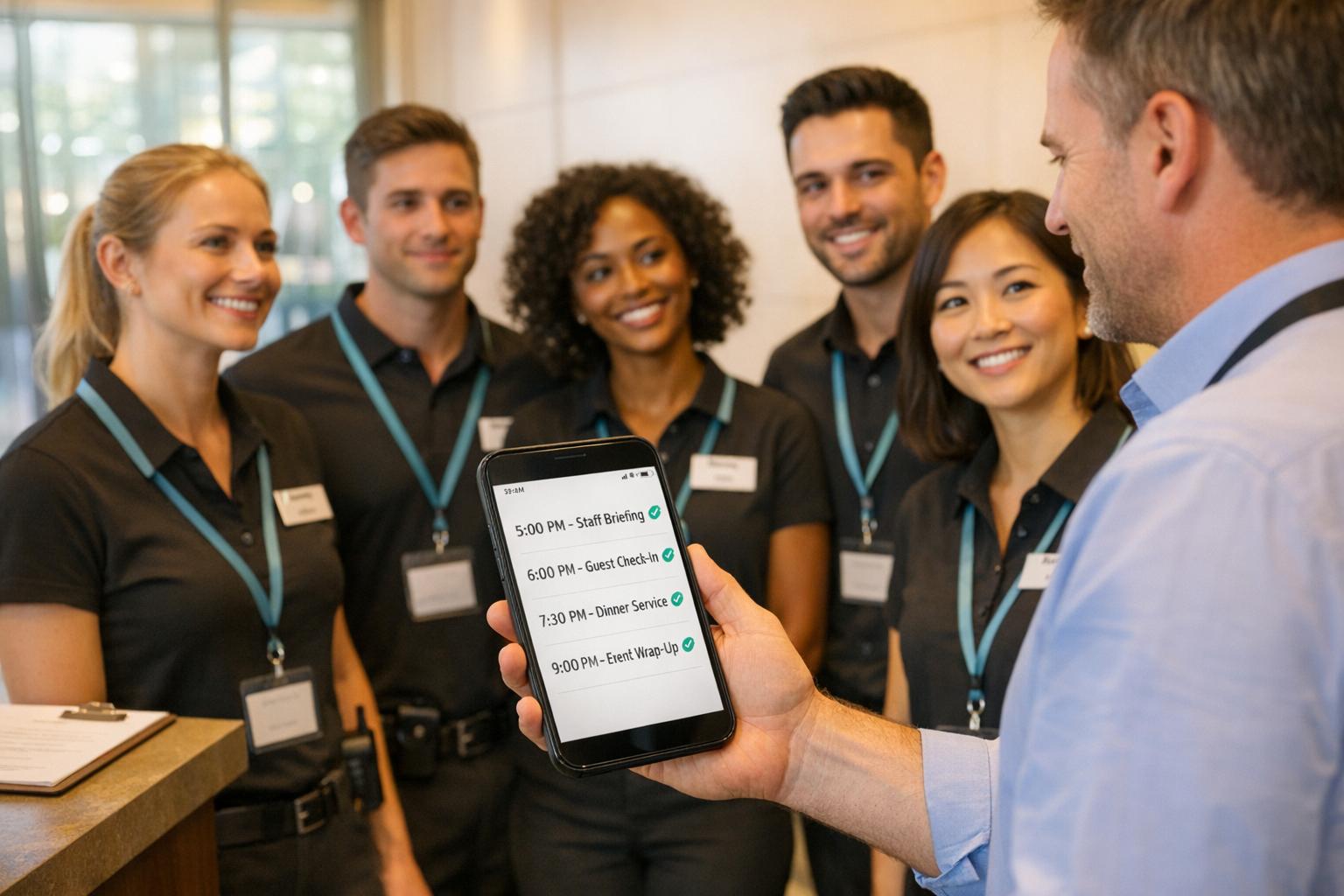
A solid first step is providing a detailed event brief to every staff member before the event. This document should cover key details like their specific role, responsibilities, event schedule, arrival instructions, dress code, and a contingency plan for common scenarios - like late arrivals or last-minute changes.
Sending these briefs 48–72 hours ahead of time gives workers enough room to prepare and ask any questions. It's worth noting that 63% of employee departures are entirely preventable. A standardized brief not only fills communication gaps but also sets clear expectations, reducing confusion and stress.
Of course, pre-event communication is just the beginning. Ongoing updates and check-ins are just as important.
A single message before the event won’t cut it. Regular communication at key moments - before, during, and after the event - can make temporary staff feel more connected and appreciated.
Laurie Wherley of Jobble highlights this point:
"Regular feedback is crucial for helping temporary staff improve and feel valued."
Consider brief check-ins at different stages of the event. Pre-event check-ins can clarify roles and answer last-minute questions. Mid-event updates help address any issues and provide support. Post-event follow-ups allow you to acknowledge their contributions and gather feedback. These touchpoints not only improve the experience but also show that their input matters. In fact, 33% of hourly workers say "good communication with management" influences where they choose to work.
To make this process even smoother, using a centralized digital tool can bring everything together.
When updates are scattered across emails, texts, or phone calls, it’s easy for important details to get lost. Using a single platform to centralize all communication ensures that everyone gets the same updates at the same time.
This is especially important outside of regular working hours. According to research, over 85% of hourly workers report needing support outside standard hours but struggle to get it. Tools like Quickstaff make it easy to consolidate event details, schedules, reminders, and messages in one mobile-friendly space. With constant access to essential information, workers feel more supported and confident in their roles. And when they feel informed and valued, they’re far more likely to return. Studies even show that effective communication can boost staff retention by up to 4.5 times.
Improving communication is a step in the right direction, but how do you know if it’s actually making a difference? The answer lies in tracking the right metrics.
Start by focusing on numbers that reflect how your temporary staff feels about their experience. For instance, repeat-shift acceptance rates reveal whether workers are opting to return for more shifts, while no-show rates can hint at early disengagement. Another key indicator is your team’s response time to staff inquiries, which shows if workers feel supported when they need help.
Research highlights a strong link between poor communication and higher turnover rates. Identifying where communication falls short - whether it’s in scheduling, payroll, or after-hours support - can help you understand what’s causing workers to leave.
| Metric | What It Tells You |
|---|---|
| Repeat-shift acceptance rate | Are workers choosing to come back? |
| No-show rate | Is disengagement or confusion creeping in? |
| Management response time | Are workers getting the support they need? |
| After-hours help success rate | Can staff get answers when they need them? |
Once you’ve identified these metrics, compare your baseline data to results after implementing communication improvements.
A clear baseline is essential for measuring how communication changes impact retention. Before making any adjustments, document your current retention rates, no-show rates, and shift acceptance rates. Then, after introducing improvements - like standardized communication protocols or a centralized platform - review the data after 60 to 90 days.
Here’s why this matters: Studies show that 69% of employees satisfied with internal communication are likely to stay, compared to just 21% of those who feel disengaged. This stark difference underscores the importance of tracking communication quality as rigorously as other operational metrics.
Once you’ve gathered solid retention data, you can translate those improvements into financial terms. On average, replacing an hourly worker costs about $1,500, not to mention the 30% productivity dip that teams experience when covering for a vacancy. For businesses with high turnover, these costs can pile up fast.
To calculate savings, compare turnover rates before and after your communication changes. Multiply the reduction in turnover by $1,500 to estimate how much you’ve saved. These numbers highlight how better communication not only boosts morale but also strengthens your bottom line.
Tools like Quickstaff can make this process easier. With centralized communication features and built-in analytics, Quickstaff helps you monitor key metrics like shift acceptance rates and response times. This streamlines the process of evaluating how your communication strategies are performing.
Studies reveal that communication is a key factor in business success - teams with effective communication can improve retention by up to 4.5 times. Despite this, many event businesses still depend on scattered channels and last-minute updates, which often alienate temporary staff.
In the event staffing world, the margin for error is slim. When workers are left uncertain about their responsibilities, struggle to get answers after hours, or feel like just another name on the list, they’re far less likely to pick up shifts. In fact, research shows that 63% of employee departures could have been avoided. This highlights the importance of clear, structured communication in reducing turnover. Practices like pre-event briefings, timely acknowledgment, and a single, dependable channel for shift details can make a world of difference.
It’s not one-off miscommunications but repeated breakdowns in clarity that push temporary staff to disengage and leave.
Quickstaff simplifies this process by merging scheduling, messaging, reminders, and event details into one centralized platform. From the moment a worker is booked to the event's conclusion, everything they need is in one place, ensuring they feel informed and supported. This streamlined approach boosts the chances they’ll return for future shifts. For more, visit quickstaffpro.com.
Clear, consistent, and respectful communication isn’t just a nice-to-have - it’s an investment that pays off. By committing to structured communication, businesses can lower turnover, cut costs, and build a dependable event team. Stronger communication strategies don’t just improve retention - they strengthen your entire staffing framework.
A pre-event staff briefing plays a crucial role in ensuring everyone is on the same page. It should clearly define expectations, roles, and responsibilities to help the team prepare efficiently. Key elements to cover include:
Encourage staff to ask questions during the briefing to address any uncertainties. Open communication fosters better alignment and contributes to a smoother event. Tools like Quickstaff can make this process easier by organizing communication, sending reminders, and managing schedules for temporary staff.
Retention metrics often reveal communication challenges within an organization. Key indicators include how employees perceive internal communication and their grasp of the company's goals. Research underscores this point: 61% of employees who are thinking about leaving identify poor communication as a major factor. This highlights just how crucial clear and effective communication is, especially when it comes to retaining temporary staff.
Quickstaff streamlines communication and keeps everyone on the same page with its tools for sending timely, personalized updates and reminders. This helps ensure your staff stays informed, engaged, and ready for their assignments, reducing the chances of no-shows.