Stand-Up Training: Taking Food Temperatures at Events
November 13, 2026

Set aside 10–15 minutes before service to teach food temperature checks, plus time for each employee to practice and pass a hands-on check. Cover probe cleaning, thermometer accuracy, placement, temperature limits, logs, and what to do when food fails a check.
The routine is simple:
Follow local food-safety rules and the event’s approved procedures - not one temperature limit for every task.

Event Food Temperature Checks: Clean, Measure, Record, Verify
Demonstrate the exact clean-and-check routine staff will follow before service. Show them how to hold the thermometer by its handle, keeping fingers off the sensing tip. Food thermometers should be accurate within ±2°F across their normal operating range. Follow the same sequence every time so staff can repeat it on site.
Wash the probe with hot, soapy water, rinse it with clean water, apply an approved food-contact sanitizer, and let it air-dry. Follow the sanitizer label’s directions for dilution, concentration, and contact time. Check the concentration with test strips and track contact time with a timer. Don’t wipe off the sanitizer unless the label specifically requires it.
Clean and sanitize the probe before first use, after each use, and whenever you switch foods, pans, or sampling locations. Use probe wipes only if both the label and your operation’s procedure allow them.
Fill a container with crushed ice and clean water. Stir the mixture and let it stabilize. Immerse the probe tip to the depth specified by the manufacturer, keeping it away from the container’s sides and bottom. Wait for a stable reading.
The target in ice water is 32°F (0°C). A reading from 30°F to 34°F meets the ±2°F tolerance unless a stricter standard applies.
If the thermometer has an adjustment feature, follow the manufacturer’s instructions to adjust it while the probe remains in the ice-water mixture. Then repeat the test.
Recheck the thermometer after a drop, a severe temperature change, suspected damage, or an inconsistent reading. Take any thermometer that fails the accuracy check out of service.
Record the thermometer ID, date and time, reading, corrective action, and initials in the calibration log. Clean and sanitize the probe again before inserting it into food.
Once the thermometer is clean and accurate, show exactly where the probe goes. Point out the sensing area and make sure the entire sensing area - not just the tip - is inside the food. Hold the probe still until the reading stabilizes, following the thermometer’s response-time instructions.
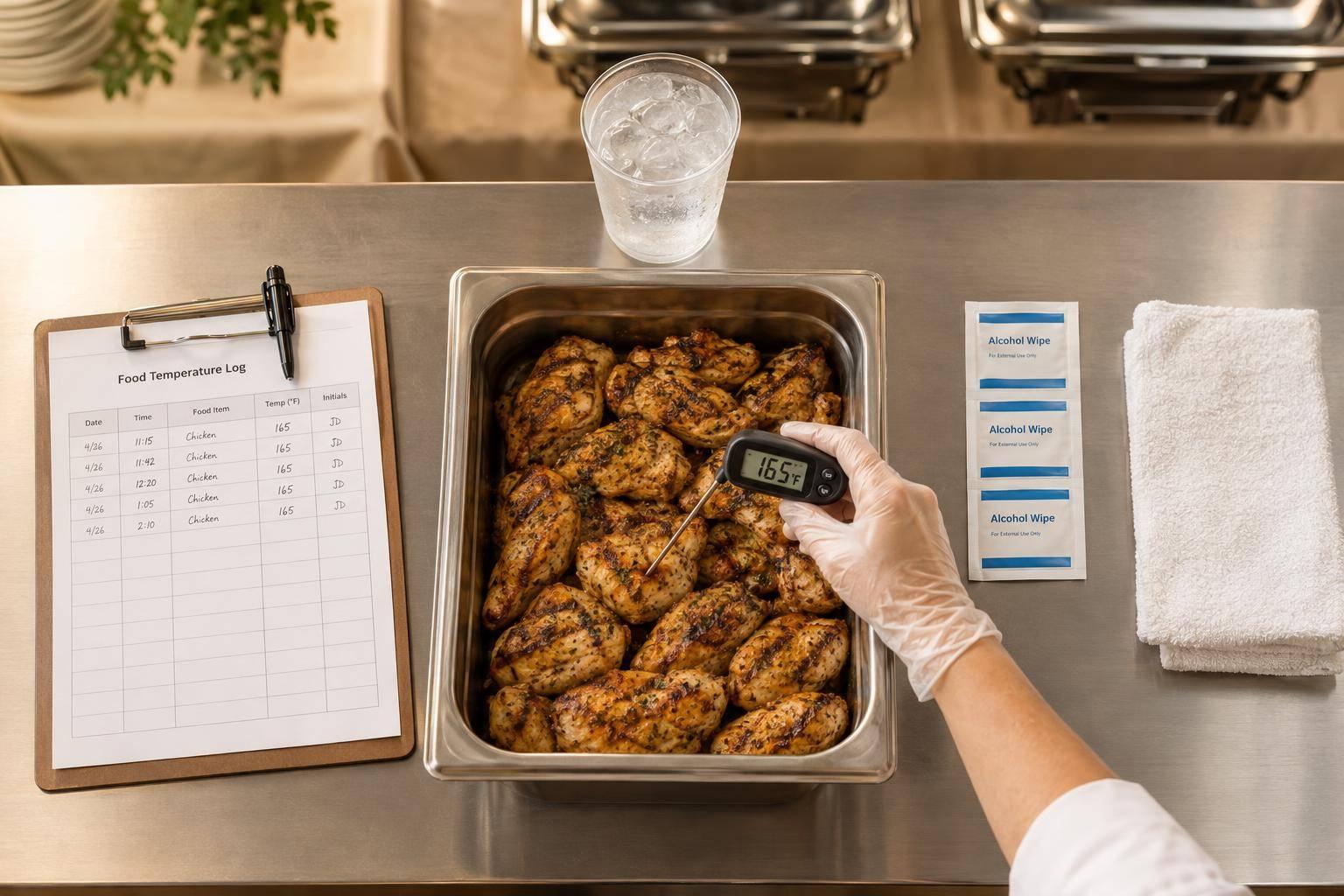
For the thick entrée demonstration, insert the probe into the thickest part, away from bones, fat, and gristle. Keep it clear of the pan’s bottom and sides, too. If it touches bone or cookware, pull it back, reposition it, and test again. Check additional spots in irregularly shaped food.
For thin foods, insert a suitable thermometer horizontally through the side so its sensing area sits in the center. Some dial thermometers need about 2–3 inches of insertion. A digital model designed for thin foods may need only about 1/2 inch. Check the model’s instructions rather than guessing. If the sensing area won’t fit inside the food, use a thermometer designed for that food.
Use the large pan to demonstrate the operation’s sampling procedure. Check the center, representative edges or corners, and any other locations the procedure calls for. Keep the probe clear of the pan at each spot. There’s no single sample count that works for every batch; follow the procedure for the food, pan size, equipment, and local code. Stir or redistribute food only if the procedure allows it, then check again.
Use the lowest reading for cooking and hot holding and the highest reading for cold holding. Never average readings to dismiss an unsafe result. Ask staff to identify which reading controls the decision and explain when to notify the person in charge.
Use the same probe placement pattern during the hands-on skill check before service.
Once the probe reads accurately, compare the temperature with the correct limit and log it right away.
Keep the temperature log next to the approved limits. Before staff judge a stable reading, have them identify the process: cooking, reheating, cooling, hot holding, or cold holding. Cooking limits vary by food and method. Food reheated for hot holding generally must reach 165°F for 15 seconds. Under the FDA Food Code, hot holding generally requires 135°F or above, while cold holding requires 41°F or below. Follow the locally adopted code and your operation’s approved procedures.
Cooling requires time-based checks. Cooked TCS food must cool from 135°F to 70°F within 2 hours, then reach 41°F or below within 6 hours total. Show staff where to record the starting time, starting temperature, and later checks.
Immediately record the date, time, food item or batch, temperature in °F, employee initials, and corrective action. Include sampling locations when required so each reading can be traced. Use formats such as 11/13/2026 and 4:30 p.m. Log measured results - not estimates or verbal assurances.
If a reading fails the limit, notify the supervisor and keep the affected food out of service. Begin the approved corrective action right away, based on the process and the food’s time-temperature history. This may mean continuing cooking, reheating, rapid cooling, moving food to working equipment, or discarding it. Do not rewarm food without following the approved corrective action.
Recheck with a clean, accurate thermometer, but don’t delay action. Keep the failed result and record which supervisor was notified, the action taken, the follow-up time and temperature, and what ultimately happened to the food. Include supervisor verification when required. Never replace a failed reading with a later passing one.
After the demonstration, test each employee on the same routine before service starts. Every food handler must perform the full temperature-check routine before working alone. A verbal explanation isn’t enough.
Have each employee complete a full check on assigned food. Include a thick item and, when relevant, a thin food or large batch. Use the same station setup and equipment they’ll use during service.
Confirm that the recorded reading matches the thermometer display. Ask the employee to name the limit and explain what to do if a reading fails. Every required step must be correct to pass. If they miss a step, coach them, demonstrate it again, and retest with another item before allowing independent checks.
Record the employee’s name, role, event, date, trainer, observed tasks, pass/retest status, and sign-off. After they pass, assign them to a station and name their backup. Keep training records separate from temperature logs in the operation’s recordkeeping system. Training records show that employees can perform the routine; temperature logs show food readings.
The pre-shift plan should name a primary and backup checker for each station, checking times, and an escalation contact. Use Quickstaff reminders to share lesson time and assigned roles, but keep food-safety records separate. Recheck performance whenever staff change stations or use unfamiliar equipment.
Follow the routine staff practiced during the pre-service skill check: clean, rinse, sanitize, and air-dry the probe. Confirm the thermometer is accurate, then place it in the thickest part of the food. Wait for a stable reading, compare it with the correct limit for that process, and record it immediately.
If a reading is unsafe, stop serving the affected food and notify the supervisor. Record the original result, the approved corrective action, and the recheck. Never average an unsafe result with later readings.
Before service opens, check that the station has trained checkers, accurate thermometers, cleaning supplies, posted limits, and logs. Pack spare batteries or a backup thermometer so equipment failure doesn’t delay checks. Begin service only after the checkers pass the skill check.
Check food temperatures when deliveries arrive on-site and at least three times per shift: at opening, mid-shift, and closing. Check again before opening a new case or starting a new batch.
Use a calibrated, sanitized probe thermometer. Record the food item, temperature, time, and name of the person who checked it. If a reading falls outside the limits, isolate the affected food and take corrective action immediately.
Use a sanitized, calibrated probe thermometer to check, record, and verify internal food temperatures during transport, receiving, and on-site holding.
The provided documentation does not list infrared thermometers as acceptable for these checks. Staff should use probe thermometers to get accurate internal readings and meet food safety standards.
When food arrives, check its temperature with a sanitized, calibrated probe thermometer. Log each item, its temperature, the time, and the initials of the person taking the reading. Then move the food directly into the appropriate cold or hot holding equipment.
Use transport checklists to record temperatures at departure, scheduled stops, and the receiving handoff. Keep event communication in Quickstaff, where you can also assign safety roles and attach temperature logs to the event schedule.