Evacuation vs. Shelter-in-Place: Event Staff Training
October 16, 2026

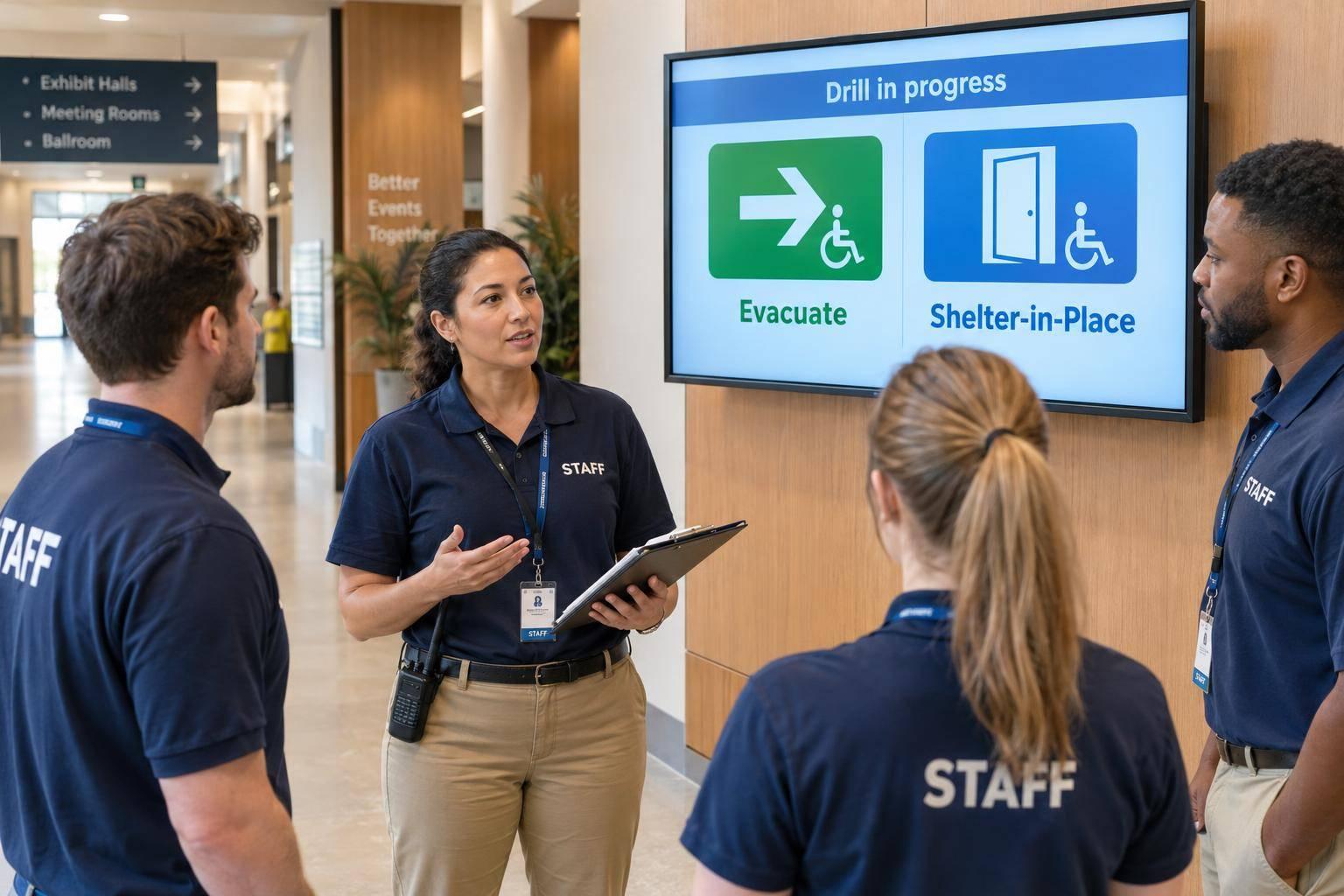
I train event staff for both evacuation and shelter-in-place because leaving isn’t always safer. Fire or smoke may require an exit; a tornado or outdoor chemical release may call for shelter indoors. The choice depends on the hazard, venue conditions, safe routes, and official instructions.
Before doors open, I check 4 things for both plans:
Quick comparison
| Planning factor | Evacuation | Shelter-in-place |
|---|---|---|
| Hazard | Conditions make the building unsafe | Conditions make staying indoors safer |
| Movement and destination | Use safe exits to reach an assembly area | Move to a protected room suited to the hazard |
| Accessibility | Plan accessible routes and assistance | Plan accessible shelter space and assistance |
| Accountability | Check attendance and missing-person reports | Count occupants and track arrivals or moves |
| Release | Wait for approved reentry or relocation | Wait for an official all-clear or movement order |
I use briefings and safe drills to test both responses, then assign and verify fixes. <u>Scalable event scheduling tools support preparation - not emergency orders or live head counts.</u> The goal is simple: staff know where to go, whom to follow, and how to help without putting themselves at risk.

Evacuation vs. Shelter-in-Place: Event Staff Safety Guide
Evacuation moves people out; shelter-in-place protects people inside until conditions change. Decide who can order each response and how staff will receive those instructions.
Use these factors to choose the right response.
| Planning factor | Evacuation | Shelter-in-place |
|---|---|---|
| Hazard conditions | Fire, smoke, structural damage, flooding, or another condition that makes the building unsafe | Severe weather, an outdoor chemical release, or another hazard that makes staying indoors safer |
| Movement | Leave by an approved route; take an alternate route if the primary route is blocked | Move to a designated interior area or another space suited to the hazard |
| Destination | Assembly area, reunification point, or relocation site | Protected room or zone suited to the hazard |
| Accessibility | Accessible exits and support for mobility, sensory, communication, and medical needs | Accessible shelter space and support for mobility, sensory, communication, and medical needs |
| Accountability | check staff rosters, assignments, and attendance records and team-lead reports against one another at assembly areas | Count occupants in each shelter area and update totals as people arrive or relocate |
| Release criteria | An authorized all-clear is required before reentry; relocation may be ordered instead | Stay in place until an authorized all-clear, evacuation order, or relocation order |
Shelter-in-place is not lockdown. Sheltering protects people from a hazard while they remain indoors. Lockdown secures occupants against an immediate security threat.
Before their shift, teach staff to recognize the evacuation alarm and find approved and alternate exits. Evacuation routes should not rely on elevators during fires or power failures; follow the venue’s elevator restrictions. Assign trained staff to assist people with disabilities rather than improvising a rescue.
Choose assembly areas away from the hazard and emergency-vehicle access lanes. Account for traffic, crowding, weather, lighting, and language needs.
At assembly areas, team leads should cross-check current staff rosters, assignments, attendance records, and team reports. Report who is present, injured, assigned elsewhere, or unaccounted for. Walk-ins and multiple exits can leave gaps in guest counts. Report those gaps, but don’t delay evacuation to resolve them.
Give responders missing people’s names, identifying details, assistance needs, and last known locations. Never send staff back inside to search. Reentry requires an authorized all-clear - not a rumor or another guest’s assurance.
Choose shelter rooms based on the hazard, not convenience. For tornado protection, use a low-level interior area away from windows. An outdoor airborne release may call for a room with few windows and vents. Neither option fits every situation, especially when flooding threatens lower floors.
Check that shelter spaces have enough accessible capacity and clear paths. Close exterior doors and windows as directed. Control access without blocking emergency exits. OSHA guidance calls for shutting off fans, air-conditioning, and forced-air heating when appropriate. Assign that task only to designated personnel who know the building’s systems.
Assign a lead to count occupants, record arrivals and relocations, and monitor official updates through an approved channel, with a backup available. Prepare for a long stay with water, food, access to needed medications, first-aid supplies, lighting, chargers, and sanitation materials. Plan for medical-device and communication needs as well.
Occupants must stay sheltered until authorized officials issue an all-clear or order evacuation or relocation.
Once a response is chosen, staff need one chain of command and one clear path for messages.
The written emergency action plan should name who can order an evacuation or shelter-in-place for each hazard type, plus a backup for every shift. Spell out the hazard-specific triggers for each response.
Include contacts and assigned areas for security, the public safety liaison, department leaders, and area wardens. Department leaders pass along orders. Front-line staff move attendees and report status.
When an alarm sounds or an immediate hazard appears, staff must take the protective action they’ve been trained to use without waiting for further direction. If on-scene public safety officials take command, staff follow their orders. The plan must also identify who authorizes the all-clear, reentry, and reopening. Before reopening, complete accountability checks and verify systems.
Every message should explain what to do, where to go, what precautions to take, what not to do, and where to get updates.
Use PA announcements, supervisor radios, and text or mobile messages. Include face-to-face direction and other backups for system failures and areas without radio coverage. Pair spoken instructions with visual or written alerts, and provide translated instructions for staff.
Supervisors must acknowledge instructions and report their location, accountability status, blocked routes, injuries, and assistance needs. Department leads should combine these reports and follow up on missing acknowledgments.
If a manager’s direction conflicts with a public safety shelter order, follow the public safety order and report the conflict. Staff must not independently direct attendees to move. They should report immediate danger and use the plan’s emergency contingencies.
The drill section should test whether staff can receive, repeat, and act on these messages quickly.
Scheduling should support the plan - not replace it.
Before the event, use Quickstaff to schedule roles, track availability, and send briefing reminders and contact lists. Keep the emergency plan and venue maps outside the scheduling tool. Scheduling software does not replace the plan, alarms, official instructions, reliable emergency communications, or live accountability.
Once authority and communication paths are set, use drills to check that staff can follow them under pressure.
Start with an announced briefing or walkthrough. Explain the purpose, scenario, timing, staff roles, communication methods, stop-exercise signal, and procedure for stopping during a real emergency. Make clear that the scenario is hypothetical. Don’t use deception or unsafe actions.
Review the drill sequence, reporting point, and how the exercise will end. Before activating equipment, coordinate with venue management, security, facilities staff, alarm-monitoring services, and relevant responders. Stop the exercise immediately if a real emergency occurs.
OSHA calls for drills often enough to keep staff prepared. Set the frequency by risk, rather than following a universal schedule. Use the same scorecard for both drills.
| Category | Evacuation drill | Shelter-in-place drill |
|---|---|---|
| Objective | Move occupants along safe routes to an assembly area | Move occupants into protected rooms suited to the hazard |
| Setup | Simulated alarm; primary and alternate exits | Simulated hazard; designated rooms; capacity check |
| Staff actions | Guide attendees, assist people with disabilities, prevent reentry, manage assembly areas, report missing people | Move occupants indoors, close openings as directed, keep emergency exits accessible, await instructions |
| Accountability | Verify staff check-in, attendee estimates, and missing-person reports | Verify occupant counts and reconcile supervisor reports |
| Timing measures | Alarm recognition, exit-flow time, assembly completion, and reporting time | Alert recognition, movement-to-room time, room occupancy time, and reporting time |
| Evaluation | Congestion, route clarity, message accuracy, accessibility, reentry control | Room suitability, capacity, message clarity, accessibility, clear radio use, all-clear recognition |
Test alarm recognition, primary and alternate routes, staff positioning, attendee guidance, disability assistance, assembly-area management, staff check-in, and missing-person reporting. Check that no one reenters until authorized.
Simulate an unavailable exit, but never block, lock, narrow, or obstruct an actual exit route. Record timestamps and congestion without rewarding speed over safe, orderly movement.
Check that rooms suit the hazard and have space for occupants, mobility devices, and service animals. Practice the steps for doors and windows, occupant counts, radio use, and supervisor reports. Verify that staff act only on an authorized all-clear or relocation order.
Access controls must allow emergency egress. Simulate HVAC, alarm, or access-control changes unless venue management has approved safe operation by trained, authorized personnel.
Use the results to address gaps before the next event.
Hold a brief review immediately after the drill. Record delays, unclear instructions, access problems, capacity issues, and accountability gaps. Give each fix an owner, deadline, and verification method.
Update plans and assignments, retrain affected staff, and retest major changes. Keep safety issues open until management verifies that the correction works.
Neither response is safer by default. Choose based on the event hazard assessment and authorized officials’ instructions - not habit or preference.
Evacuation and shelter-in-place involve different movements, but both require clear authority, instructions, and accountability. Apply the same four checks to both: authority, communication, accountability, and release criteria. Put these details in the event plan: who can order each response, how staff get instructions, how supervisors account for people, and who authorizes release or reopening.
Before doors open, test whether staff can act without hesitation. Have each staff member name their supervisor, zone, backup duties, communication channel, assistance duties, assembly area, and shelter location. Make sure everyone understands that work resumes only after authorized reopening and confirmation that the venue is safe - not simply when movement stops.
Keep both procedures easy to find, along with current maps, routes, shelter rooms, contacts, decision-makers, and backup leaders. Document fixes identified during drills, assign responsibility, verify the changes, and retest before opening.
Stay alert for updated instructions. Sheltering in place is intended to be safer than evacuating at that moment. If the hazard spreads, the site becomes compromised, or officials determine it’s no longer safe, the Incident Commander will change the response.
Follow updated instructions from the Incident Commander, venue leadership, or public-safety officials immediately. That may mean moving to another shelter area or evacuating.
Follow the established backup hierarchy to keep the chain of command clear. Designated runners should carry written messages between fixed points, while face-to-face relays should take place at preassigned meeting locations. If a power outage knocks out the public address system, use bullhorns and manual signs.
Practice these procedures during drills, including simulated total radio and cellular failure, so staff can switch communication methods without confusion or loss of authority.
Give each worker an event-specific role card during onboarding. Include their post, supervisor, communication channels, and emergency duties. Walk staff through exits, assembly points, and key equipment. Then check their understanding: ask them to repeat instructions or point out their assigned areas.
Use Quickstaff to keep details in one place, schedule staff by role, and send pre-event reminders. Before doors open, hold a short, mandatory pre-shift briefing to answer questions, review the event layout, and discuss hazards.